
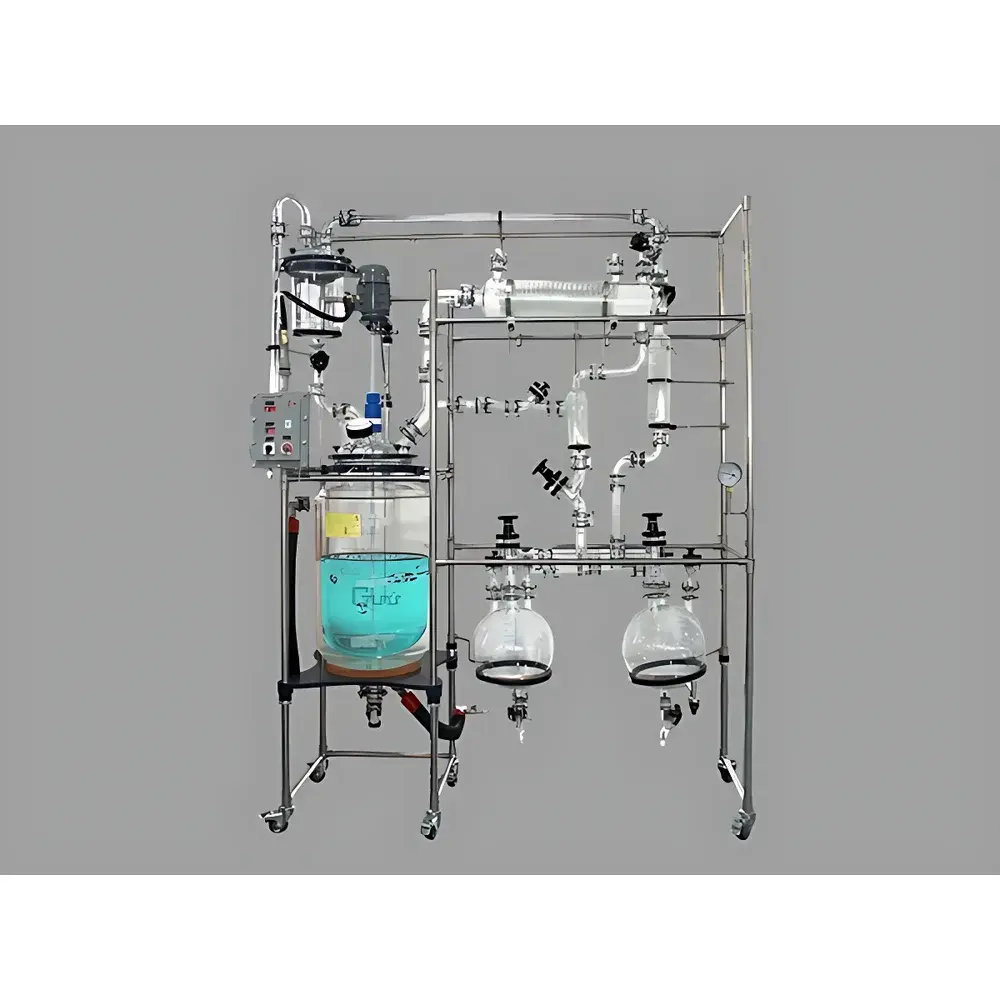
Great Wall GR-100 Solvent Recovery System
| Brand | Great Wall |
|---|---|
| Origin | Henan, China |
| Manufacturer Type | Direct Manufacturer |
| Country of Origin | China |
| Model | GR-100 |
| Instrument Category | Glass Reactor / Solvent Recovery Unit |
| Working Volume | 100 L |
| Construction Material | Borosilicate Glass (3.3) + Stainless Steel Frame (304/316) |
| Operating Pressure | Low-pressure, Vacuum-Driven |
| Maximum Vacuum Level | 0.098 MPa (≈ 735 mmHg) |
| Explosion Protection Rating | Ex dⅡBT4 |
| Condenser Type | Horizontal Shell-and-Tube Glass Condenser |
| Secondary Condenser | Integrated |
| Collection Configuration | Dual Collection Vessels with Independent Valve Control |
| Connection Method | Flanged Glass Joints (ISO-KF or DIN 28, depending on configuration) |
Overview
The Great Wall GR-100 Solvent Recovery System is a purpose-engineered, pilot-scale glass-based vacuum distillation apparatus designed for efficient, safe, and scalable solvent recovery in synthetic chemistry, pharmaceutical process development, and fine chemical manufacturing. Built upon the principles of fractional vacuum distillation under controlled low-pressure conditions, the system enables precise separation of volatile organic solvents—such as acetone, ethanol, ethyl acetate, toluene, and THF—from reaction mixtures, crude extracts, or post-reaction slurries. Its core architecture integrates a 100 L high-borosilicate glass (DIN ISO 3585, Schott Duran®-equivalent) reactor vessel mounted on a corrosion-resistant stainless steel support frame, ensuring mechanical stability while preserving optical clarity for real-time visual monitoring of boiling behavior, foaming, phase separation, and condensate formation. The system operates exclusively under negative pressure, eliminating risks associated with positive-pressure vapor release and enabling lower boiling point operation—critical for thermally sensitive compounds and high-boiling-point solvents requiring gentle thermal input.
Key Features
- 100 L borosilicate glass (3.3) main reactor with full transparency, calibrated volume markings, and integrated PT100 temperature port for external probe insertion
- Explosion-proof certified design (Ex dⅡBT4), compliant with IEC 60079-1 for use in Zone 1 hazardous environments where flammable vapors may be present
- Dual-stage condensation system: primary horizontal shell-and-tube glass condenser (≥0.8 m² effective cooling area) + secondary auxiliary condenser to minimize solvent loss via re-volatilization from collection vessels
- Flanged glass tubing throughout—including reflux line, distillate path, and vacuum manifold—ensuring leak-tight integrity, rapid disassembly, and compatibility with standard laboratory glassware interfaces (DIN 28 or ISO-KF)
- Vacuum-driven feed mechanism: eliminates need for peristaltic or diaphragm pumps during charging; reduces contamination risk and simplifies operator workflow
- Independent valve-controlled dual-collection configuration: permits uninterrupted solvent recovery by switching between collection vessels without breaking vacuum or interrupting distillation
- Stainless steel (AISI 304 or optional 316) structural frame with powder-coated finish, engineered for long-term resistance to acid, alkali, and organic solvent exposure
Sample Compatibility & Compliance
The GR-100 accommodates a broad spectrum of organic solvents, aqueous-organic mixtures, and moderately viscous solutions typical in API synthesis, natural product isolation, and polymer workup. It is not intended for strongly oxidizing agents (e.g., concentrated nitric or perchloric acid), hydrofluoric acid, or halogenated solvents above 180 °C. All wetted parts comply with USP Class VI and EU Pharmacopoeia Chapter 3.2.1 requirements for glass extractables. The system meets CE marking criteria for machinery (2006/42/EC) and electromagnetic compatibility (2014/30/EU). While not inherently 21 CFR Part 11–compliant (as it lacks digital data logging), its mechanical design supports integration with third-party validated temperature and pressure recorders for GLP/GMP-aligned process documentation.
Software & Data Management
The GR-100 is a manually operated, analog-controlled system with no embedded firmware or proprietary software. Temperature monitoring requires external PT100-compatible digital thermometers; vacuum level is read via analog compound gauge (0–−0.1 MPa range). For regulated environments, users may integrate certified third-party data loggers (e.g., Omega OM-DAQPRO-5300 or Testo 176 T4) connected to the system’s sensor ports. All operational parameters—including vacuum setpoint, jacket heating profile, and condensate collection timing—are documented manually in lab notebooks or electronic lab notebooks (ELNs) adhering to ALCOA+ principles. Maintenance logs, calibration records, and glass component replacement history must be retained per ISO/IEC 17025:2017 Clause 7.6.
Applications
- Recovery and reuse of solvents from Grignard, Suzuki, or Heck reaction workups
- Concentration of botanical extracts under reduced pressure to preserve heat-labile terpenes and flavonoids
- Removal of residual THF or DMF from peptide coupling filtrates prior to lyophilization
- Distillative purification of recycled isopropanol or ethanol used in chromatography mobile phase preparation
- Pilot-scale dehydration of hygroscopic intermediates via azeotropic distillation with toluene or benzene (with appropriate safety controls)
- Process validation studies supporting tech transfer from lab to manufacturing scale
FAQ
What is the maximum operating temperature of the GR-100 reactor?
The borosilicate glass vessel is rated for continuous service up to 200 °C; however, practical upper limits depend on jacket heating medium (e.g., oil bath ≤ 180 °C, steam ≤ 130 °C) and solvent boiling point at applied vacuum.
Can the system be upgraded with automated temperature or vacuum control?
Yes—external PID controllers, programmable heating circulators, and vacuum regulators (e.g., VAT or Leybold units) can be interfaced via standard 4–20 mA or 0–10 V analog signals; no factory retrofitting is required.
Is replacement glass available as spare parts?
All major glass components—including reactor body, condensers, collection flasks, and connecting tubes—are stocked as OEM spares with traceable batch certification; lead time is typically 2–4 weeks.
Does the system include vacuum pump and chiller?
No—these are specified separately based on user requirements (e.g., two-stage rotary vane pump for ≤0.098 MPa, −10 °C recirculating chiller for condenser duty).
What maintenance intervals are recommended for long-term reliability?
Glass joint lubrication every 50 operating hours; O-ring inspection and replacement every 6 months or after 200 cycles; stainless steel frame cleaning with neutral detergent biweekly in corrosive environments.



