
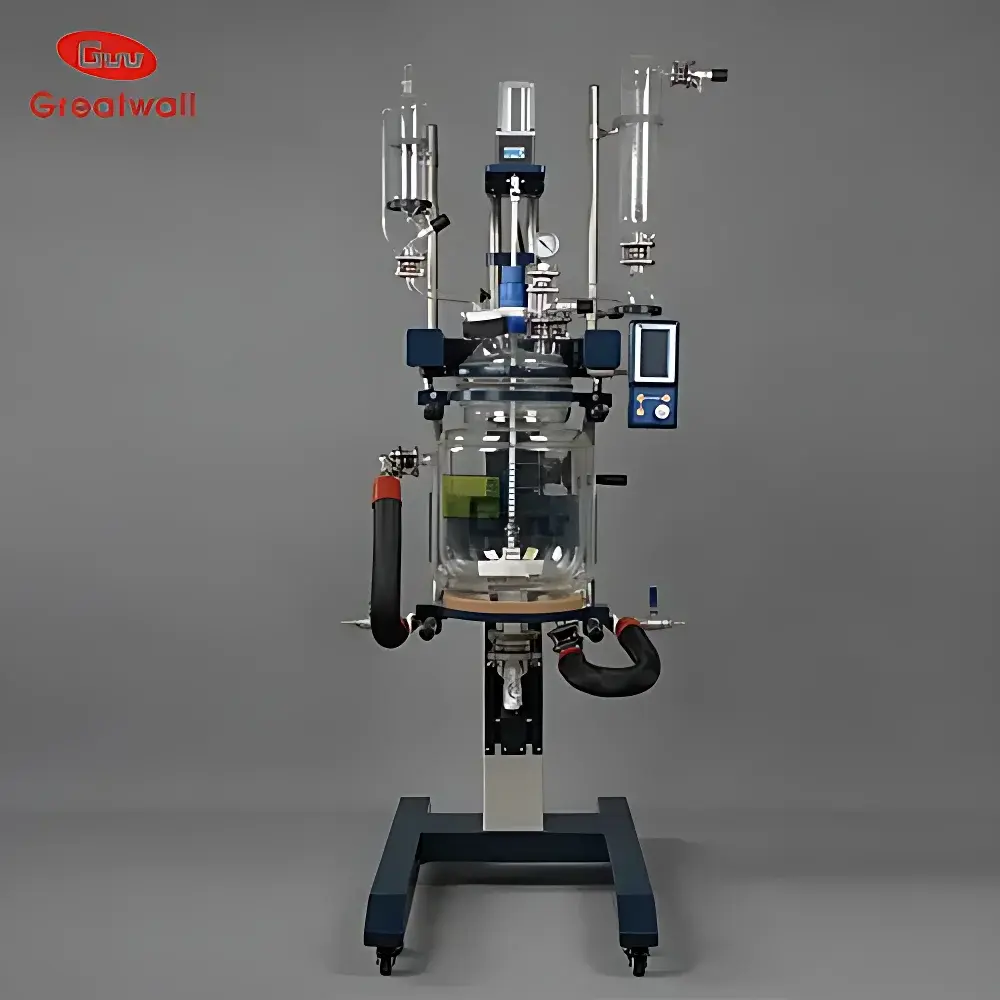
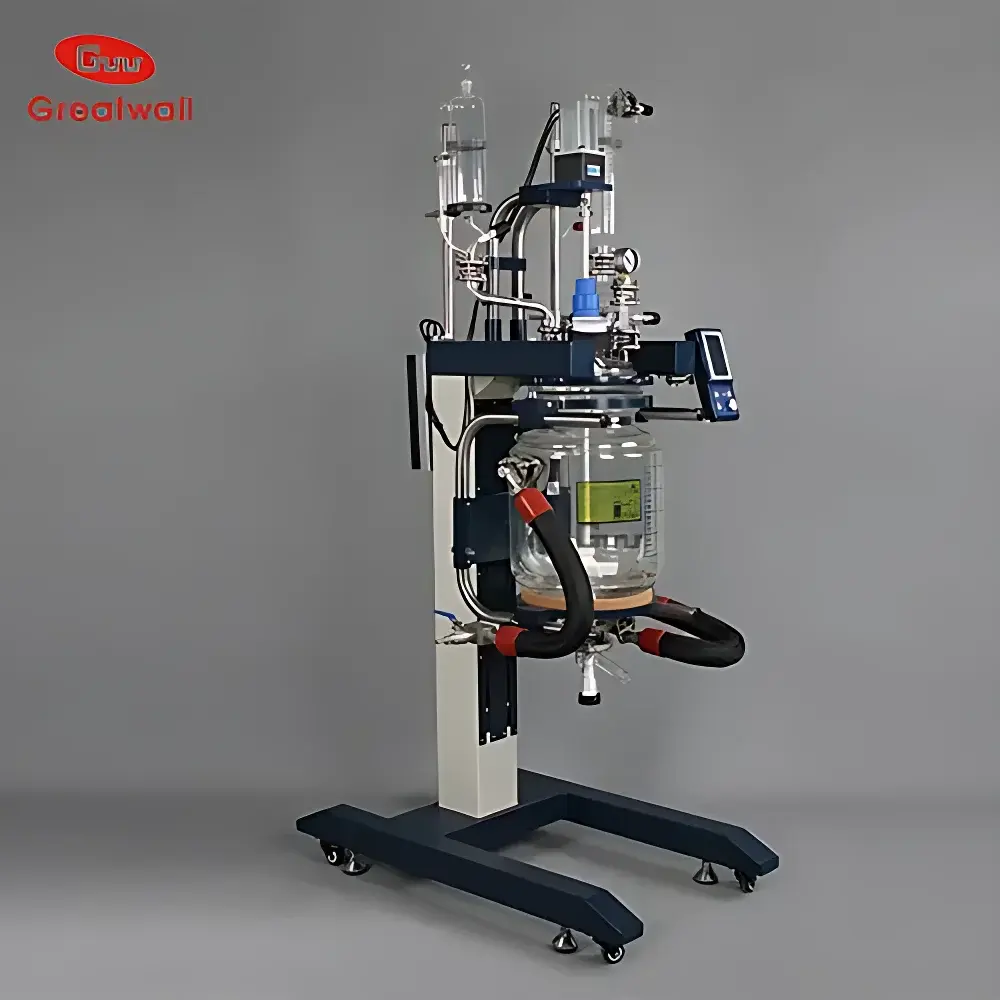
Zhengzhou Great Wall GRL-20 Adjustable-Height Glass Reactor
| Brand | The Great Wall |
|---|---|
| Origin | Henan, China |
| Manufacturer Type | Direct Manufacturer |
| Origin Category | Domestic |
| Model | GRL-20 |
| Instrument Classification | Glass Reactor |
| Usable Volume | Medium-Scale |
| Construction Material | Borosilicate Glass 3.3 |
| Operating Pressure Range | -0.1 MPa to 0.0 MPa |
| Capacity | 20 L |
| Temperature Range | -80 °C to 200 °C |
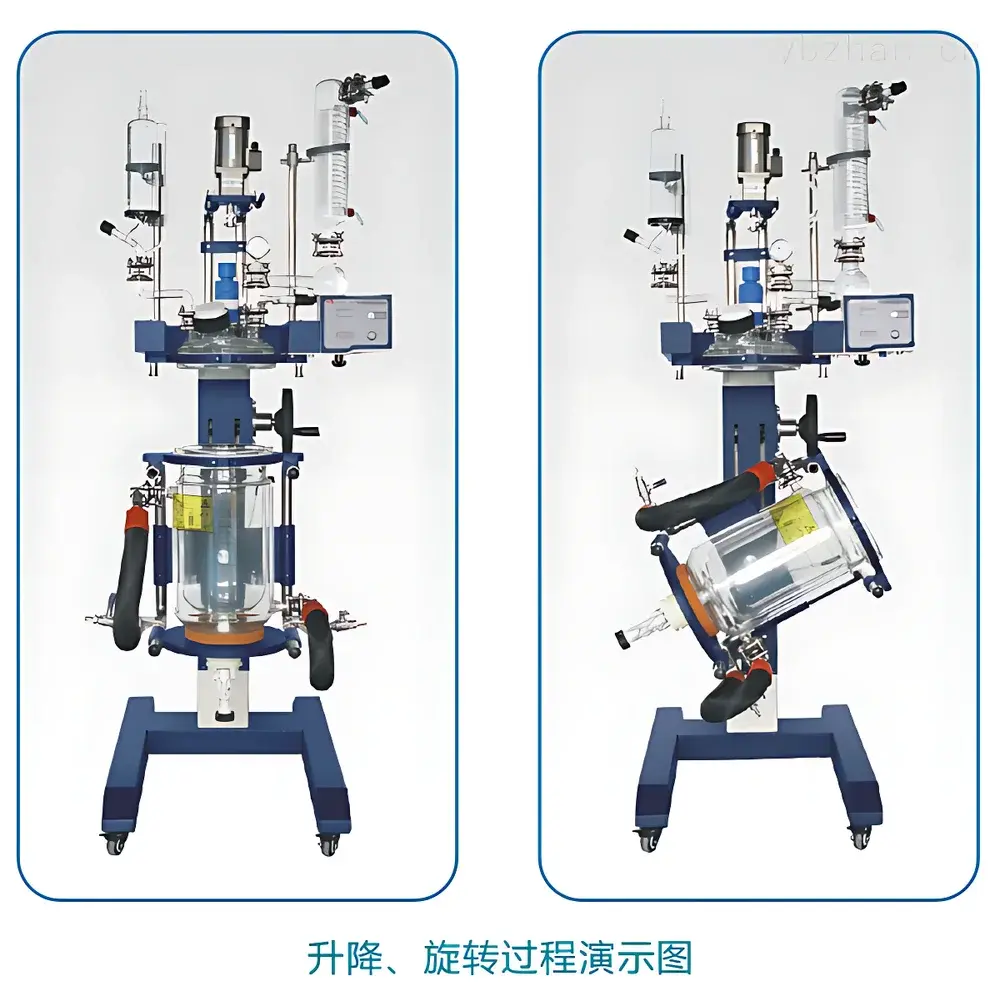
| Vessel Mobility | Vertical Lift + 120° Rotation |
| Sealing System | Custom-Engineered PTFE-Coated Magnetic Drive Bearing |
| Stirring Assembly | PTFE Blades + SS304 Shaft with Full PTFE Cladding |
| Frame Material | 06Cr19Ni10 Stainless Steel + Powder-Coated Carbon Steel + Anodized Aluminum |
| Mobility | Locking Casters with Brake Mechanism |
| Jacket Connection | Stainless Steel Insulated Flexible Hoses |
| Discharge Valve | Top-Mounted Angled Drain Valve |
Overview
The Zhengzhou Great Wall GRL-20 Adjustable-Height Glass Reactor is an engineered laboratory-scale synthesis platform designed for controlled chemical reactions, solvent reflux, distillation, concentration, and vacuum-enabled processes. Built upon the principles of jacketed thermal management and magnetically coupled mechanical agitation, this reactor integrates a vertically adjustable borosilicate glass vessel with precise angular positioning (up to 120° rotation) to facilitate safe handling, efficient reagent addition, and thorough post-experiment cleaning. Its core architecture supports both ambient and extreme thermal operation—from cryogenic conditions at –80 °C (using external low-temperature circulators) to high-temperature applications up to 200 °C—while maintaining structural integrity under controlled negative pressure (–0.1 MPa). The system operates as a sealed, chemically inert environment where reaction kinetics, heat transfer efficiency, and vapor-phase behavior can be systematically studied under reproducible conditions.
Key Features
- Borosilicate glass 3.3 vessel assembly compliant with DIN/ISO 3585 standards, offering exceptional resistance to thermal shock, chemical corrosion, and optical clarity for real-time process observation.
- Motor-driven vertical lift mechanism enabling precise height adjustment of the reactor body relative to heating/cooling baths and condenser assemblies.
- 120° rotational capability of the main vessel for ergonomic access during charging, sampling, and cleaning—reducing manual handling risks and improving workflow continuity.
- Double- or triple-jacket configurations available (standard configuration is double-jacketed) to support simultaneous heating and cooling, or auxiliary temperature control loops for advanced reaction profiling.
- Magnetically coupled stirring system featuring a proprietary PTFE-coated stainless steel (06Cr19Ni10) shaft and fully PTFE impeller blades, eliminating dynamic seal leakage points and ensuring long-term vacuum integrity.
- Top-mounted angled discharge valve with PTFE seating enables complete, residue-free material evacuation without disassembling the vessel—critical for batch-to-batch consistency in QC/QA environments.
- Modular frame constructed from hybrid materials: structural-grade carbon steel with epoxy-polyester powder coating, 06Cr19Ni10 stainless steel load-bearing components, and anodized aluminum control panels—optimized for corrosion resistance, static stability, and ease of decontamination.
- Flexible stainless steel insulated hoses connect jacket inlet/outlet ports, decoupling thermal expansion stresses and preventing hose fatigue during repeated temperature cycling.
Sample Compatibility & Compliance
The GRL-20 is compatible with a broad spectrum of organic solvents, aqueous solutions, acidic and basic reagents, and moderately aggressive media—including chlorinated hydrocarbons, esters, alcohols, and dilute mineral acids—provided operating parameters remain within specified thermal and pressure limits. All wetted parts meet USP Class VI and FDA-compliant material specifications where applicable. While not certified for ASME Section VIII or PED compliance due to its non-pressurized design (max operating pressure = 0 MPa gauge), the unit adheres to general laboratory safety standards per ISO 15195 and GLP-relevant installation practices. Vacuum operations conform to ISO 2859-1 sampling plans for leak integrity verification when used with calibrated vacuum gauges and controlled evacuation protocols.
Software & Data Management
The GRL-20 operates as a standalone analog/digital hybrid instrument. Temperature and agitation speed are controlled via front-panel digital interfaces with PID-regulated outputs for external circulators and variable-frequency drive (VFD) motor controllers. Optional integration with third-party data acquisition systems (e.g., LabVIEW, DeltaV, or custom SCADA platforms) is supported through 4–20 mA analog signal outputs and RS485 Modbus RTU communication ports. Audit trails, parameter logging, and user-access controls require external software implementation; the device itself does not embed FDA 21 CFR Part 11-compliant electronic records functionality. However, its stable analog signaling and deterministic response time make it suitable for inclusion in validated GMP workflows when paired with compliant peripheral instrumentation.
Applications
- Multi-step organic synthesis requiring sequential addition, reflux, and intermediate isolation under inert or reduced-pressure conditions.
- Kinetic studies of esterification, polymerization, and catalytic hydrogenation where visual monitoring and precise thermal ramping are essential.
- Solvent recovery and concentration of heat-sensitive compounds via rotary evaporation-compatible configurations.
- Process development for pharmaceutical intermediates, fine chemicals, and nanomaterial precursors where batch reproducibility and contamination control are prioritized.
- Teaching laboratories demonstrating reaction engineering fundamentals—including mass/heat transfer correlations, residence time distribution analysis, and vacuum thermodynamics.
FAQ
Is the GRL-20 rated for positive pressure operation?
No. The GRL-20 is engineered exclusively for atmospheric and sub-atmospheric (vacuum) service, with a maximum allowable pressure of 0.0 MPa gauge and minimum of –0.1 MPa. It is not designed or tested for internal overpressure applications.
Can the reactor be integrated into an automated reaction station?
Yes—via optional analog I/O modules and Modbus RTU interface. Full automation requires external PLC or DCS coordination for interlock logic, safety shutdowns, and synchronized peripheral control (e.g., condenser coolant flow, feed pump activation).
What certifications accompany the unit for international shipment?
CE marking is not applied, as the device falls outside EU Machinery Directive scope due to its laboratory-use classification and lack of integrated electrical safety enclosures. Export documentation includes RoHS-compliant material declarations and ISO 9001 manufacturing certification from the manufacturer.
How often does the magnetic coupling require maintenance?
Under normal operation with clean, non-abrasive media, the PTFE-coated coupling exhibits no scheduled maintenance interval. Visual inspection every 500 operational hours is recommended to verify absence of particulate accumulation or axial play.
Is replacement glassware available as spare parts?
Yes—standardized GRL-series glass components (vessel, condenser, distillation head, thermometer adapter) are stocked globally through authorized distributors and carry individual DIN/ISO traceable calibration documentation.



