
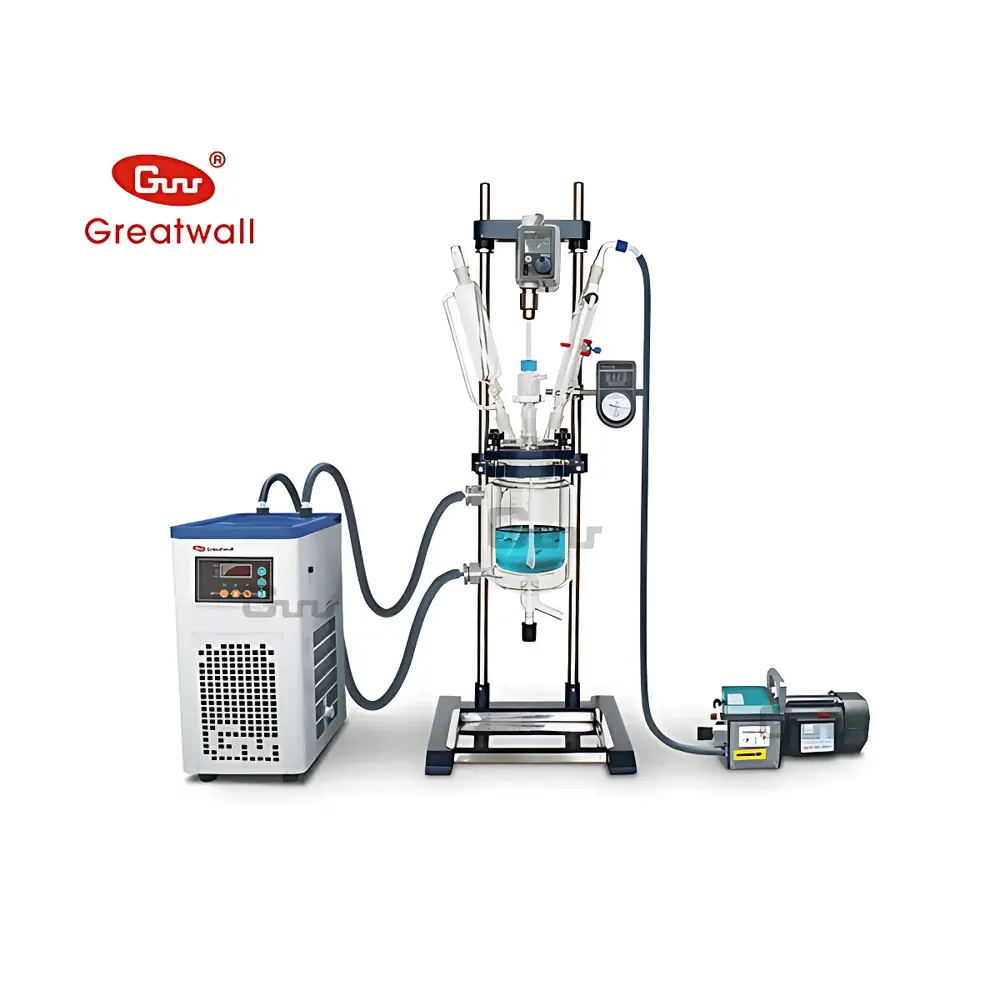
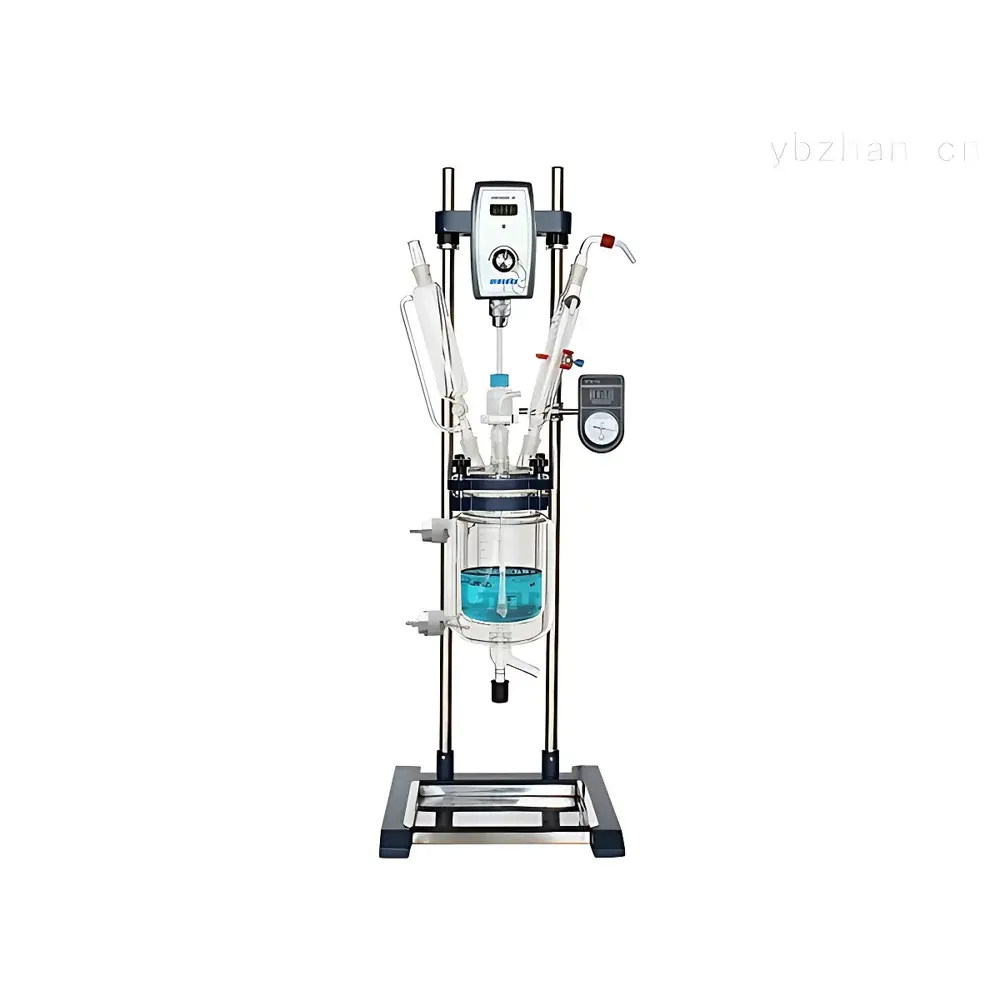
The Great Wall GR-3L Benchtop Glass Reactor
| Brand | The Great Wall |
|---|---|
| Origin | Henan, China |
| Manufacturer Type | Direct Manufacturer |
| Country of Origin | China |
| Model | GR-3L |
| Price Range | USD 2,800–7,000 (FOB) |
| Usable Volume | 3 L |
| Vessel Material | Borosilicate Glass 3.3 |
| Operating Pressure Range | −0.1 to 0.0 MPa (gauge) |
| Vacuum Level | ≤ −0.098 MPa (absolute) |
| Jacket Capacity | ~0.9 L |
| Condenser Surface Area | ~0.025 m² |
| Constant-Pressure Funnel Capacity | 200 mL |
| Temperature Range | −80 °C to +200 °C |
| Stirring Speed | 50–500 rpm |
| Stirring Torque | 70 N·cm |
| Stirring Power | 70 W |
| Temperature Sensor | Pt100 (±0.1 °C accuracy) |
| Sealing Material | PTFE |
| Frame Material | SUS304 Stainless Steel |
| Stirrer Shaft & Blades | SUS304 with PTFE coating |
| Feed/Outlet Port | Rc 1/2 or Rc 3/4 |
| Overall Dimensions (W×D×H) | ~480 × 420 × 1200 mm |
| Ambient Operating Conditions | 5–35 °C, ≤70% RH |
Overview
The Great Wall GR-3L Benchtop Glass Reactor is a compact, modular, and chemically inert laboratory-scale reaction system engineered for precise control of temperature, pressure, and mixing dynamics in synthetic chemistry, process development, and material science applications. Built around a seamless borosilicate glass 3.3 vessel—compliant with DIN/ISO standards for thermal shock resistance and chemical durability—the reactor operates under controlled vacuum (down to −0.098 MPa absolute) and ambient-to-moderate positive pressure (up to 0.0 MPa gauge), enabling safe execution of distillations, reflux reactions, hydrogenations, crystallizations, and moisture-sensitive syntheses. Its jacketed design supports external thermal fluid circulation (via Rc 1/2 or Rc 3/4 NPT-compatible ports), permitting rapid and uniform heat transfer across the full −80 °C to +200 °C operational range. The system’s low thermal mass and high surface-area-to-volume ratio ensure rapid response to setpoint changes while maintaining ±0.1 °C temperature stability via integrated Pt100 sensing and PID-regulated heating/cooling interfaces.
Key Features
- Borosilicate glass 3.3 construction (DIN ISO 3585) for exceptional resistance to thermal stress, alkalis, acids, and organic solvents—validated for long-term exposure at ΔT ≤ 80 °C between vessel interior and jacket.
- SUS304 stainless steel support frame and material tray, electropolished and passivated to ASTM A967, minimizing corrosion risk in humid or solvent-rich lab environments.
- PTFE-sealed, side-discharge valve with zero dead-volume geometry—designed to prevent sample retention and cross-contamination during quantitative discharge under vacuum or inert atmosphere.
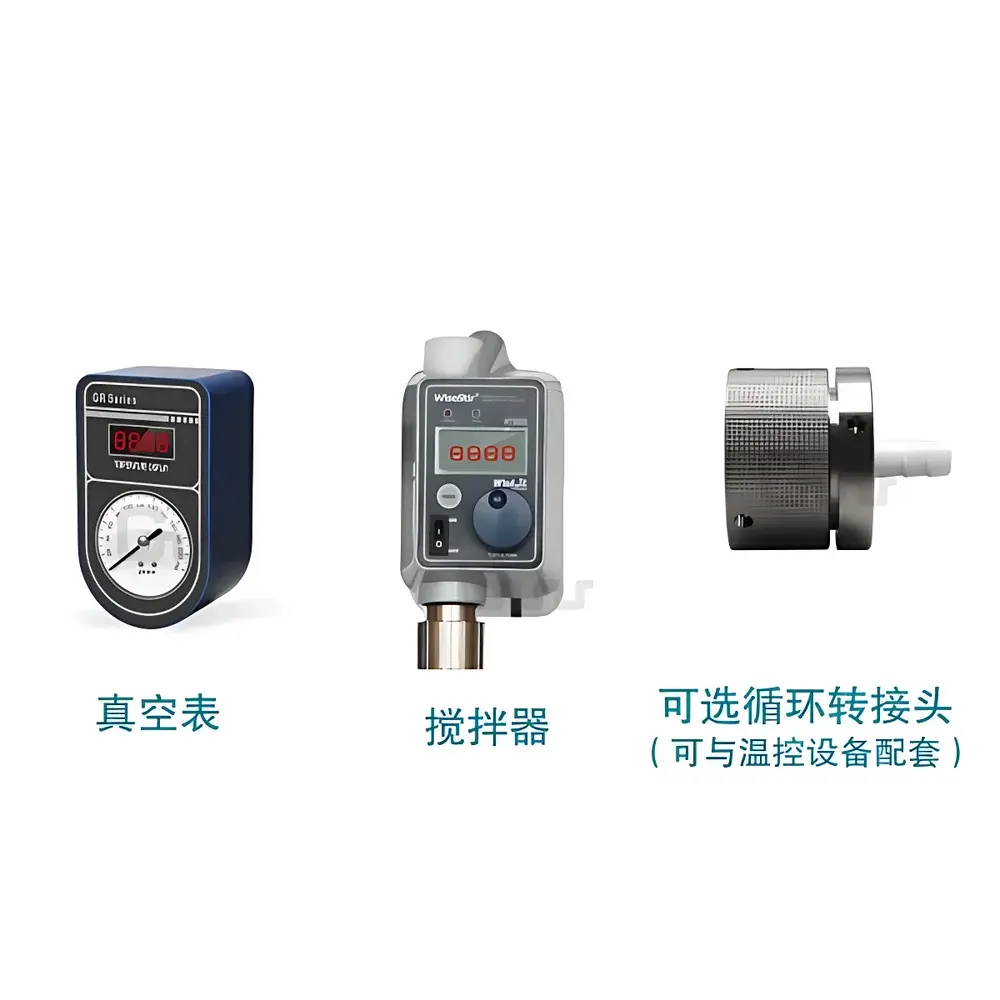
- Imported heavy-duty stirring drive unit with LED digital speed display, offering stepless regulation from 50 to 500 rpm and consistent torque delivery (70 N·cm) even at high-viscosity conditions.
- Precision-engineered stirrer assembly: SUS304 shaft with dual-layer PTFE cladding; paddle impeller with fully PTFE-coated blades; ceramic-reinforced PTFE bearings to eliminate metallic wear debris and ensure >10,000 hr service life under continuous operation.
- Standardized 24/29 ground-glass joints (DIN 16901) across all ports—including temperature sensor insertion, condenser connection, liquid feed, and constant-pressure funnel—ensuring interchangeability with common lab glassware and vacuum accessories.
- Integrated safety architecture: over-temperature cutoff, motor overload protection, and vacuum leak detection (max pressure rise ≤ 2 kPa/h under sealed conditions), supporting GLP-compliant experimental documentation.
Sample Compatibility & Compliance
The GR-3L is suitable for homogeneous and heterogeneous reaction mixtures up to 3 L working volume, including aqueous, anhydrous, corrosive (e.g., HCl, HNO₃, HF-dilute), and air/moisture-sensitive systems (when coupled with Schlenk line or glovebox integration). All wetted surfaces—glass, PTFE, and passivated SUS304—are compatible with USP Class VI and FDA 21 CFR 177.1550 materials requirements. The reactor meets CE marking directives for electrical safety (EN 61010-1) and electromagnetic compatibility (EN 61326-1), and its mechanical design adheres to ASME B31.3 process piping guidelines for low-pressure glass systems. Documentation packages include Factory Acceptance Test (FAT) reports, material traceability certificates (MTRs) for SUS304 components, and calibration records for Pt100 sensors—facilitating audit readiness per ISO/IEC 17025 and GMP Annex 15 protocols.
Software & Data Management
While the GR-3L operates as a stand-alone analog/digital hybrid instrument, it features RS-485 Modbus RTU output (optional) for integration into centralized lab automation platforms (e.g., LabVantage, Thermo Fisher SampleManager). Temperature and stirring speed signals can be logged at 1 Hz resolution using third-party SCADA software, with timestamped CSV export supporting 21 CFR Part 11-compliant electronic records when paired with validated audit-trail-enabled systems. All firmware updates are delivered via secure USB interface with SHA-256 signature verification, ensuring integrity of control logic throughout device lifecycle.
Applications
- Organic synthesis: Grignard, Friedel-Crafts, lithiation, and catalytic cross-coupling under inert or reduced-pressure conditions.
- Pharmaceutical process optimization: API crystallization kinetics, solvent screening, and polymorph isolation studies.
- Materials chemistry: Sol-gel synthesis, nanoparticle nucleation/growth, and polymerization initiation under controlled thermal ramping.
- Green chemistry workflows: Solvent-free mechanochemical reactions, microwave-assisted pre-screening, and continuous-flow precursor generation.
- Quality control testing: Stability-indicating assays, forced degradation studies (acid/base/oxidative), and extractables/leachables evaluation per ICH Q5C.
FAQ
What is the maximum allowable temperature differential between the reactor interior and jacket?
The vessel is rated for a maximum ΔT of 80 °C to prevent thermal stress-induced fracture—e.g., −20 °C internal with 60 °C jacket is permissible; −80 °C internal requires jacket temperature ≥ 0 °C.
Can the GR-3L be used under positive pressure?
No—it is certified only for vacuum and atmospheric operation (−0.1 to 0.0 MPa gauge); positive pressure use voids warranty and violates ASME B31.3 low-pressure glass system limits.
Is the Pt100 sensor calibrated and traceable to NIST standards?
Yes—each unit ships with a factory calibration certificate (±0.1 °C at 0 °C, 100 °C, and 200 °C), with optional UKAS-accredited recalibration services available.
What maintenance intervals are recommended for the stirring system?
PTFE bearings require inspection every 2,000 operating hours; shaft seal integrity should be verified before each high-vacuum run using helium leak detection per ASTM E499.
Does the system support GMP-compliant electronic record keeping?
Standalone operation does not include built-in 21 CFR Part 11 functionality, but Modbus-enabled data acquisition enables compliant archiving when deployed within validated third-party LIMS or ELN infrastructures.



