
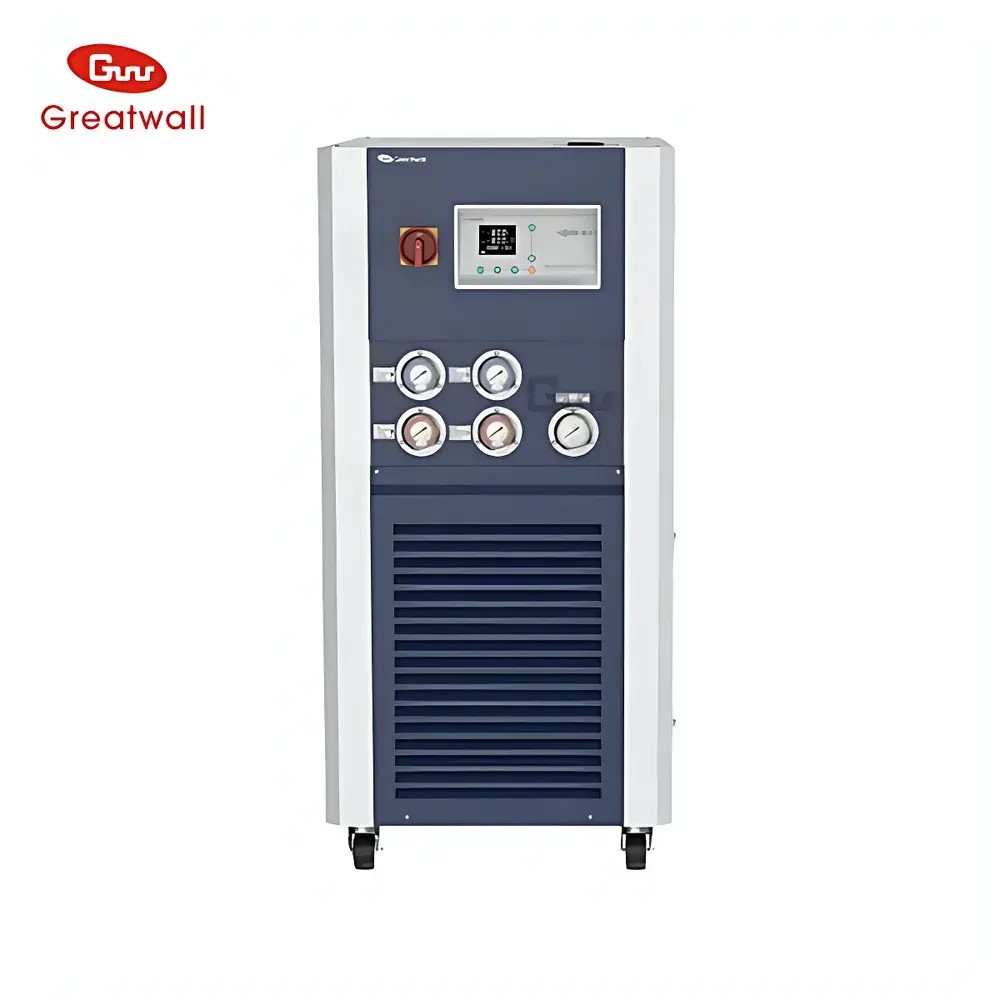
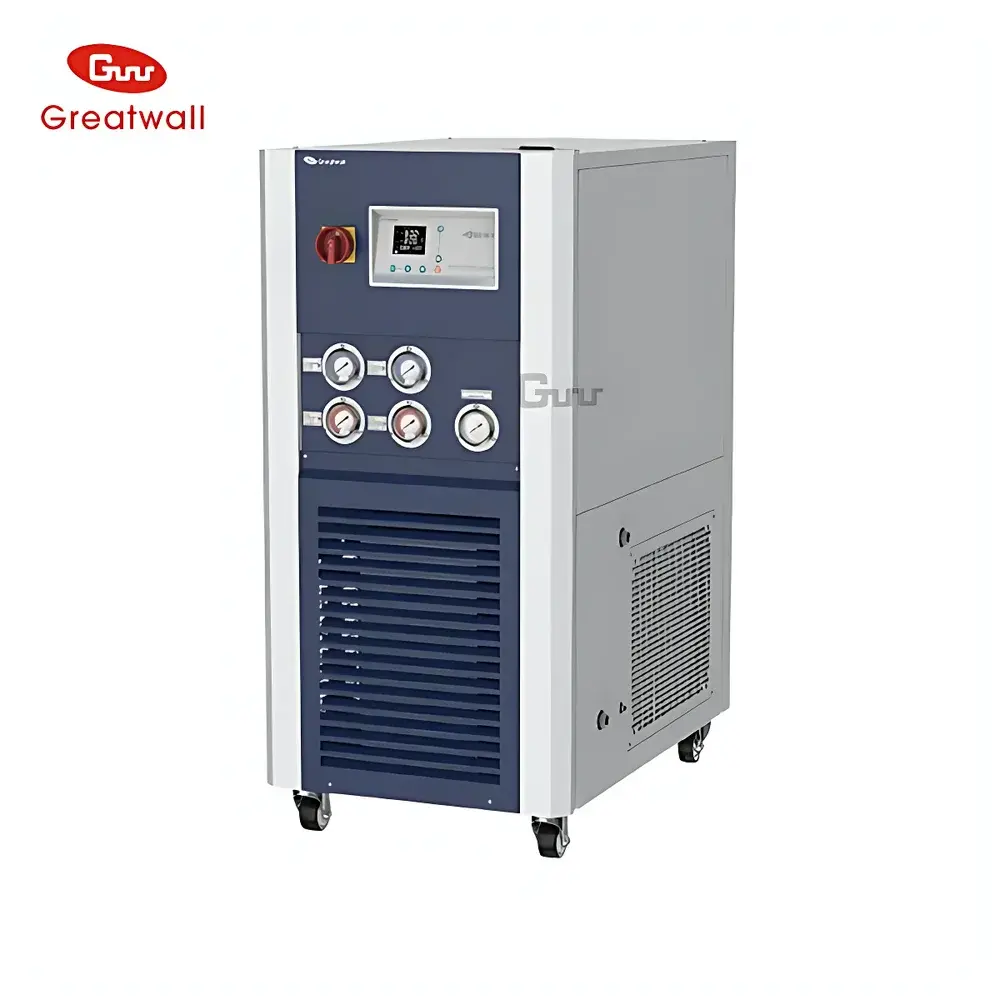
The Great Wall LT-20-80 Ultra-Low Temperature Circulating Chiller
| Brand | The Great Wall |
|---|---|
| Origin | Henan, China |
| Manufacturer Type | Direct Manufacturer |
| Country of Origin | China |
| Model | LT-20-80 |
| Cooling Capacity | 2000 W @ −40°C / 1400 W @ −60°C / 450 W @ −80°C |
| Temperature Range | −80°C to −40°C |
| Temp. Stability | ±2°C |
| Display | Digital (Pt100 sensor) |
| Refrigerants | R404A & R23 |
| Reservoir Volume | 10 L |
| Pump Power | 280 W |
| Flow Rate | 30 L/min |
| Max. Pressure | 1 bar |
| Power Supply | 3-phase, 380 V, 50 Hz |
| Ambient Operating Conditions | 5–35°C, ≤70% RH |
| Reservoir Material | SUS304 stainless steel |
| External Port | Rc 1/2 internal thread |
| Fill Opening | Ø60 mm |
| Dimensions (W×D×H) | 645×1060×1320 mm |
| Net Weight | 235 kg |
| Safety Protections | Compressor delay start, high/low pressure cut-off, thermal overload, overcurrent, phase sequence, overflow, leakage current |
Overview
The Great Wall LT-20-80 Ultra-Low Temperature Circulating Chiller is an industrial-grade, closed-loop refrigeration system engineered for precise and stable thermal control in demanding laboratory and pilot-scale process environments. Utilizing a dual-stage cascade refrigeration architecture with R404A (high-stage) and R23 (low-stage) refrigerants, the LT-20-80 achieves sustained operation at temperatures as low as −80°C while maintaining consistent heat exchange performance across its full operating range (−80°C to −40°C). Its primary function is to circulate temperature-controlled heat-transfer fluid—typically silicone oil or specialized low-temperature glycol blends—to external equipment such as jacketed reactors, calorimeters, material testing chambers, and environmental simulation rigs. The chiller’s sealed circulation design minimizes fluid oxidation and moisture absorption, preserving thermal stability and extending service life of both the coolant and connected instrumentation.
Key Features
- Robust cascade refrigeration system optimized for ultra-low temperature delivery with verified output capacity of 450 W at −80°C (tested at 25°C ambient), 1400 W at −60°C, and 2000 W at −40°C
- Hermetically sealed SUS304 stainless steel reservoir (10 L volume) with overflow protection mechanism that automatically discharges excess fluid during filling
- Industrial-grade circulation pump delivering up to 30 L/min flow rate at 1 bar maximum pressure, compatible with standard Rc 1/2 internal-thread external connections
- Comprehensive multi-layer safety architecture including compressor delay start, high/low pressure cut-offs, thermal overload relay, overcurrent protection, and three-phase sequence monitoring
- Digital temperature display with Pt100 platinum resistance sensor offering ±2°C thermal stability across the entire setpoint range
- Integrated electrical safety features compliant with IEC 61000-6-2/6-4 immunity and emission standards; leakage current protection meets Class I equipment requirements
Sample Compatibility & Compliance
The LT-20-80 is designed for integration into regulated workflows common in pharmaceutical development (e.g., API crystallization, lyophilization support), fine chemical synthesis, polymer characterization, and advanced materials testing. Its closed-loop architecture prevents contamination of external systems and supports GLP-compliant documentation when paired with validated external temperature loggers. While not certified to FDA 21 CFR Part 11 out-of-the-box, the chiller’s deterministic control logic, repeatable setpoint response, and auditable safety interlocks facilitate qualification under ISO 9001, ISO 13485, and ASTM E2500-13 frameworks. It operates within ambient conditions specified by ICH Q1A(R2) guidelines (5–35°C, ≤70% RH), ensuring reliability during extended thermal cycling protocols.
Software & Data Management
The LT-20-80 operates via a dedicated microprocessor-based controller with local digital interface only—no embedded Ethernet, USB, or cloud connectivity. This design prioritizes electromagnetic compatibility and operational integrity in electrically noisy industrial settings. For traceable data acquisition, users may integrate third-party temperature loggers (e.g., Omega OM-DAQPRO-5300 or Testo 176 T4) directly into the external loop using calibrated Pt100 probes. All safety events—including compressor shutdowns, pressure excursions, and overflow activation—are latched and indicated via LED status codes on the front panel, supporting root-cause analysis during maintenance reviews. No firmware updates or software licensing are required; all operational parameters are fixed at factory calibration.
Applications
- Temperature control of jacketed glass or stainless-steel reactors during exothermic/endothermic synthesis (e.g., Grignard reactions, hydrogenations, cryogenic lithiation)
- Stabilization of DSC, TGA, and DMA instruments requiring sub-60°C baseline thermal conditioning
- Environmental stress screening of electronic components and battery cells under controlled low-temperature profiles
- Simulating arctic or aerospace thermal cycles in polymer aging and composite material fatigue testing
- Supporting cryo-milling and low-temperature grinding operations where thermal drift compromises particle size distribution
- Providing auxiliary cooling for high-power laser sources and superconducting magnet systems requiring stable −70°C heat sink interfaces
FAQ
What is the minimum achievable temperature with the LT-20-80 under standard lab conditions?
The unit achieves and maintains −80°C continuously when ambient temperature is ≤25°C and relative humidity ≤70%. Performance degrades linearly above 30°C ambient due to condenser efficiency loss.
Can the LT-20-80 be used with water-based coolants?
No. Water freezes below 0°C and risks system blockage or expansion damage. Only low-freezing-point, thermally stable fluids such as silicone oils (e.g., DC200 series) or synthetic hydrocarbon blends (e.g., Marlotherm SH) are approved.
Is remote monitoring or analog output available?
The base model includes no analog voltage/current outputs or Modbus RTU. Optional 4–20 mA temperature signal output can be added via external signal conditioner interfaced to the Pt100 sensor terminals.
What maintenance intervals are recommended for long-term reliability?
Compressor oil and filter-drier replacement every 24 months; refrigerant charge verification every 36 months; annual inspection of electrical terminations and pump impeller clearance.
Does the unit comply with ATEX or IECEx for hazardous area use?
No. The LT-20-80 is rated for general-purpose indoor laboratory and industrial environments only (IP20 enclosure rating). Explosion-proof variants require custom engineering and third-party certification.
Related Products



