
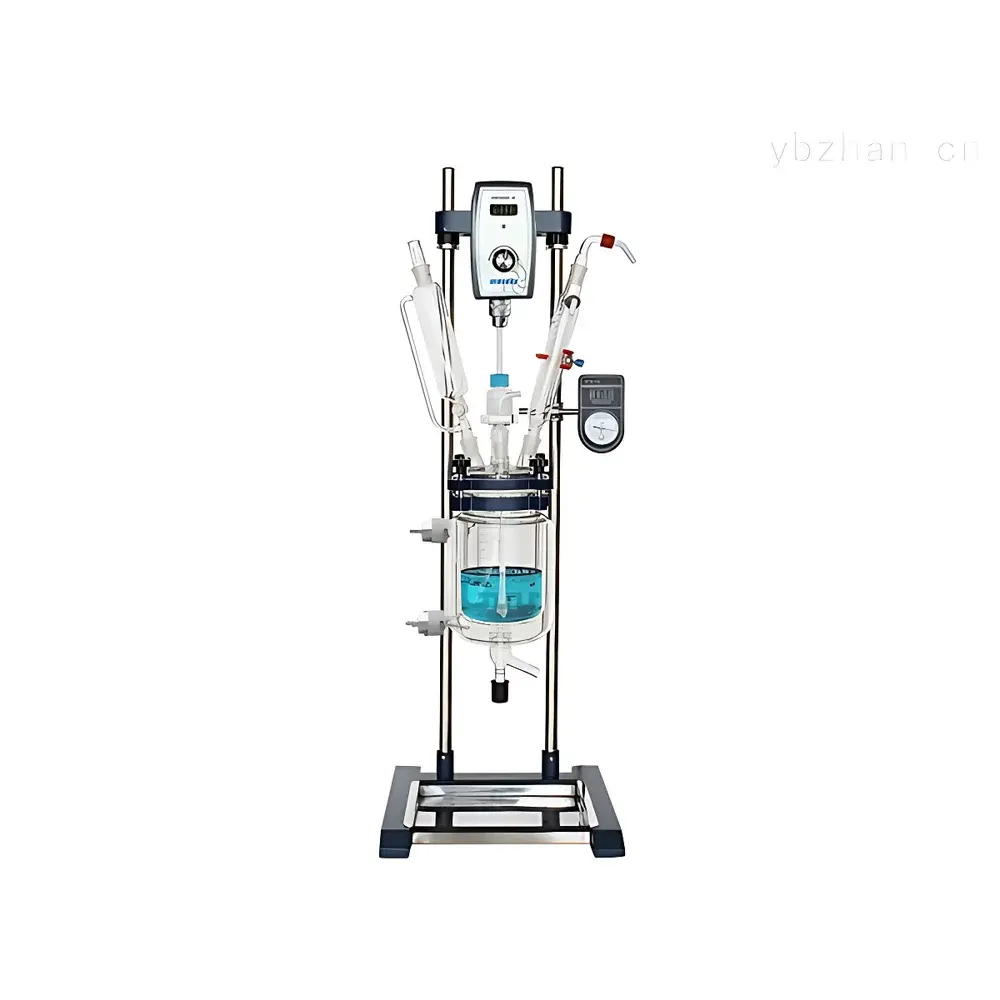
The Great Wall GR-5 Benchtop Dual-Jacketed Glass Reactor
| Brand | The Great Wall |
|---|---|
| Origin | Henan, China |
| Manufacturer Type | Direct Producer |
| Country of Origin | China |
| Model | GR-5 |
| Price Range | USD 2,800 – 7,000 (FOB) |
| Working Volume | 1–5 L (Standard Configurations: 1 L, 2 L, 3 L, 5 L) |
| Vessel Material | High-Borosilicate Glass (GG-17 / DIN 7080 equivalent) |
| Jacket Material | Borosilicate Glass |
| Operating Pressure Range | −0.1 MPa to 0 MPa (gauge) |
| Maximum Vacuum Level | −0.098 MPa (absolute) |
| Temperature Range | −80 °C to +200 °C |
| Stirring Speed | 50–500 rpm |
| Max Torque | 300 N·cm (3.0 N·m) |
| Jacket Capacity | 1.5 L |
| Power Supply | 220–240 V~, 50/60 Hz |
| Dimensions (W×D×H) | 535 × 450 × 1230 mm |
| Sealing Components | PTFE/FKM composite stopcocks and discharge valves |
| Control Interface | Integrated digital vacuum gauge and PT100 temperature display module |
Overview
The Great Wall GR-5 is a benchtop dual-jacketed glass reactor engineered for precise control of temperature, pressure, and mixing dynamics in synthetic chemistry, catalysis, and process development laboratories. Based on Couette-type mechanical stirring and double-wall thermal management principles, the GR-5 enables simultaneous heating and cooling via external circulators connected to its borosilicate glass jacket. Its all-glass wetted path—constructed from GG-17 high-borosilicate glass—ensures chemical inertness toward strong acids, bases, halogens, and organic solvents across a wide operational envelope (−80 °C to +200 °C). Designed for low-pressure and vacuum-intensive applications—including solvent reflux, crystallization, distillation under reduced pressure, and gas-liquid phase reactions—the GR-5 operates safely within a gauge pressure range of −0.1 MPa to ambient (0 MPa), with verified vacuum stability down to −0.098 MPa absolute.
Key Features
- Optically transparent GG-17 glass vessel and jacket for real-time reaction monitoring and photoreaction compatibility
- Dual-jacket design supporting independent heating/cooling media circulation for rapid thermal ramping and isothermal hold stability
- PTFE/FKM composite stopcocks and FEP-coated Viton® O-rings ensuring leak-tight sealing under vacuum and aggressive chemical exposure
- Digitally controlled variable-speed stirrer (50–500 rpm) delivering up to 3.0 N·m torque for viscous or heterogeneous reaction mixtures
- Integrated vacuum gauge and PT100-based temperature display module for local process parameter verification
- Benchtop footprint (535 × 450 × 1230 mm) optimized for fume hood integration and space-constrained lab environments
- Modular configuration options: standard 1 L, 2 L, 3 L, and 5 L vessels; optional condenser, dropping funnel, and inert gas inlet kits
Sample Compatibility & Compliance
The GR-5 supports a broad spectrum of sample types, including aqueous, anhydrous, corrosive, and air-sensitive reagents. Its chemically resistant glass construction complies with ISO 3585 (borosilicate glass specifications) and meets general laboratory safety requirements per IEC 61010-1. While not certified for ASME BPVC Section VIII or PED 2014/68/EU, the reactor is explicitly rated for non-pressurized and sub-atmospheric service only. It is routinely deployed in academic research labs, pharmaceutical R&D settings, and fine chemical pilot studies where GLP-aligned documentation practices are maintained. Users performing regulated work (e.g., API synthesis under ICH Q7) are advised to implement supplementary calibration logs, maintenance records, and operator training documentation to support audit readiness.
Software & Data Management
The GR-5 operates as a standalone analog-digital hybrid instrument without embedded data logging or remote connectivity. Process parameters—vacuum level and vessel surface temperature—are displayed locally via front-panel indicators. For traceable data acquisition, integration with third-party systems is supported through standard 0–10 V or 4–20 mA analog outputs (available on upgraded control modules). When paired with validated environmental monitoring platforms (e.g., DeltaTrak, Testo, or Siemens Desigo), the GR-5 can contribute to 21 CFR Part 11-compliant workflows provided that electronic records are generated, signed, and archived using compliant software infrastructure. No proprietary firmware or cloud interface is included.
Applications
- Controlled-temperature esterification, amidation, and Grignard reactions under nitrogen or argon blanket
- Vacuum-assisted solvent removal and low-boiling-point fractionation (e.g., THF, diethyl ether, dichloromethane)
- Catalytic hydrogenation screening using palladium-on-carbon or Raney nickel under mild vacuum
- Polymerization initiation studies requiring precise exotherm management via jacket temperature modulation
- Crystallization kinetics experiments with in-situ visual observation and controlled supersaturation generation
- Photochemical synthesis utilizing UV-transparent glass walls and external LED/lamp coupling
- Extraction and leaching protocols in natural product isolation workflows
FAQ
Is the GR-5 suitable for pressurized reactions?
No. The GR-5 is designed exclusively for atmospheric and vacuum operation (−0.1 MPa to 0 MPa gauge). It is not rated for internal positive pressure and must never be sealed against overpressure conditions.
Can the reactor be used with dry ice/acetone cooling baths?
Yes—external cryogenic baths may be applied to the jacket, but sustained operation below −40 °C requires verified thermal shock resistance of the specific glass batch and careful ramping to avoid fracture.
What certifications does the GR-5 carry?
It carries CE marking for EMC and LVD compliance (2014/30/EU and 2014/35/EU). No ATEX, UL, or FDA device listing applies, as it is classified as general-purpose laboratory equipment.
Is custom engineering available for OEM integration?
Yes—The Great Wall offers mechanical and electrical interface customization (e.g., DIN rail mounting, RS485 Modbus RTU output, extended jacket ports) under NDA-bound OEM agreements.
How often should sealing components be replaced?
Under continuous vacuum service, FEP-coated Viton® O-rings and PTFE/FKM stopcocks should be inspected quarterly and replaced annually—or immediately upon visible compression set, cracking, or leakage detection.



