
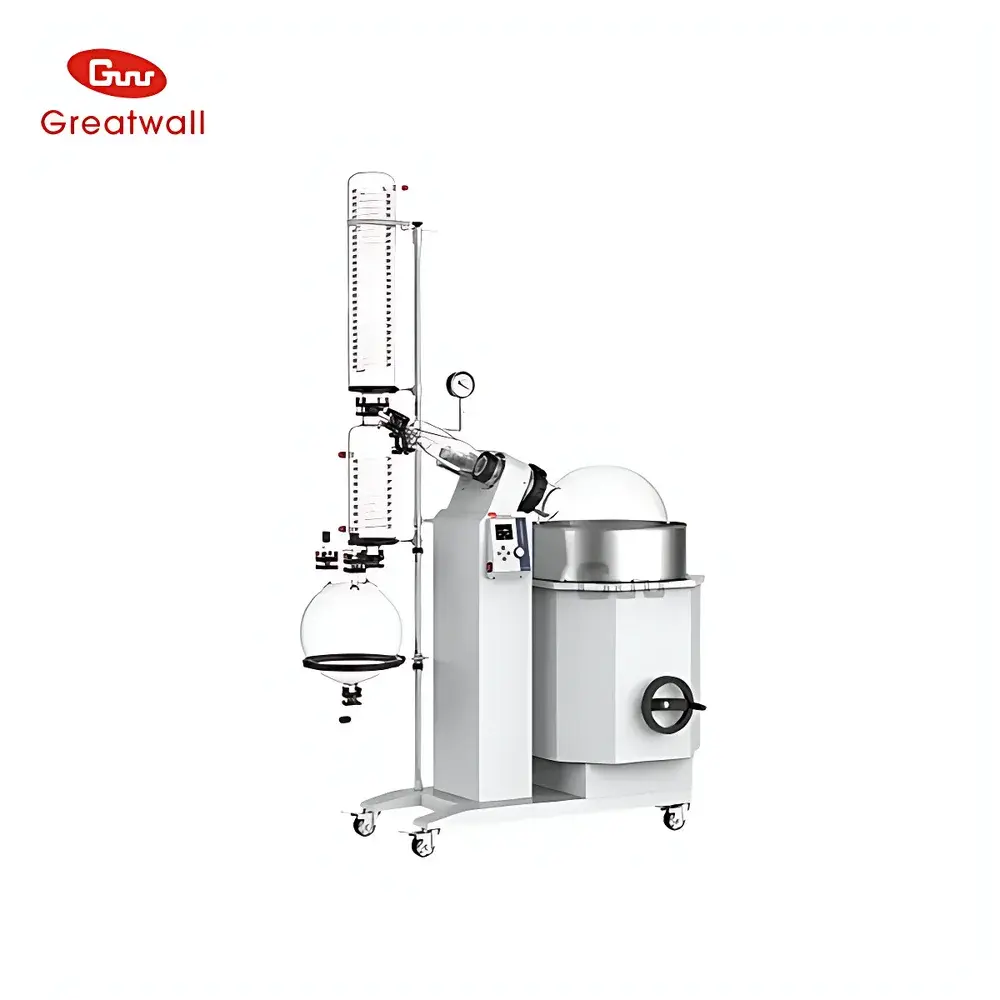
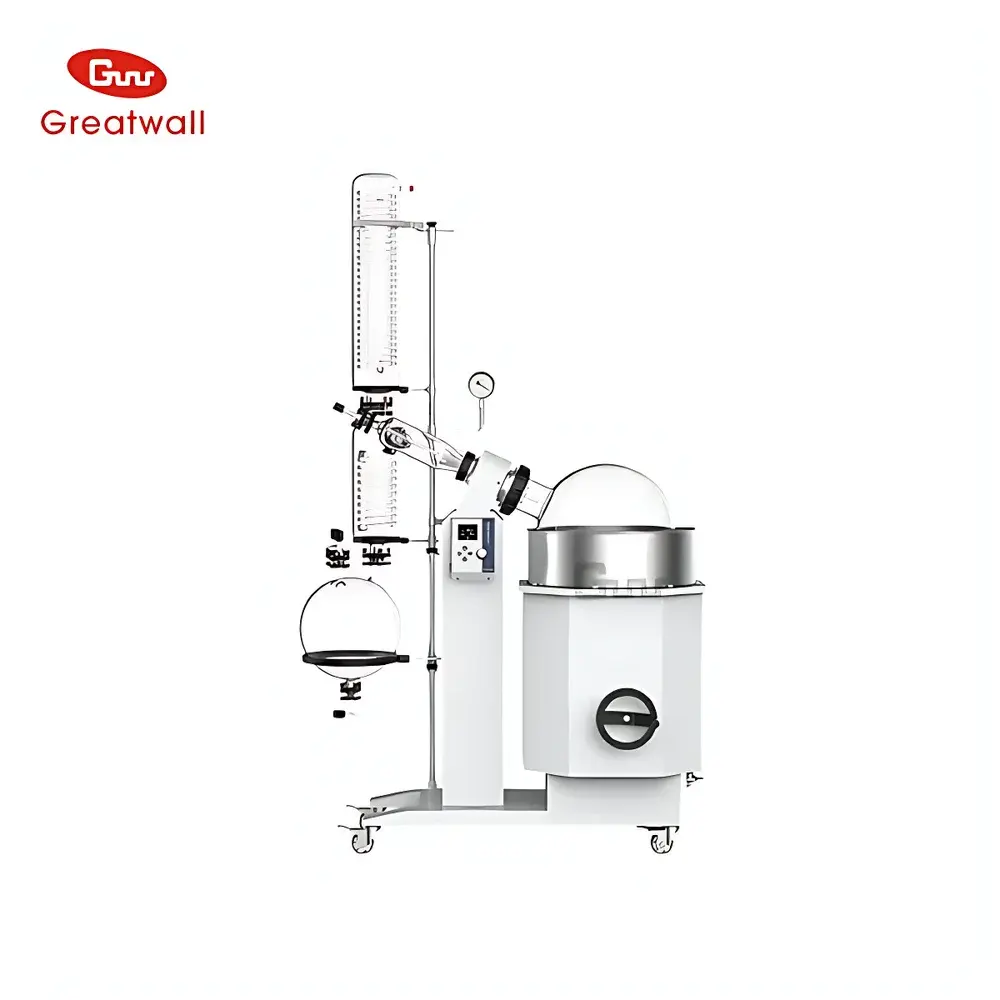
Great Wall R-1050 Rotary Evaporator
| Brand | The Great Wall |
|---|---|
| Origin | Henan, China |
| Manufacturer | The Great Wall Scientific Industrial & Trading Co., Ltd. |
| Model | R-1050 |
| Capacity | 50 L |
| Rotation Speed | 20–110 rpm |
| Bath Temperature Range | +5 °C to 95 °C (ambient referenced) |
| Temperature Control Accuracy | ±1.5 °C |
| Condensing Area | Main Condenser 1.15 m² |
| Power Supply | 3-phase, 380 V, 50 Hz |
| Total Power Consumption | 6300 W |
| Rotating Motor Power | 250 W |
| Heating Power | 6000 W |
| Max. Water Evaporation Rate | 9 L/h |
| Sealing Leakage Rate | ≤0.03 kPa/min |
| Bath Material | 06Cr19Ni10 Stainless Steel (Φ550 × 320 mm) |
| Glassware | DIN/ISO-compliant borosilicate 3.3 glass |
| PTFE Valve | Yes |
| Quick-Release Flange Connection | Yes |
| IP Rating | IP20 |
| Pollution Degree | 2 |
| Dimensions (with glassware) | 1345 W × 770 D × 2230 H mm |
| Installed Footprint (min.) | 1445 W × 870 D × 2280 H mm |
| Weight (with glass) | 140 kg |
| Ambient Operating Conditions | 5–35 °C, ≤70% RH, ≤2000 m altitude |
Overview
The Great Wall R-1050 Rotary Evaporator is an industrial-grade benchtop-to-floor-standing system engineered for mid-scale purification and solvent recovery in pilot laboratory environments. It operates on the principle of reduced-pressure distillation, where simultaneous rotation, controlled bath heating, and efficient condensation enable rapid, gentle removal of volatile solvents from heat-sensitive samples. Designed for continuous operation under vacuum conditions down to <5 mbar, the R-1050 integrates a dual-stage condensation architecture—comprising a primary vertical coil condenser (1.15 m²) and auxiliary horizontal condenser (0.4 m²)—to maximize vapor capture efficiency across diverse solvent boiling points (e.g., dichloromethane, ethyl acetate, ethanol, water). Its robust mechanical design supports 50 L rotating flask capacity and accommodates high-volume batch processing typical in pharmaceutical process development, natural product isolation, and fine chemical synthesis.
Key Features
- Hermetic sealing system validated to ≤0.03 kPa/min leakage rate—enabling stable vacuum without silicone grease application, compliant with ISO 27427-1:2021 vacuum integrity requirements for lab-scale evaporators.
- Automated solvent collection valve with programmable switching logic—allows uninterrupted distillation during single-receiver operation by diverting condensed fractions to alternate paths without manual intervention.
- PTFE-coated discharge valve and borosilicate 3.3 glass components (DIN 28720 / ISO 3585 certified) ensure chemical resistance against strong acids, bases, and organic media per ASTM E2573-22 material compatibility guidelines.
- Quick-connect flanged joints (φ125 mm main flask, φ60 mm receiver) reduce assembly time and minimize misalignment-induced stress on glassware—critical for reproducible thermal transfer and mechanical stability.
- Stainless steel (06Cr19Ni10) thermostatic bath with PT100 three-wire temperature sensor and PID-based digital control delivers ±1.5 °C accuracy across 5–95 °C range, supporting USP thermal validation protocols.
- DC infinitely variable speed drive (20–110 rpm) with LCD tachometric feedback ensures precise rotational shear control—essential for preventing bumping, foaming, or emulsion formation in viscous or surfactant-laden solutions.
Sample Compatibility & Compliance
The R-1050 accommodates heterogeneous feed streams including aqueous extracts, polymer solutions, crude reaction mixtures, and suspension-based formulations. Its all-borosilicate 3.3 wetted path meets ISO 3585 specifications for hydrolytic resistance (Class HGB), while PTFE valves conform to FDA 21 CFR §177.1550 for food-contact applications. The system complies with IEC 61010-1:2010 safety standards for laboratory electrical equipment (Pollution Degree 2, Overvoltage Category III), and its IP20 enclosure rating aligns with indoor installation requirements per EN 60529. Optional bath insulation sleeves mitigate surface temperatures above 50 °C, satisfying EN 60598-1 thermal hazard mitigation criteria.
Software & Data Management
While the R-1050 operates via standalone analog/digital controls (LCD display for bath temp and rotation speed), it is compatible with external data acquisition systems via 4–20 mA analog outputs for bath temperature and rotational speed signals. When integrated into GLP/GMP workflows, users may log operational parameters—including vacuum setpoint, condensate volume estimates, and runtime—using third-party SCADA platforms compliant with FDA 21 CFR Part 11 electronic record requirements. Audit trails can be generated through timestamped CSV exports when paired with USB-enabled controllers (optional accessory).
Applications
- Pharmaceutical: Solvent removal post-extraction of active pharmaceutical ingredients (APIs); concentration of peptide solutions prior to lyophilization.
- Biotechnology: Recovery of ethanol from bacterial culture supernatants; desolvation of plasmid DNA preparations.
- Food & Beverage: Concentration of fruit juice extracts and essential oil distillates under low-temperature vacuum to preserve thermolabile volatiles.
- Materials Science: Solvent exchange in nanoparticle synthesis; removal of THF from block copolymer solutions prior to film casting.
- Environmental Chemistry: Pre-concentration of trace organics from aqueous environmental samples prior to GC-MS analysis.
FAQ
What vacuum level is recommended for optimal performance with the R-1050?
For most organic solvents, a working vacuum range of 10–50 mbar is recommended. The system achieves stable operation below 5 mbar when paired with a two-stage vacuum pump meeting ISO 8573-1 Class 4 purity standards.
Can the R-1050 be used for heat-sensitive compounds like vitamins or enzymes?
Yes—its precise bath temperature control (±1.5 °C), low-shear rotation profile, and efficient condensation minimize thermal degradation. Users should select appropriate bath temperatures and vacuum levels to maintain compound integrity per published decomposition thresholds.
Is the glassware interchangeable with other rotary evaporator brands?
The R-1050 uses standard ISO/DIN flange dimensions (φ125 mm main joint, φ60 mm receiver), enabling compatibility with third-party borosilicate 3.3 glassware that conforms to ISO 3585 and DIN 28720 specifications.
Does the unit support automated start/stop sequences or remote monitoring?
The base configuration includes manual control only. Automation-ready versions with RS485 Modbus RTU interface and relay outputs are available upon request for integration into centralized lab management systems.
What maintenance intervals are recommended for long-term reliability?
Bath fluid replacement every 6 months (deionized water recommended), O-ring inspection quarterly, and vacuum hose integrity verification before each high-vacuum run—consistent with ISO/IEC 17025 Clause 6.4.5 preventive maintenance guidance.



