
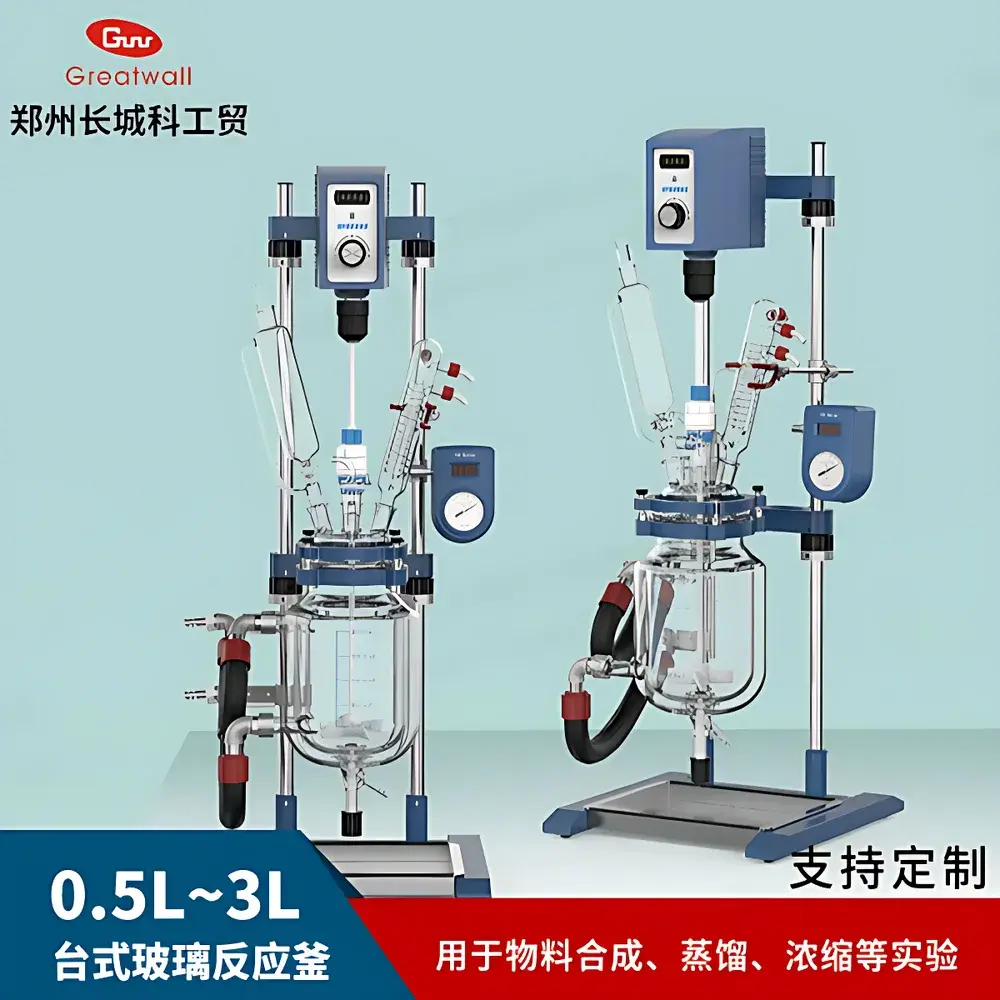
Great Wall GR-1 Variable-Speed Glass Reactor
| Brand | Great Wall |
|---|---|
| Origin | Henan, China |
| Manufacturer Type | Direct Manufacturer |
| Origin Category | Domestic (China) |
| Model | GR-1 |
| Instrument Classification | Jacketed Glass Reactor |
| Usable Volume | Small-Scale |
| Vessel Material | Borosilicate Glass 3.3 |
| Capacity | 1–5 L |
| Operating Temperature Range | −80 °C to +200 °C |
| Pressure Rating | −0.1 MPa to 0 MPa (Vacuum Only) |
| Jacket Inlet/Outlet | Stainless Steel Insulated Flexible Hoses |
| Drain Valve | Zero-Dead-Volume PTFE-Lined Valve |
| Frame Construction | Hybrid Structure — 06Cr19Ni10 (AISI 304) + Carbon Steel with Epoxy Powder Coating + Anodized Aluminum |
| Drip Tray Material | 06Cr19Ni10 Stainless Steel |
| Stirring Shaft | AISI 304 Core with Full PTFE Cladding |
| Impeller Material | Solid PTFE |
| Sealing Bearings | Imported High-Precision Radial Ball Bearings |
Overview
The Great Wall GR-1 Variable-Speed Glass Reactor is an engineered platform for controlled, scalable chemical synthesis and process development in academic research laboratories, pharmaceutical R&D units, and fine chemical pilot facilities. Designed around the principles of jacketed batch reaction under vacuum or inert atmosphere, the GR-1 employs a dual-wall borosilicate glass 3.3 vessel to enable precise thermal management via external circulating fluid (e.g., silicone oil, ethylene glycol/water mixtures, or cryogenic media). Its operational envelope—spanning −80 °C to +200 °C and −0.1 MPa (full vacuum) to ambient pressure—supports a broad spectrum of reactions including low-temperature lithiation, high-boiling-point esterifications, catalytic hydrogenations (with optional gas inlet kits), and solvent-free condensations. The reactor’s all-glass wetted path ensures full chemical compatibility with aggressive reagents (e.g., concentrated acids, strong bases, halogenated solvents), while its vacuum-rated design complies with standard laboratory safety protocols for volatile or moisture-sensitive chemistry.
Key Features
- Borosilicate glass 3.3 vessel and condenser assemblies—certified to DIN ISO 3585 standards—exhibit ≤3.3 × 10⁻⁶ K⁻¹ coefficient of thermal expansion, enabling stable operation across extreme thermal gradients without stress-induced cracking.
- Vacuum-compatible sealing system featuring imported radial ball bearings and dual-lip PTFE shaft seals, rated for continuous operation at ≤1 × 10⁻² mbar residual pressure with zero particulate shedding into the reaction mixture.
- PTFE-coated AISI 304 stirring shaft and solid-PTFE impeller deliver non-reactive, non-contaminating agitation; torque transmission remains linear up to 200 rpm with <±0.5% speed regulation accuracy under load.
- Zero-dead-volume bottom discharge valve with integrated PTFE seat and stem—fully actuated via threaded manual control—enables quantitative transfer of viscous or crystalline products without holdup or cross-contamination.
- Modular frame architecture combines corrosion-resistant 06Cr19Ni10 stainless steel structural elements, epoxy-powder-coated carbon steel load-bearing brackets, and anodized aluminum housing panels—designed for long-term exposure to organic vapors and aqueous splashes.
- Jacket port configuration utilizes flexible stainless steel insulated hoses with swivel fittings, eliminating mechanical strain on glass joints during thermal cycling and preventing microfracture propagation at flange interfaces.
Sample Compatibility & Compliance
The GR-1 accommodates heterogeneous, homogeneous, and multiphase reaction systems—including slurries, emulsions, and gas-liquid reactions—within its 1–5 L working volume range. Its chemically inert glass/PTFE/stainless steel construction meets ASTM E438 Type I Class A specifications for laboratory glassware and aligns with ISO 7208 requirements for static mixing equipment used in GLP-compliant environments. While not intrinsically rated for pressurized operation, the system supports integration with external pressure regulators, inert gas purging manifolds, and reflux condensers conforming to ISO 6779 and USP guidelines for analytical instrument qualification. All wetted components are non-leaching and extractables-tested per USP , ensuring suitability for API intermediate synthesis and early-stage formulation studies.
Software & Data Management
The GR-1 operates as a manually controlled standalone unit; no embedded controller or digital interface is included. However, its mechanical architecture is fully compatible with third-party process monitoring and automation systems. Analog outputs (0–10 V or 4–20 mA) can be retrofitted to temperature sensors and stirrer tachometers for connection to PLC-based SCADA platforms (e.g., Siemens SIMATIC, Rockwell Allen-Bradley) or PC-based data acquisition software (e.g., LabVIEW, MATLAB Data Acquisition Toolbox). When deployed in regulated environments, users may implement electronic batch records using 21 CFR Part 11–compliant software to log setpoints, actual temperatures, agitation speeds, and vacuum levels—provided hardware timestamps and audit trails are maintained externally.
Applications
- Organometallic synthesis requiring strict exclusion of oxygen and moisture (e.g., Grignard, organolithium, and transition-metal-catalyzed cross-coupling reactions).
- Controlled crystallization studies where supersaturation profiles are modulated via programmed cooling ramps through the jacket circuit.
- Exothermic nitration and sulfonation reactions with real-time thermal profiling and emergency quench capability.
- Enzymatic biotransformations conducted at sub-ambient temperatures with pH-stat or dissolved oxygen feedback loops.
- Solvent recovery and concentration under reduced pressure using integrated distillation head configurations.
- Material compatibility screening of novel catalysts, ligands, or polymerization initiators under reproducible thermal-mechanical conditions.
FAQ
Is the GR-1 suitable for pressurized reactions?
No—the GR-1 is rated exclusively for vacuum and atmospheric pressure operation (−0.1 MPa to 0 MPa gauge). It must not be used above ambient pressure without third-party engineering validation and safety interlocks.
Can the reactor be integrated with a chiller/heater circulator?
Yes—standard 1/2″ NPT or G1/2″ BSP jacket ports accept common industrial circulators (e.g., Huber, LAUDA, Julabo) with compatible hose barb or compression fittings.
What maintenance is required for the stirring seal assembly?
Inspect PTFE lip seals annually or after 2,000 hours of cumulative operation; replace bearings every 5,000 hours or when axial play exceeds 0.05 mm, per manufacturer service bulletin GR-1-MNT-2023.
Does the system include temperature sensing or control instrumentation?
No—temperature monitoring requires external Pt100 or thermocouple probes inserted via auxiliary ports; PID controllers and circulator setpoints must be managed independently.
Is the GR-1 compliant with CE or UL safety directives?
The GR-1 is supplied as a component-level apparatus without integrated electrical safety certification; end-users are responsible for full-system compliance verification under their local regulatory framework (e.g., IEC 61010-1, EN 61326-1).



