
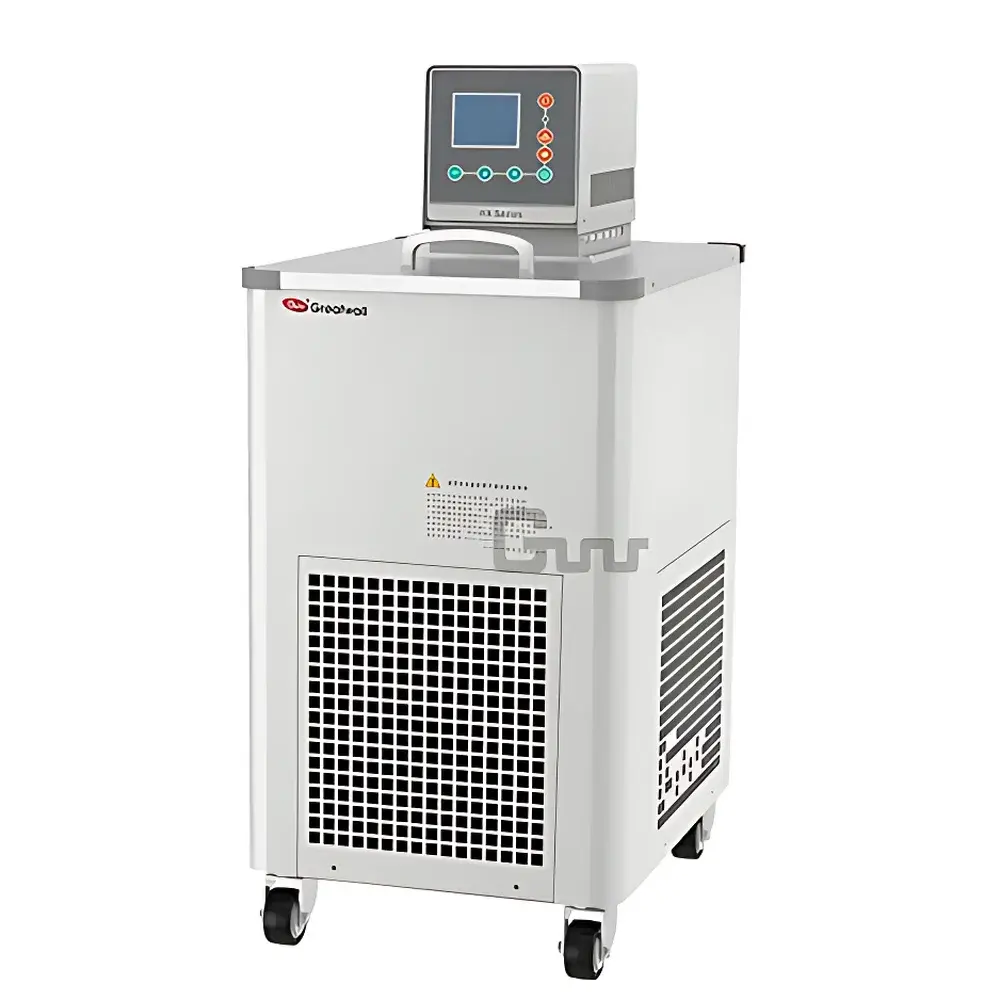
The Great Wall HX-2015 Laboratory Cryogenic Circulating Chiller
| Brand | The Great Wall |
|---|---|
| Origin | Henan, China |
| Manufacturer Type | Direct Manufacturer |
| Country of Origin | China |
| Model | HX-2015 |
| Price Range | USD 1,400–7,000 |
| Reservoir Volume | 15 L |
| Temperature Stability | ±0.05 °C |
| Operating Temperature Range | −20 to 99 °C |
| Cooling Capacity | 370–1200 W |
| Refrigerant | R404A |
| Flow Rate | 10 L/min |
| Opening Dimensions | 245 W × 365 D × 168 H mm |
| Heating Power | 1750 W |
| External Dimensions | 340 W × 480 D × 780 H mm |
| Weight | 48 kg |
| Power Supply | 220–240 V~, 50 Hz |
| Tank Material | 304 Stainless Steel |
| Compressor Type | Hermetic Air-Cooled (Imported from USA/France) |
| Pump Configuration | Dual-Impeller with Self-Priming Function |
Overview
The Great Wall HX-2015 Laboratory Cryogenic Circulating Chiller is a precision temperature control system engineered for stable thermal management in analytical, synthetic, and quality assurance laboratories. It operates on a closed-loop refrigeration principle utilizing a hermetically sealed air-cooled compressor (sourced from established U.S. and French manufacturers), combined with resistive heating and PID-based digital feedback control. This architecture enables continuous, bidirectional temperature regulation—from sub-zero cryogenic conditions (−20 °C) up to near-boiling aqueous environments (99 °C)—with exceptional stability of ±0.05 °C under steady-state operation. Unlike open-bath chillers, the HX-2015 circulates conditioned fluid through external devices—such as electrophoresis units, electron probe microanalyzers (EPMA), calorimeters, or reaction jackets—ensuring uniform thermal loading and minimizing ambient interference. Its 15-liter 304 stainless steel reservoir provides sufficient thermal mass for transient load absorption while resisting corrosion from common solvents and buffer solutions.
Key Features
- PID-controlled digital temperature regulation with real-time display and setpoint resolution of 0.1 °C
- Dual-impeller circulation pump offering self-priming capability, 10 L/min flow rate, and enhanced head pressure for multi-point or elevated-loop configurations
- Optimized internal flow path design promoting laminar, uniformly dispersed recirculation—critical for minimizing thermal gradients across external apparatus
- High-efficiency R404A refrigeration circuit delivering scalable cooling power (370–1200 W) dependent on setpoint and ambient load
- Robust 304 stainless steel reservoir and structural frame compliant with ISO 9001 manufacturing protocols and CE-marked electrical safety standards
- Integrated over-temperature, low-flow, and refrigerant pressure monitoring with automatic shutdown and visual alarm indication
Sample Compatibility & Compliance
The HX-2015 is compatible with a broad range of laboratory instrumentation requiring precise external thermal coupling—including but not limited to gel electrophoresis systems, X-ray diffractometers, FTIR spectrometers with cooled detectors, viscometers, and jacketed reactor vessels. Its fluid loop accommodates water, water-glycol mixtures (up to 30% v/v), and other non-aggressive heat transfer media. The unit complies with IEC 61010-1:2010 for electrical safety in laboratory equipment and meets RoHS Directive 2011/65/EU requirements for hazardous substance restriction. While not intrinsically rated for explosion-proof environments, it is routinely deployed in GLP-compliant QC labs supporting ASTM D2570 (viscosity bath calibration), USP (thermal validation of dissolution apparatus), and ISO 17025-accredited testing workflows where traceable temperature control is mandated.
Software & Data Management
The HX-2015 operates via an embedded microcontroller with local front-panel interface; no proprietary software or PC connectivity is included in the base configuration. However, analog output (0–5 V or 4–20 mA) is available for integration into centralized SCADA or LIMS platforms, enabling remote monitoring of bath temperature and system status. For regulated environments requiring audit trails—such as pharmaceutical stability chambers or contract research organizations—the unit supports manual logbook documentation aligned with FDA 21 CFR Part 11 principles when paired with validated procedural controls. Optional RS485 Modbus RTU communication modules (sold separately) allow for programmable setpoint scheduling and event-triggered data capture in compliance with GMP Annex 15 verification frameworks.
Applications
- Temperature stabilization of electrophoresis tanks to prevent DNA band smearing during high-voltage runs
- Cooling of electron-optical columns and detector assemblies in SEM/TEM and EPMA systems
- Thermal conditioning of reference standards in metrology labs performing thermometer calibration per ISO/IEC 17025
- Controlled exotherm management during catalytic hydrogenation or Grignard reactions in jacketed glass reactors
- Supporting accelerated stability studies (ICH Q1A) by maintaining constant temperature zones in environmental test chambers
- Calibration of thermocouples, RTDs, and infrared pyrometers across extended subzero-to-boiling ranges
FAQ
What is the minimum operating temperature, and can it sustain −20 °C continuously?
Yes—the HX-2015 achieves and maintains −20 °C under standard ambient conditions (≤25 °C, ≤60% RH) with adequate ventilation. Continuous operation at this limit requires use of ≥30% ethylene glycol/water mixture to prevent freezing-induced pump cavitation.
Is the reservoir accessible for cleaning or fluid replacement?
Yes—the top cover is removable, and the 304 stainless steel tank includes a drain valve and fill port with quick-connect fittings for rapid media exchange and decontamination.
Does the unit support external temperature feedback control?
No—the HX-2015 uses internal Pt100 sensor feedback only. External probe input is not supported in the standard configuration.
Can it be used with flammable solvents like acetone or THF?
No—only water, aqueous buffers, and glycol-based heat transfer fluids are approved. Organic solvents may degrade seals and compromise refrigerant system integrity.
What maintenance intervals are recommended for long-term reliability?
Compressor oil and refrigerant levels should be verified annually; condenser coils require bi-monthly dust removal; pump impellers and seals inspected every 24 months under continuous operation.



