
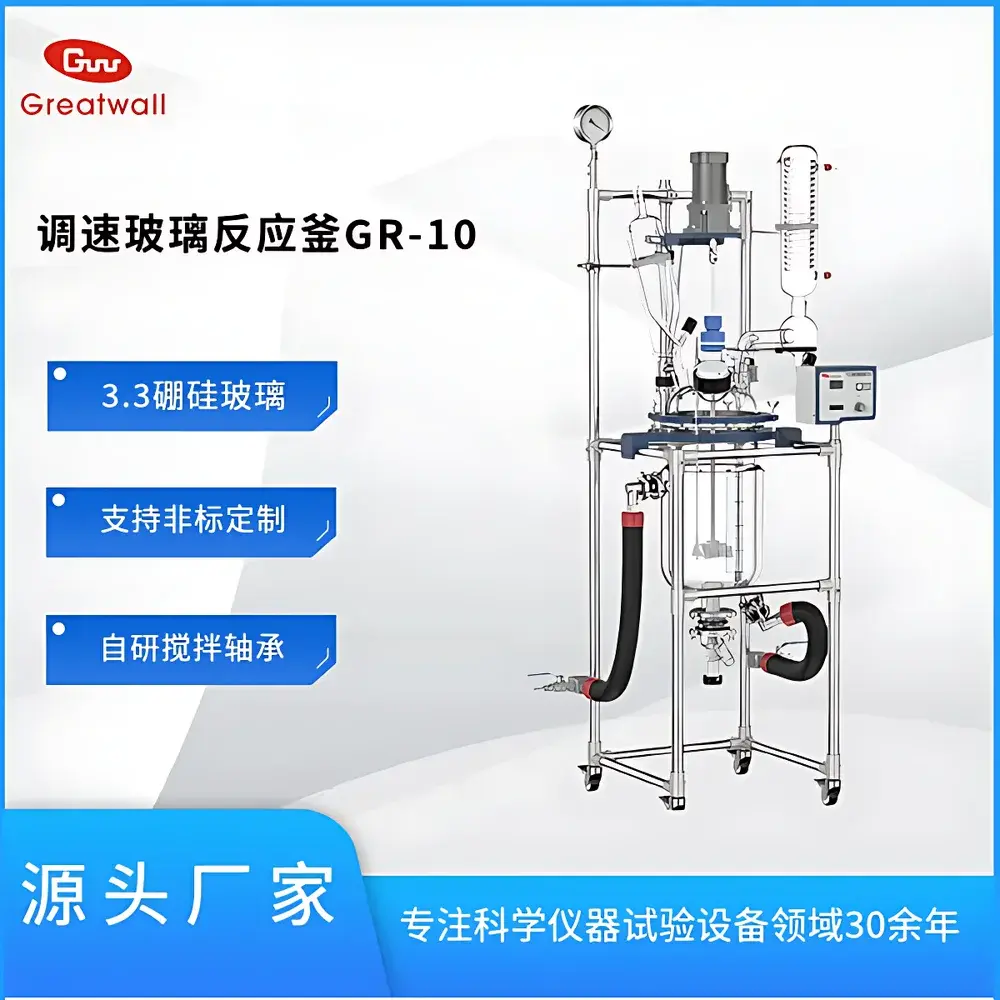
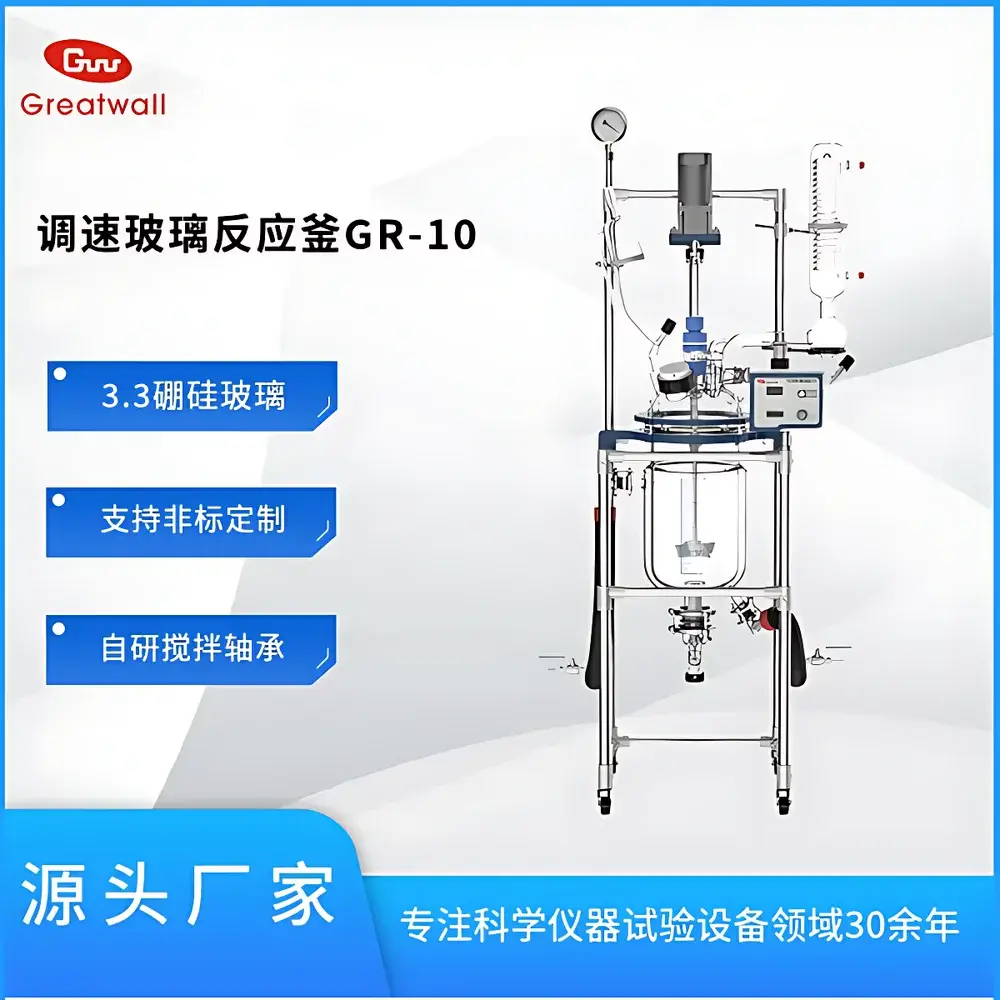
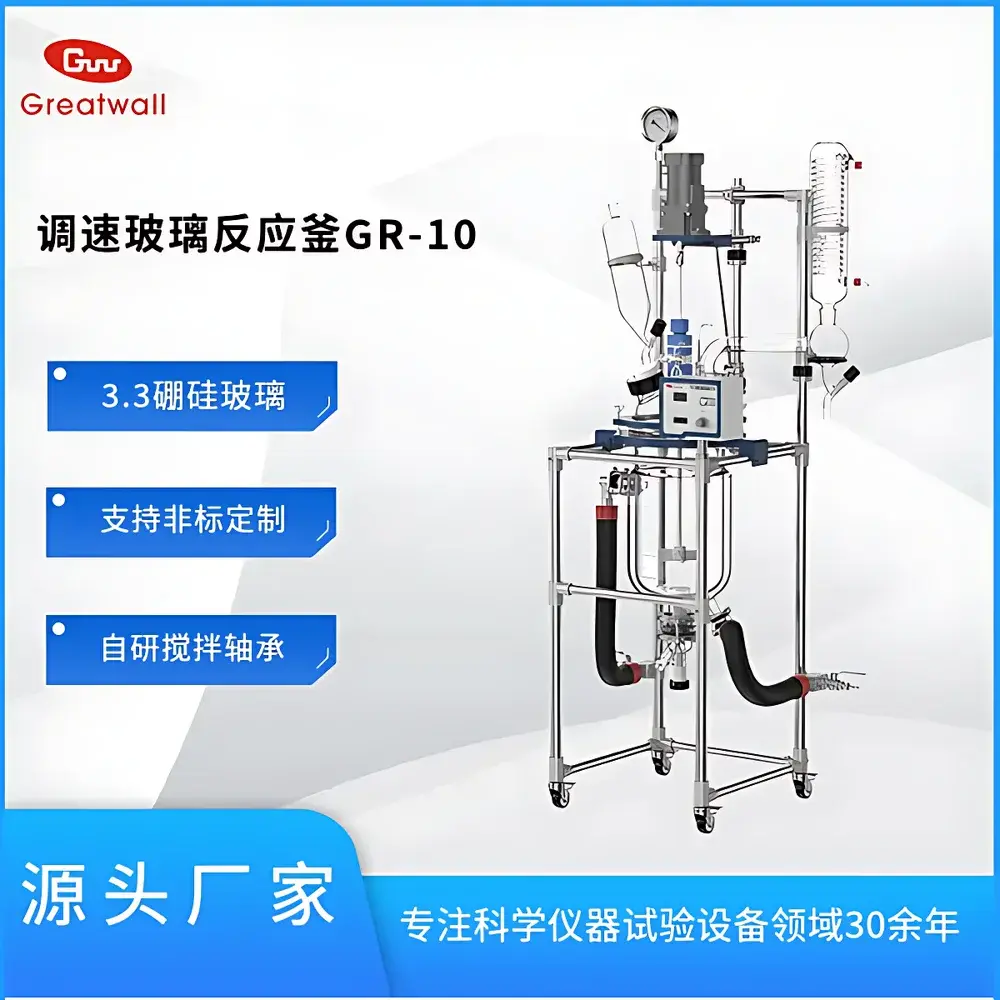
The Great Wall GR-10 Borosilicate Glass Reactor
| Brand | The Great Wall |
|---|---|
| Origin | Henan, China |
| Manufacturer Type | Direct Manufacturer |
| Origin Category | Domestic |
| Model | GR-10 |
| Instrument Classification | Jacketed Glass Reactor |
| Usable Volume | Medium-Scale (10 L) |
| Construction Material | 3.3 Borosilicate Glass |
| Operating Pressure Range | Vacuum to Atmospheric (–0.1 MPa to 0 MPa) |
| Jacket Pressure Rating | ≤ 0.03 MPa |
| Temperature Range | –80 °C to +200 °C |
| Thermal Shock Resistance | 80 °C |
| Stirring Speed Range | 50–500 rpm |
| Speed Accuracy | ±1 rpm |
| Motor Power | 90 W |
| Drive Type | Three-Phase Asynchronous Motor with Frequency Inverter Control |
| Stirrer Shaft & Blades | 06Cr19Ni10 Stainless Steel Core with PTFE Cladding |
| Sealing System | Vacuum-Compatible Mechanical Seal with PTFE Bearings |
| Condenser Surface Area | 0.234 m² |
| Standard Ground Joint Sizes | 40/38, 35/30, 29/22, 80/60 |
| Main Flask Flange Diameter | 215 mm |
| Bottom Valve Inner Diameter | φ21 mm |
| Drain Port Outlet | φ33 mm |
| Chiller Hose Connection | Rc 3/4 |
| Temperature Sensor | PT100 (±0.1 °C accuracy) |
| Frame Material | 06Cr19Ni10 Stainless Steel + Powder-Coated Aluminum Alloy |
| Mobility | Locking Casters with Brake |
| Dimensions (W×D×H) | ≈ 825 × 665 × 1780 mm |
| Net Weight | ≈ 48 kg |
Overview
The Great Wall GR-10 Borosilicate Glass Reactor is a precision-engineered, medium-scale jacketed laboratory reactor designed for controlled chemical synthesis, process development, and reaction optimization under vacuum, inert, or reflux conditions. Built around ASTM E438 Type I, Class A borosilicate 3.3 glass components—including the main vessel, condenser, dropping funnel, and receiving flask—the system ensures exceptional thermal stability, chemical resistance, and optical clarity across a broad operational envelope. Its core architecture follows classic double-jacketed reactor principles: the outer jacket circulates temperature-controlled fluid (e.g., silicone oil or coolant) to regulate reaction mass temperature, while the inner vessel withstands internal pressures from –0.1 MPa (full vacuum) up to ambient—enabling distillations, low-temperature reductions, and solvent-free condensations. The reactor operates within a certified working range of –80 °C to +200 °C, with proven thermal shock tolerance of ±80 °C, making it suitable for cryogenic Grignard additions and high-boiling-point esterifications alike.
Key Features
- Borosilicate 3.3 glass construction compliant with ISO 3585 and DIN 7080 standards for hydrolytic class HGB 1 and thermal class TCO 1.
- Vacuum-rated mechanical seal with PTFE-faced rotating element and stationary ceramic seat—tested to maintain integrity at ≤1×10⁻² mbar over extended operation.
- Integrated frequency-inverter-driven stirring system (50–500 rpm, ±1 rpm resolution) with digital LED speed readout and torque-responsive overload protection.
- PTFE-coated stainless steel (06Cr19Ni10) stirrer shaft and four-blade inclined turbine impeller—optimized for radial flow and uniform suspension of heterogeneous catalysts or precipitates.
- Stress-relieved jacket inlet/outlet ports fitted with flexible 304 stainless steel braided hoses (Rc 3/4) to eliminate thermal expansion-induced strain on glass joints.
- Modular top-plate configuration with six standardized ground-glass ports (including 50#, 35#, 40/38, 34/35, and 80#), enabling simultaneous connection of condenser, thermometer, addition funnel, gas inlet, vacuum line, and sampling valve.
- Ergonomic stainless steel–aluminum frame with locking casters, integrated leveling feet, and corrosion-resistant powder coating (ISO 20468 Class C3).
Sample Compatibility & Compliance
The GR-10 accommodates diverse sample types—including corrosive reagents (e.g., concentrated HBr, anhydrous AlCl3 slurries), moisture-sensitive organometallics, and thermally labile biomolecules—without leaching or catalytic interference. All wetted surfaces are either borosilicate glass or PTFE-clad 06Cr19Ni10, eliminating metal ion contamination risks. The system supports GLP-compliant workflows through traceable temperature logging (PT100 sensor, ±0.1 °C), calibrated speed control, and documented maintenance intervals. While not intrinsically rated for hazardous area use, its design aligns with general laboratory safety requirements per EN 61010-1 and conforms to CE marking directives for electrical equipment. Optional accessories—including explosion-proof motor variants, pressure relief valves, and data-logging interfaces—facilitate integration into GMP-regulated environments per FDA 21 CFR Part 11 when paired with validated software.
Software & Data Management
The GR-10 operates as a standalone instrument with local digital control of stirring speed and real-time temperature monitoring. For advanced process documentation, it is compatible with third-party LabVIEW™ or MATLAB®-based acquisition systems via analog 0–10 V output signals (speed and temperature). Optional USB-connected data loggers enable time-stamped recording of RPM, vessel temperature, and jacket inlet/outlet temperatures at user-defined intervals (1 s to 60 min). All logged datasets export to CSV format for post-processing in Excel or statistical analysis platforms. Audit trails—including operator ID, parameter changes, and timestamped event logs—can be generated when interfaced with validated LIMS or ELN solutions meeting ALCOA+ data integrity principles.
Applications
- Synthesis of fine chemicals and pharmaceutical intermediates under reflux, nitrogen blanket, or vacuum.
- Kinetic studies requiring precise temperature ramping and reproducible agitation profiles.
- Exothermic reaction calorimetry using jacket fluid enthalpy balance (with calibrated flowmeter and ΔT measurement).
- Multi-step tandem reactions involving sequential reagent addition via the 1000 mL恒压滴液漏斗 (pressure-equalized dropping funnel).
- Small-batch polymerization trials (e.g., polycondensation of PET precursors) with continuous water removal via Dean-Stark trap integration.
- Crystallization process development with controlled cooling rates and anti-solvent dosing.
FAQ
What is the maximum allowable jacket pressure?
The GR-10 jacket is rated for continuous operation at ≤0.03 MPa (30 kPa gauge)—sufficient for circulating silicone oil at elevated temperatures without risk of jacket rupture.
Can the reactor be used for hydrogenation under 1 bar H₂?
Yes, provided all seals (mechanical seal, ground joints, and valve O-rings) are inspected and rated for hydrogen service; optional Viton® or Kalrez® gasket kits are available for enhanced gas retention.
Is the PT100 sensor calibrated and NIST-traceable?
The factory-installed PT100 sensor meets IEC 60751 Class B tolerance (±0.3 °C at 0 °C); full NIST-traceable calibration certificates are available upon request with optional third-party certification.
How is cleaning validation performed for multi-product use?
The fully disassemblable glass train—combined with smooth PTFE surfaces and absence of dead-legs—supports swab testing and rinse recovery studies per ICH Q5C and EU Annex 15 guidelines.
Does the system support automated pH or conductivity monitoring?
Yes—via optional 12 mm diameter side-port adapters (S51 or 35#) for insertion of sterilizable inline probes compatible with standard industrial transmitters.



