
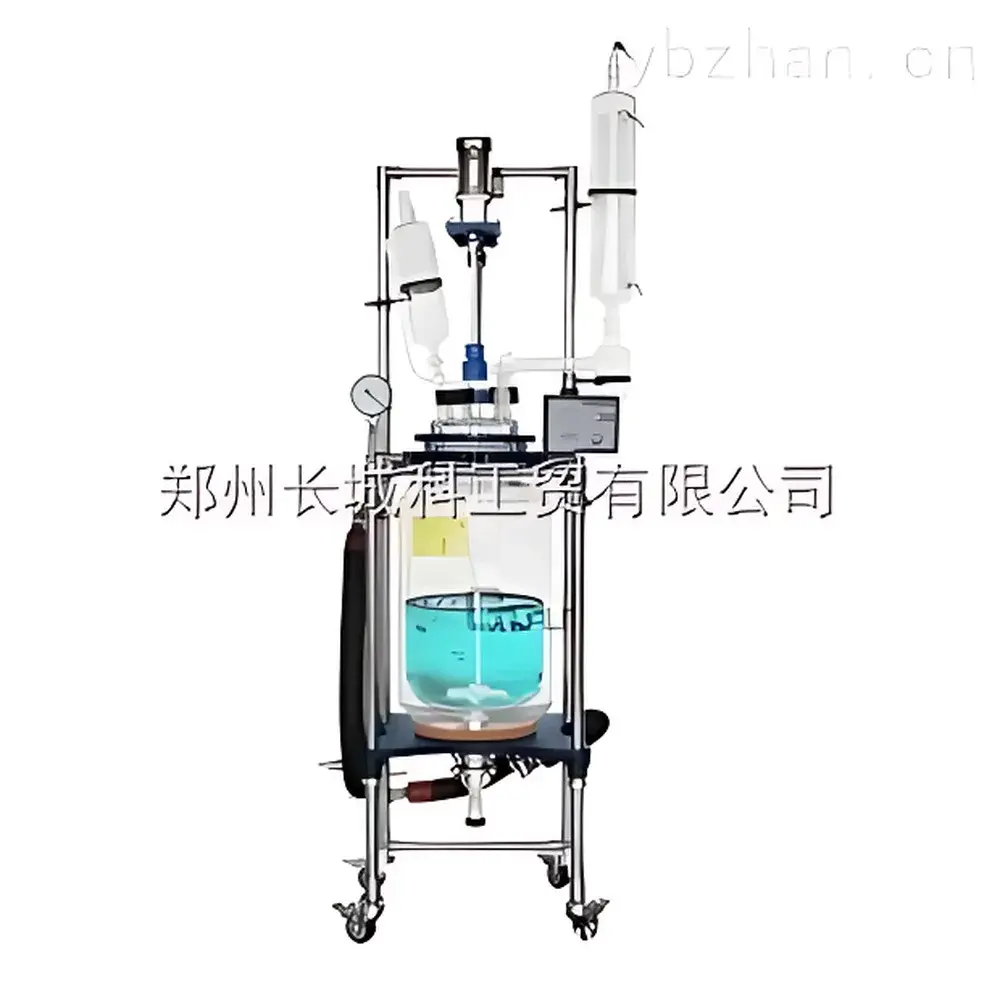
The Great Wall GR-150 Variable-Frequency Speed-Controlled Double-Jacketed Glass Reactor
| Brand | The Great Wall |
|---|---|
| Origin | Henan, China |
| Manufacturer Type | Direct Manufacturer |
| Country of Origin | China |
| Model | GR-150 |
| Price Range | USD 2,800 – 7,000 (FOB) |
| Usable Volume | 150 L (Large-Scale Lab Reactor) |
| Construction Material | Borosilicate Glass 3.3 |
| Operating Pressure Range | −0.1 to 0.0 MPa (Vacuum to Atmospheric) |
| Jacket Volume | ~45 L |
| Condenser Heat Exchange Area | ~1.32 m² |
| Feed Bottle Capacity | 10 L |
| Receiver Flask Capacity | 20 L |
| Temperature Range | −80 °C to +200 °C |
| Max. ΔT (Inner–Outer Wall) | ≤80 °C |
| Jacket Max. Pressure | ≤+0.03 MPa |
| Vacuum System Leak Rate | ≤2 kPa/h |
| Stirring Motor Power | 370 W |
| Speed Control | Variable-Frequency Drive (VFD) |
| Speed Range | 50–300 rpm |
| Temperature Sensor | Pt100 (±0.1 °C display accuracy) |
| Stirrer Type | Anchor/Paddle with PTFE-coated blades |
| Stirrer Shaft | SUS304 stainless steel with PTFE sheath |
| Seals & Gaskets | PTFE |
| Feed Ports | Two 34# standard ground joints, one 95# flange (solid feed), two 40# ground joints (feed bottles), 50# standard spherical joint (condenser), 60# flange (stirrer), 35# flange (Pt100) |
| Insulated Stainless Steel Flexible Hoses | 3/4″ male NPT |
| Discharge Valve Height | ~370 mm |
| Footwheel Design | Lockable casters |
| Power Supply | 220–240 V~, 50/60 Hz |
| Ambient Operating Conditions | 5–35 °C, RH ≤65% |
| Overall Dimensions (W×D×H) | ~1250 × 1100 × 2700 mm |
Overview
The Great Wall GR-150 Variable-Frequency Speed-Controlled Double-Jacketed Glass Reactor is an engineered platform for scalable laboratory synthesis, process development, and controlled chemical reaction studies under vacuum, inert, or temperature-regulated conditions. Designed around the principles of jacketed thermal management and mechanical agitation, it enables precise control over reaction thermodynamics and kinetics through independent regulation of jacket fluid temperature (via external chiller/heater), internal pressure (down to −0.1 MPa), and impeller rotational speed (50–300 rpm). Its all-borosilicate glass 3.3 construction ensures optical clarity for real-time visual monitoring while maintaining high resistance to thermal shock, chemical corrosion, and mechanical stress—critical for multi-step organic syntheses, catalytic hydrogenations, crystallization trials, and solvent recovery via reflux or distillation.
Key Features
- Double-jacketed borosilicate glass 3.3 vessel (150 L working volume) rated for −80 °C to +200 °C operation with ≤80 °C permissible wall-to-wall thermal gradient.
- Integrated variable-frequency drive (VFD) motor (370 W) delivering smooth, stepless speed control from 50 to 300 rpm with digital RPM readout and torque stability across load variations.
- Pt100 temperature sensor (±0.1 °C display resolution) housed in SUS304 sheath with PTFE insulation, mounted via 35# flange port for accurate in-situ reaction mass monitoring.
- PTFE-coated paddle-type agitator with SUS304 shaft and dual-seal mechanical stirring bearing assembly—designed to eliminate metal particulate generation and ensure long-term vacuum integrity.
- Vacuum-rated system architecture: validated leak rate ≤2 kPa/h at −0.1 MPa; compatible with oil-free diaphragm or scroll vacuum pumps per ISO 8573-1 Class 0 air purity requirements.
- Stress-relieved fluid connections using insulated 3/4″ stainless steel flexible hoses on jacket inlet/outlet ports; no-load side-discharge valve with PTFE seat and elevated 370 mm clearance for universal flask compatibility.
- Modular top-plate configuration with standardized ground joints (34#, 40#, 50#, 95#) and flanged ports (35#, 60#) enabling reproducible integration of condensers, dropping funnels, gas inlets, and sampling probes per ASTM E2656 guidelines for lab-scale reactor setup.
Sample Compatibility & Compliance
The GR-150 accommodates heterogeneous, viscous, and gas-evolving reaction mixtures—including organometallics, polymer precursors, fine chemical intermediates, and aqueous/organic biphasic systems. Its inert glass/PTFE/SUS304 wetted-path materials meet USP Class VI biocompatibility criteria and are compatible with cleaning validation protocols under ISO 13485 and FDA 21 CFR Part 211. The reactor supports GLP-compliant documentation when paired with external data loggers recording time-stamped temperature, pressure, and speed parameters. Vacuum performance complies with ISO 2859-1 sampling plans for leak integrity verification; thermal cycling profiles adhere to IEC 61000-4-2 electrostatic discharge immunity standards for lab instrumentation.
Software & Data Management
While the GR-150 operates as a standalone analog-digital hybrid unit (no embedded PLC), its analog outputs—including 4–20 mA temperature signal and 0–10 V speed reference—are designed for seamless integration into third-party SCADA or LIMS environments. Users may connect the Pt100 sensor and VFD controller to validated data acquisition systems (e.g., NI CompactDAQ or Keysight DAQ970A) configured for 21 CFR Part 11 audit trails, electronic signatures, and secure data archiving. Optional RS485 Modbus RTU interface kits enable remote parameter monitoring and alarm-triggered shutdown sequences compliant with IEC 61511 functional safety levels SIL-1.
Applications
- Multi-stage synthesis of pharmaceutical APIs under controlled exotherm management and inert atmosphere.
- Solvent-free esterification and transesterification reactions requiring simultaneous vacuum dehydration and mechanical mixing.
- Crystallization process mapping (cooling, anti-solvent addition) with real-time slurry observation through transparent walls.
- Catalytic batch hydrogenation using palladium-on-carbon or Raney nickel, with integrated H2 pressure monitoring via optional pressure transducer.
- Distillative product recovery and solvent recycling via vertical condenser (1.32 m² surface area) and dual-receiver configuration.
- Academic research in green chemistry, flow-assisted batch hybridization, and kinetic modeling of heterogeneous catalysis.
FAQ
What is the maximum allowable temperature differential between the inner vessel and jacket?
The design limits the wall-to-wall ΔT to ≤80 °C to prevent thermal stress fracture in borosilicate glass 3.3—this must be observed during rapid heating/cooling cycles.
Can this reactor be used for pressurized reactions?
No. The GR-150 is rated exclusively for vacuum-to-atmospheric operation (−0.1 to 0.0 MPa); it is not designed or certified for positive pressure service.
Is the stirring system suitable for highly viscous media?
Yes—the 370 W VFD motor with high-torque low-speed capability (50 rpm minimum) and PTFE-coated paddle geometry provides effective bulk mixing for viscosities up to ~50,000 mPa·s, assuming adequate heat transfer and no solid cake formation.
How is temperature calibration verified?
The Pt100 sensor is factory-calibrated traceable to NIST standards; users may perform field verification using a calibrated dry-block calibrator or precision thermometer inserted via the 35# flange port.
What maintenance intervals are recommended for the mechanical seal and bearings?
Under continuous operation, inspect the stirrer seal and bearing assembly every 500 operational hours; replace PTFE components annually or after exposure to aggressive halogenated solvents.



