
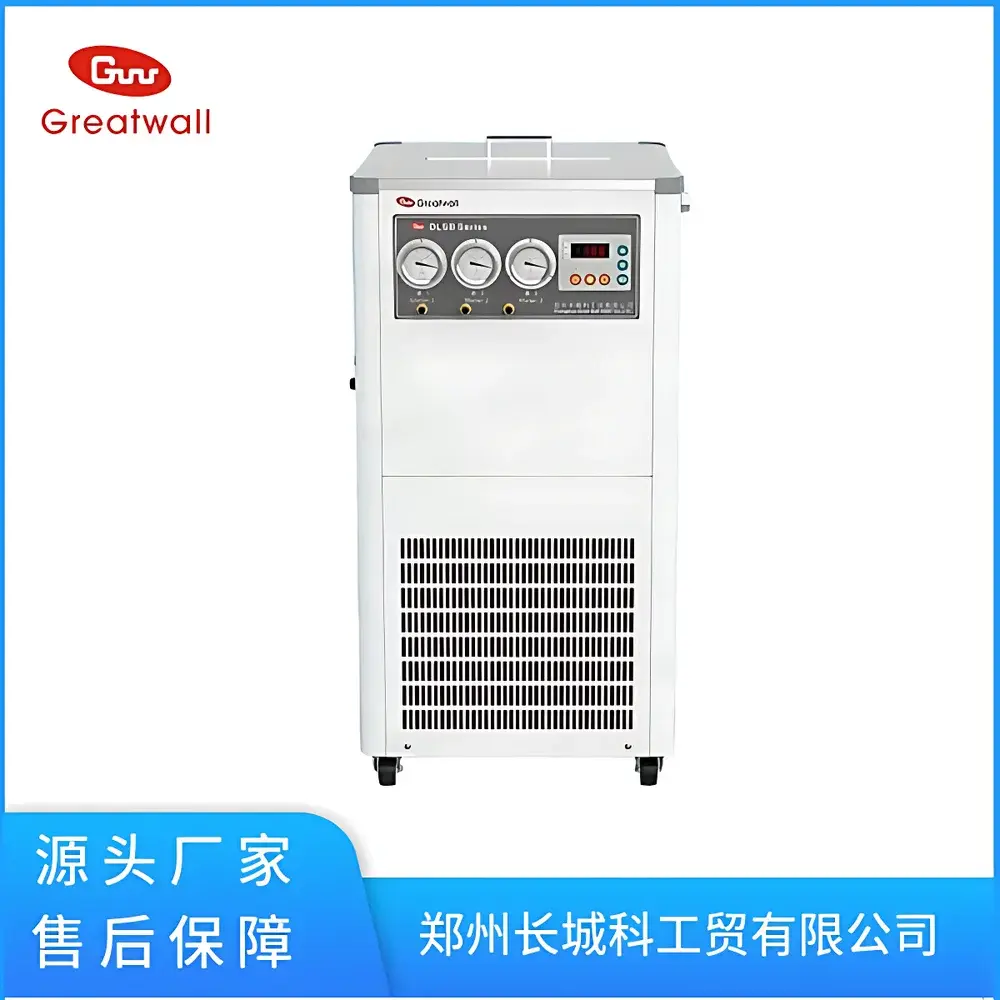
Zhengzhou Great Wall DLSB-ZC Low-Temperature Circulating Vacuum Pump
| Brand | The Great Wall |
|---|---|
| Origin | Henan, China |
| Manufacturer Type | Manufacturer |
| Country of Origin | China |
| Model | DLSB-ZC |
| Operating Temperature Range | −10 °C to 25 °C |
| Ambient Temperature Range | 5 °C to 25 °C |
| Temperature Stability | ±2 °C |
| Total Power Consumption | 1650 W |
| Voltage/Frequency | 220–240 V~, 50 Hz |
| Reservoir Capacity | 20 L |
| Refrigeration Capacity | 600–2550 W |
| Circulation Pump Power | 280 W |
| Rated Flow Rate | 30 L/min |
| Maximum Pressure | 1.0 bar |
| Ultimate Vacuum | 0.098 MPa (20 mbar) |
| Number of Vacuum Ports | 3 |
| Single-Port Pumping Speed | 10 L/min |
| Dimensions (W×D×H) | 595 × 475 × 925 mm |
| Evaporator Material | Stainless Steel (06Cr19Ni10) |
Overview
The Zhengzhou Great Wall DLSB-ZC Low-Temperature Circulating Vacuum Pump is an integrated laboratory utility device engineered for simultaneous vacuum generation and precise low-temperature fluid circulation. Unlike conventional water aspirators or standalone diaphragm vacuum pumps, the DLSB-ZC employs a closed-loop refrigerated circulation system coupled with a robust vacuum generation module—enabling coordinated operation with rotary evaporators, short-path distillation units, and cold-trap-based solvent recovery systems. Its core principle relies on dual-function thermodynamic integration: a hermetic refrigeration circuit maintains coolant temperature at ~4 °C within the reservoir, while a multi-stage vacuum pump assembly—optimized for stable operation under chilled condensing conditions—achieves ultimate vacuum levels up to 20 mbar (0.098 MPa). This architecture eliminates external chiller dependency and mitigates vapor backstreaming during high-boiling-point solvent removal, thereby improving distillation reproducibility and condensate capture efficiency in compliance with standard laboratory practices for volatile organic compound (VOC) handling.
Key Features
- Integrated refrigeration and vacuum generation in a single chassis—eliminates need for separate chillers or auxiliary cooling baths.
- Stainless steel (06Cr19Ni10) evaporator chamber ensures corrosion resistance against acidic, basic, and organic solvent vapors commonly encountered in rotary evaporation workflows.
- Triple independent vacuum ports with dedicated analog vacuum gauges (0–−0.1 MPa range), enabling real-time monitoring of pressure differentials across multiple concurrent applications.
- Thermally stabilized reservoir with ±2 °C temperature control over −10 °C to 25 °C operating range—critical for maintaining consistent vapor pressure gradients during fractional distillation.
- High-flow circulation system (30 L/min rated flow, 10 L/min per port) supports large-scale condenser jackets and extended tubing runs without significant thermal lag or pressure drop.
- Refrigeration capacity scalable from 600 W to 2550 W depending on ambient load and setpoint—adaptive performance for variable heat loads in multi-step synthesis or parallel extraction setups.
Sample Compatibility & Compliance
The DLSB-ZC is compatible with standard laboratory glassware interfaces (e.g., 10/15/19/24 standard taper joints) and designed for use with common organic solvents (e.g., acetone, ethyl acetate, dichloromethane, methanol) and aqueous solutions. Its stainless steel wetted components conform to ISO 8502-3 for surface cleanliness and resist pitting under prolonged exposure to chlorinated or nitric acid vapors. While not certified for explosive atmospheres (ATEX), the unit meets IEC 61010-1 safety requirements for laboratory electrical equipment and complies with GB/T 2893.1 (Chinese national standard equivalent to ISO 3864-1) for hazard labeling. For GLP/GMP-aligned laboratories, its analog pressure readouts support manual audit trails; digital data logging may be added via third-party RS485 or analog 4–20 mA interface modules (sold separately).
Software & Data Management
The DLSB-ZC operates as a standalone hardware platform with no embedded firmware or proprietary software. All operational parameters—including reservoir temperature, vacuum gauge readings, and power status—are displayed via front-panel analog dials and LED indicators. For integration into automated workflows, optional analog output signals (0–5 V or 4–20 mA) are available for external SCADA or LIMS systems to record time-stamped temperature and vacuum trends. No onboard data storage or FDA 21 CFR Part 11-compliant electronic signatures are provided; however, the unit’s mechanical reliability and analog transparency facilitate straightforward validation under ISO/IEC 17025 calibration protocols when paired with traceable reference instruments.
Applications
- Routine and preparative rotary evaporation under controlled sub-ambient condensation conditions.
- Short-path distillation of thermolabile natural products (e.g., essential oils, cannabinoids) requiring precise vacuum and condenser temperature coordination.
- Vacuum-assisted crystallization and solvent exchange in peptide synthesis and small-molecule pharmaceutical development.
- Cold-trap augmentation in freeze-drying pre-treatment and residual solvent removal from lyophilized intermediates.
- Multi-reactor vacuum manifold support for parallel reaction screening under uniform pressure and thermal conditions.
FAQ
Can the DLSB-ZC be used with aggressive solvents such as concentrated HCl or HF?
No—while the stainless steel evaporator resists mild acids and organics, hydrofluoric acid and hot concentrated mineral acids will compromise material integrity and void warranty.
Is remote monitoring or Ethernet connectivity supported natively?
No—the unit lacks built-in digital communication interfaces; external analog-to-digital converters or PLC gateways are required for networked data acquisition.
What maintenance intervals are recommended for long-term vacuum stability?
Vacuum pump oil replacement every 500 hours of cumulative operation; refrigerant charge verification annually by certified HVAC-R technician; reservoir descaling every 6 months if using hard tap water.
Does the unit meet UL or CE safety certification standards?
It carries CCC (China Compulsory Certification) and conforms to GB 4706.1 and GB 4706.19, but does not hold UL 61010-1 or CE marking for export to North America or the EU without additional regional conformity assessment.
Can the three vacuum ports operate at different pressures simultaneously?
Yes—each port functions independently; differential pressure across ports is governed solely by individual load impedance and tubing configuration, not internal valving.



