
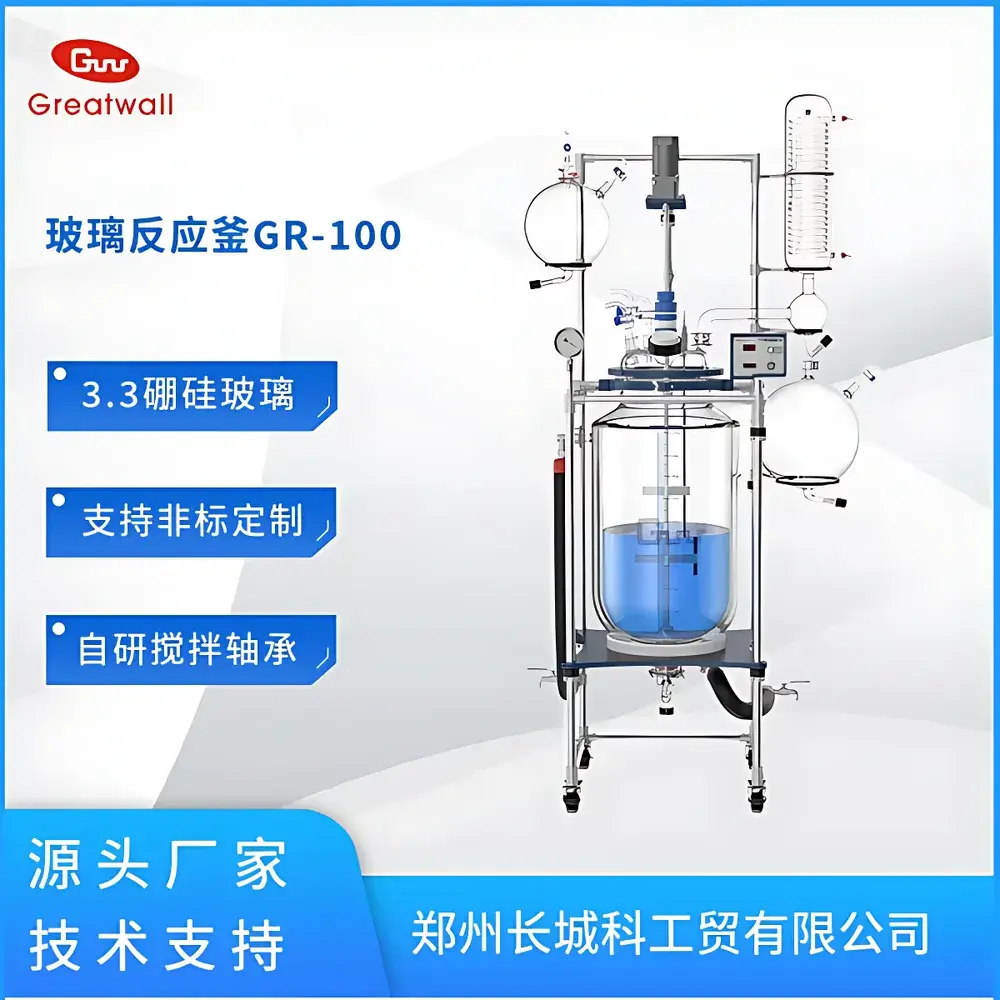
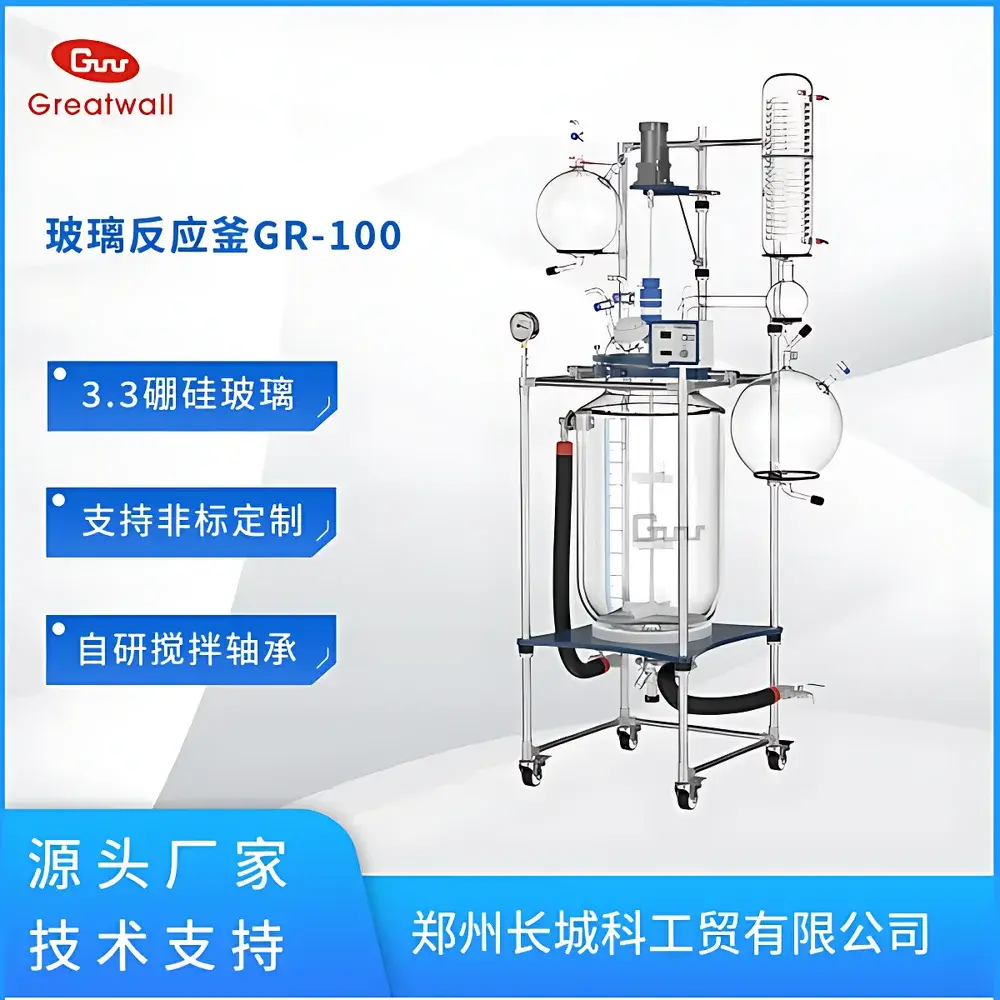
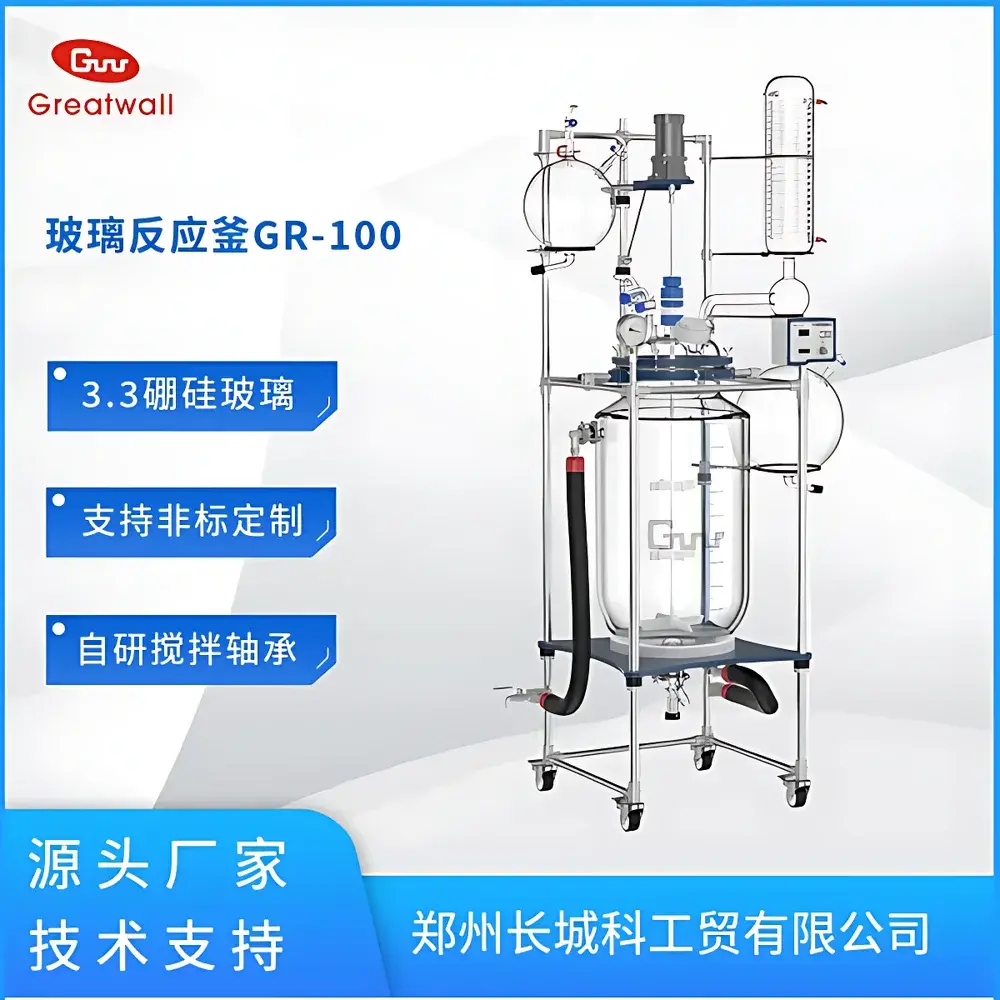
The Great Wall GR-100 Dual-Jacketed Glass Reactor
| Brand | The Great Wall |
|---|---|
| Origin | Henan, China |
| Manufacturer Type | Direct Manufacturer |
| Origin Category | Domestic |
| Model | GR-100 |
| Instrument Classification | Jacketed Reactor |
| Usable Volume | Large-Scale |
| Construction Material | Borosilicate Glass 3.3 |
| Operating Pressure | Low Pressure (Vacuum to Atmospheric) |
| Capacity | 100 L |
| Jacket Volume | 25 L |
| Temperature Range | −80 °C to +200 °C |
| Jacket Pressure Rating | ≤ 0.03 MPa |
| Thermal Shock Resistance | 80 °C |
| Stirring Speed Range | 50–500 rpm |
| Speed Accuracy | ±1 rpm |
| Motor Power | 250 W |
| Drive Type | Three-Phase AC Motor with Frequency Converter Control |
| Sealing System | Vacuum-Compatible Mechanical Seal with PTFE Components |
| Stirrer Configuration | Triple Impeller — Four-Blade Angled Turbine + Two Sets of Four-Blade Flat Turbine |
| Stirrer Shaft Material | 06Cr19Ni10 (AISI 304) with PTFE Cladding |
| Impeller Material | PTFE-Coated 06Cr19Ni10 |
| Temperature Sensor | PT100, Digital Display, ±0.1 °C Accuracy |
| Main Flange Diameter | 285 mm |
| Top Port Outer Diameter | 338 mm |
| Bottom Drain Valve ID | φ21 mm |
| Discharge Nozzle OD | φ33 mm |
| Condenser Heat Transfer Area | 0.954 m² |
| Condenser Port Standard | 40/38 |
| Constant-Pressure Dropping Funnel Capacity | 10,000 mL (φ12.5 mm Port) |
| Receiver Flask Capacity | 20,000 mL |
| Frame Material | 06Cr19Ni10 Stainless Steel + Powder-Coated Aluminum Alloy |
| Overall Dimensions (W×D×H) | ~1160 × 780 × 2400 mm |
| Net Weight | ~119 kg |
Overview
The Great Wall GR-100 Dual-Jacketed Glass Reactor is an engineered laboratory-scale chemical synthesis platform designed for controlled exothermic and endothermic reactions under vacuum or inert atmosphere conditions. Its core architecture employs a double-walled borosilicate glass 3.3 vessel—internally resistant to thermal shock up to 80 °C and chemically inert across pH 1–14—enabling safe operation from −80 °C (with cryogenic coolant circulation) to +200 °C (with high-temp silicone oil). The reactor operates at low-pressure regimes (−0.1 MPa to ambient), making it suitable for distillation, reflux, hydrogenation, polymerization, and crystallization workflows where visual process monitoring, contamination-free containment, and precise thermal management are critical. Unlike single-jacketed systems, the GR-100’s integrated jacket supports uniform heat transfer across the entire reaction volume, minimizing axial temperature gradients and improving reproducibility in scale-up studies.
Key Features
- Borosilicate glass 3.3 construction throughout all wetted parts—including reactor body, lid, condenser, and feed vessels—ensures optical clarity, hydrolytic stability, and resistance to organic solvents, strong acids, and alkalis.
- Vacuum-rated mechanical seal with PTFE dynamic components and precision-ground ceramic stationary faces delivers leak-tight performance down to 10⁻² mbar, supporting solvent removal and moisture-sensitive chemistry.
- Triple-stage impeller system (angled turbine + dual flat turbines) optimizes radial and axial flow patterns for homogeneous mixing in high-viscosity or heterogeneous slurries up to 100 L working volume.
- Stainless steel (06Cr19Ni10) frame with powder-coated aluminum alloy structural elements provides corrosion resistance, static rigidity, and ergonomic serviceability; lockable casters enable stable positioning on lab floors without anchoring.
- Integrated digital control panel features independent displays for stirrer speed (50–500 rpm, ±1 rpm resolution) and bath temperature (PT100 sensor, ±0.1 °C accuracy), both calibrated traceably to NIST standards.
- Jacket inlet/outlet ports fitted with stainless steel insulated flexible hoses eliminate thermal stress at glass-metal interfaces, extending service life and reducing microfracture risk during rapid temperature transitions.
Sample Compatibility & Compliance
The GR-100 accommodates diverse sample types including aqueous solutions, organometallic complexes, viscous polymer precursors, and suspended catalysts. Its 7-port top flange (including 60#, S51, 35#, 40/38, 34/35×2, and 95# standardized joints) permits simultaneous integration of temperature probes, pH electrodes, gas inlets, sampling valves, and reflux condensers—fully compliant with ISO 8573-1 (compressed air purity) and ASTM E2654 (laboratory equipment qualification guidance). All electrical components meet IEC 61010-1 safety requirements for laboratory equipment. While not certified for explosion-proof environments, the reactor is routinely deployed in GMP-aligned pilot labs conducting API intermediate synthesis, adhering to USP Analytical Instrument Qualification protocols and supporting 21 CFR Part 11-compliant data integrity when paired with validated third-party SCADA software.
Software & Data Management
The GR-100 operates as a standalone analog-digital hybrid instrument. Stirring speed and temperature setpoints are manually configured via front-panel controls, with real-time values displayed on dual-digit LED readouts. For automated process recording, optional RS-485/Modbus RTU interface enables integration with LabVIEW, MATLAB, or DeltaV DCS platforms. When connected to compliant data acquisition systems, the reactor supports electronic audit trails, user access logging, and raw parameter export in CSV format—facilitating alignment with GLP documentation requirements and internal SOPs governing reaction reproducibility validation.
Applications
- Batch synthesis of fine chemicals and pharmaceutical intermediates under controlled thermal and atmospheric conditions.
- Multi-step catalytic hydrogenation with real-time visual monitoring of catalyst dispersion and gas evolution.
- Solvent recovery and concentration via vacuum-assisted rotary evaporation integration.
- Emulsion polymerization requiring precise shear control and jacket-mediated cooling to manage exotherms.
- Crystallization screening across defined supersaturation profiles using programmable cooling ramps.
- Educational demonstrations of reaction kinetics, mass transfer limitations, and phase separation phenomena in undergraduate and graduate chemistry laboratories.
FAQ
What is the maximum allowable jacket pressure?
The jacket is rated for continuous operation at ≤ 0.03 MPa (3 bar gauge); exceeding this may compromise glass integrity or seal longevity.
Can the GR-100 be used for pressurized reactions?
No—it is engineered exclusively for vacuum-to-atmospheric pressure operation. Pressurized synthesis requires autoclave-rated metal reactors.
Is the PTFE-coated stirrer shaft compatible with HF or fluorinated solvents?
While PTFE offers broad chemical resistance, prolonged exposure to anhydrous hydrogen fluoride or elemental fluorine is not recommended; consult compatibility charts per ASTM D471.
How is temperature calibration verified?
Each unit ships with a factory calibration certificate referencing PT100 probe output against a NIST-traceable dry-block calibrator at three points (0 °C, 100 °C, 200 °C).
Does the reactor support CIP/SIP protocols?
It is not designed for Clean-in-Place or Steam-in-Place cycles; manual disassembly and solvent rinsing are required between batches per ISO 22000 hygiene guidelines.



