
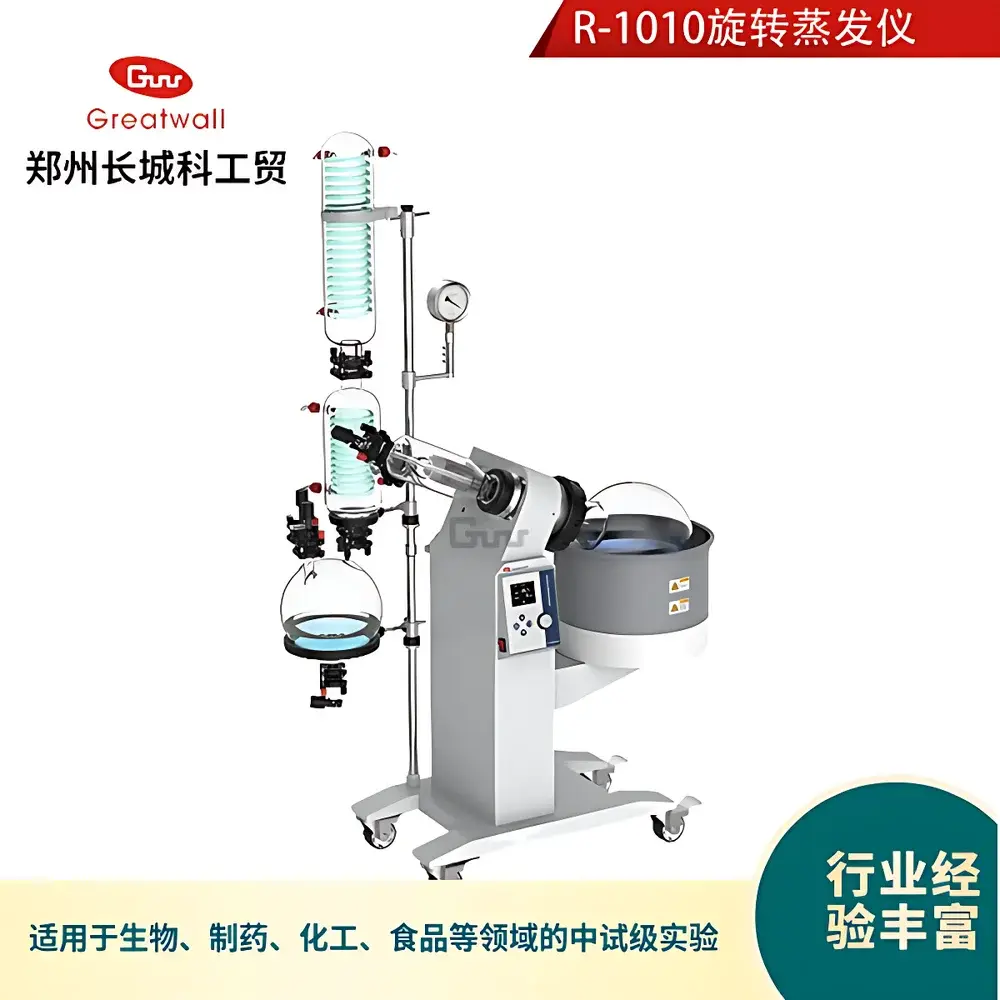
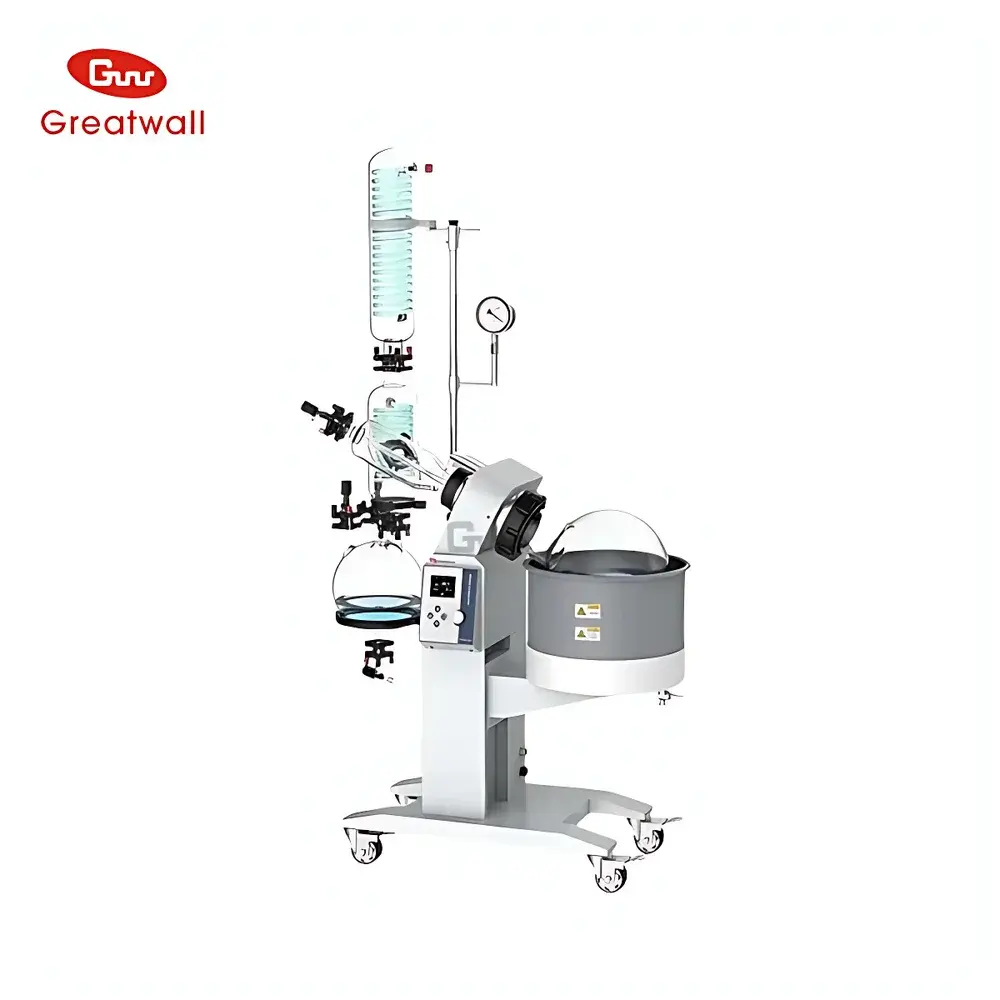
Great Wall R-1010 Large-Scale Rotary Evaporator
| Brand | Great Wall |
|---|---|
| Origin | Henan, China |
| Manufacturer Type | Direct Manufacturer |
| Origin Category | Domestic (China) |
| Model | R-1010 |
| Capacity | 10 L |
| Rotation Speed | 20–130 rpm |
| Bath Temperature Range | Ambient +5 °C to 95 °C |
| Temperature Control Accuracy | ±1.5 °C |
| Sealing Leakage Rate | ≤0.03 kPa/min |
| Evaporation Rate (Water) | 3.2 L/h |
| Condensing Area | Main Condenser ≈ 0.39 m² |
| Rotating Flask | 10,000 mL, φ125 mm ISO-KF flange |
| Collection Flask | 5,000 mL, φ50 mm ISO-KF flange |
| Bath Material | 06Cr19Ni10 Stainless Steel (Φ370 × 220 mm) |
| Glass Material | DIN 3.3 Borosilicate Glass |
| PTFE Valve | Yes |
| Quick-Release Flange Connection | Yes |
| Heating Power | 3500 W |
| Motor Power | 250 W |
| Total Power | 3800 W |
| Protection Class | IP20 |
| Pollution Degree | 2 |
| Ambient Operating Conditions | 5–35 °C, ≤70% RH, ≤2000 m altitude |
Overview
The Great Wall R-1010 Large-Scale Rotary Evaporator is an engineered solution for pilot-scale solvent removal, concentration, and gentle distillation in research and development laboratories across pharmaceutical, biotechnology, fine chemical, and food science applications. Based on the fundamental principle of reduced-pressure evaporation—where lowering system pressure decreases the boiling point of solvents—the R-1010 integrates precise rotational dynamics, controlled thermal input, and high-integrity vacuum sealing to enable reproducible, scalable processing of heat-sensitive compounds. Its 10 L rotating flask capacity supports batch volumes typical of mid-scale process development, bridging the gap between benchtop optimization and early-stage manufacturing. Designed for integration with external vacuum pumps and recirculating chillers, the system operates as a modular component within a validated purification workflow compliant with GLP-aligned laboratory practices.
Key Features
- High-Integrity Vacuum System: Achieves ≤0.03 kPa/min leakage rate without vacuum grease—enabled by precision-machined PTFE-sealed joints and optimized glass-to-metal interface geometry—ensuring stable vacuum conditions critical for low-boiling-point or thermolabile solvents.
- Automated Dual-Flask Collection: Integrated auto-switching valve allows continuous distillation during collection bottle changeover, minimizing process interruption and operator exposure—particularly valuable during extended overnight runs or multi-solvent fractionation protocols.
- Robust Thermal Management: 3500 W stainless steel (06Cr19Ni10) heating bath with PT-100 (3-wire) sensor feedback delivers ±1.5 °C temperature stability across the full 5–95 °C operational range, supporting both water-bath and oil-bath configurations.
- Ergonomic & Safe Design: Quick-connect ISO-KF flanges (φ125 mm for rotary flask, φ50 mm for collector) reduce assembly time and misalignment risk; optional rubber-insulated bath cover mitigates surface contact hazards; all glass components fabricated from DIN 3.3 borosilicate glass (e.g., Schott Duran® equivalent) for thermal shock resistance and chemical inertness.
- Precision Motion Control: Brushless DC motor enables stepless speed regulation from 20–130 rpm with digital LCD feedback—optimized for viscous samples and large-volume films while maintaining consistent centrifugal force distribution.
Sample Compatibility & Compliance
The R-1010 accommodates a broad spectrum of sample matrices—including aqueous buffers, organic solvent mixtures (e.g., ethyl acetate, dichloromethane, ethanol), polymer solutions, and crude natural product extracts—without compromising seal integrity or thermal uniformity. All wetted surfaces consist exclusively of chemically resistant materials: 3.3 borosilicate glass, PTFE, and 06Cr19Ni10 stainless steel—fully compatible with cleaning validation per ISO 14644-1 cleanroom standards and routine autoclaving of detachable components. While not certified to IEC 61010-1 Annex BB for hazardous area use, the unit meets IP20 ingress protection and Pollution Degree 2 requirements for indoor laboratory environments per IEC 60664-1. Its design facilitates alignment with FDA 21 CFR Part 11 data integrity expectations when paired with compliant third-party logging software.
Software & Data Management
The R-1010 operates via standalone embedded controls with dual LCD displays for real-time monitoring of rotation speed and bath temperature. Though it does not include onboard data logging or Ethernet connectivity, its analog outputs (0–10 V or 4–20 mA) support integration into centralized Lab Information Management Systems (LIMS) or SCADA platforms for audit-trail-capable parameter recording. Users may configure external programmable logic controllers (PLCs) or PC-based acquisition systems to log timestamps, setpoints, and measured values—enabling traceability required under GLP and GMP Annex 11 frameworks. Firmware updates are performed manually via USB interface, ensuring version control and revision history documentation.
Applications
- Concentration of dilute bioactive fractions (e.g., peptide eluates, fermentation broths) prior to HPLC or lyophilization.
- Removal of residual solvents from API intermediates under ICH Q3C-compliant conditions.
- Essential oil recovery from botanical extracts using low-temperature vacuum distillation.
- Preparative-scale solvent exchange in nanoparticle synthesis (e.g., transferring from THF to aqueous dispersion media).
- Stability-indicating method development for forced degradation studies requiring controlled thermal stress profiles.
FAQ
What vacuum level can the R-1010 sustain during continuous operation?
When paired with a suitable two-stage vacuum pump (≤4 mbar ultimate pressure) and properly maintained seals, the system maintains ≤10 mbar operating pressure over extended periods—verified by integrated pressure decay testing per ASTM E493.
Is the heating bath compatible with silicone oil or other high-temperature media?
Yes—the 06Cr19Ni10 stainless steel bath and PT-100 sensor are rated for use with silicone oils up to 180 °C; however, the standard control firmware limits setpoint input to 95 °C to preserve glass joint integrity and comply with EN 61000-6-3 EMC emission thresholds.
Can the R-1010 be validated for regulated pharmaceutical use?
The hardware platform supports IQ/OQ protocol execution (e.g., temperature uniformity mapping, rotation speed linearity verification); however, formal PQ requires user-defined acceptance criteria aligned with internal SOPs and relevant USP <1225> validation principles.
What maintenance intervals are recommended for long-term reliability?
PTFE valve lubrication and O-ring inspection every 500 operating hours; bath fluid replacement every 6 months or after 1000 h of cumulative heating; annual calibration of PT-100 sensor against NIST-traceable reference.



