
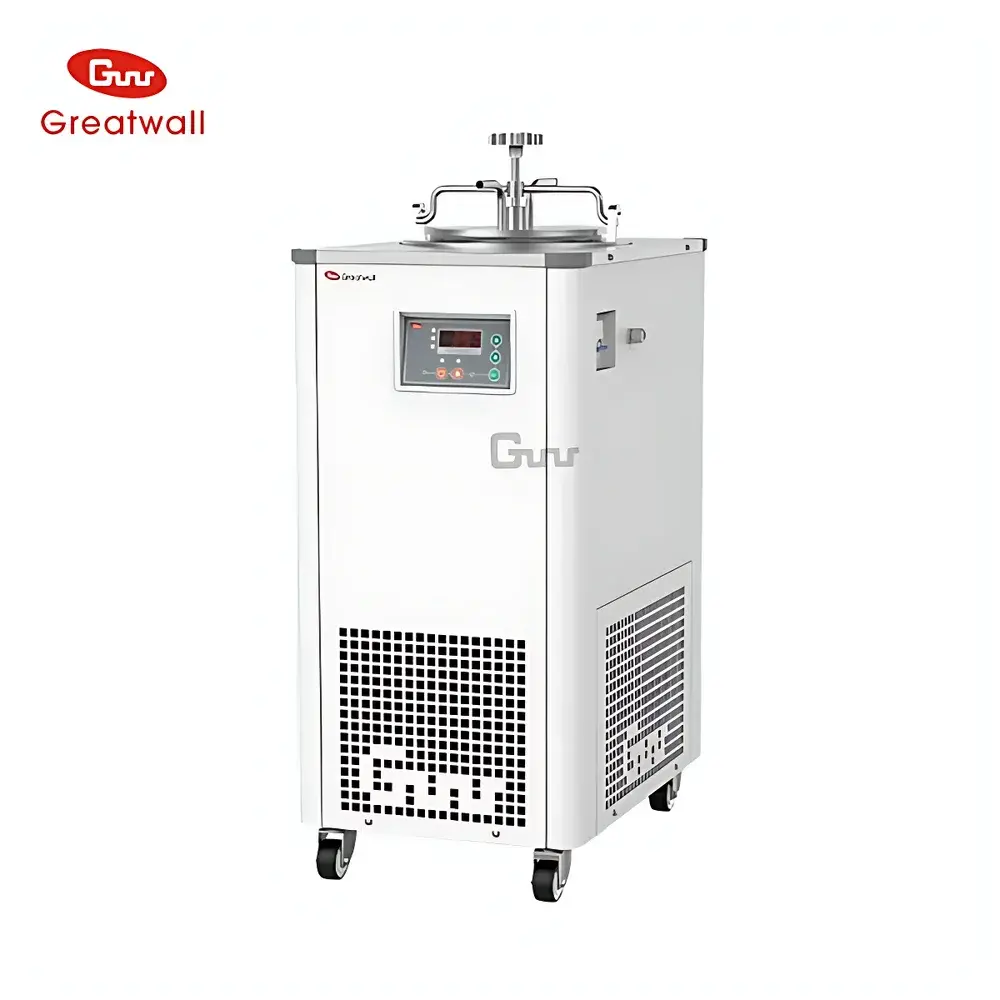
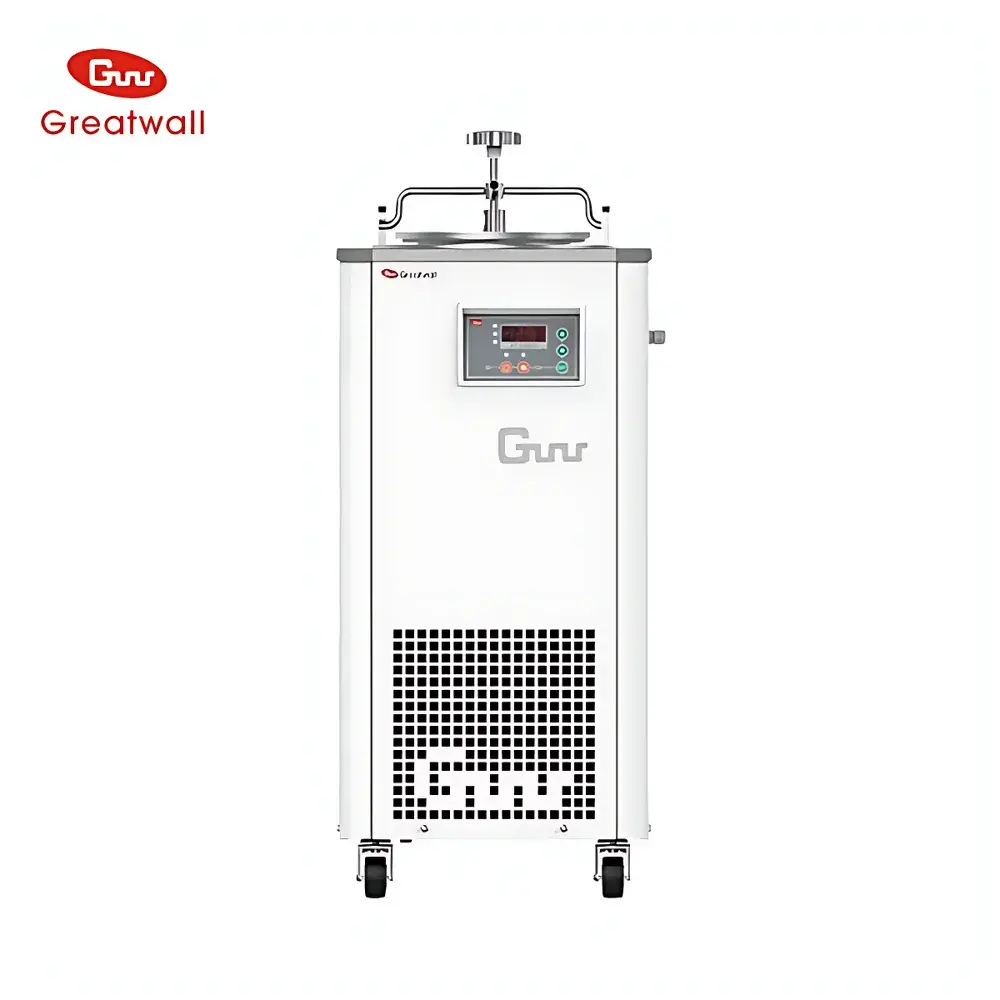
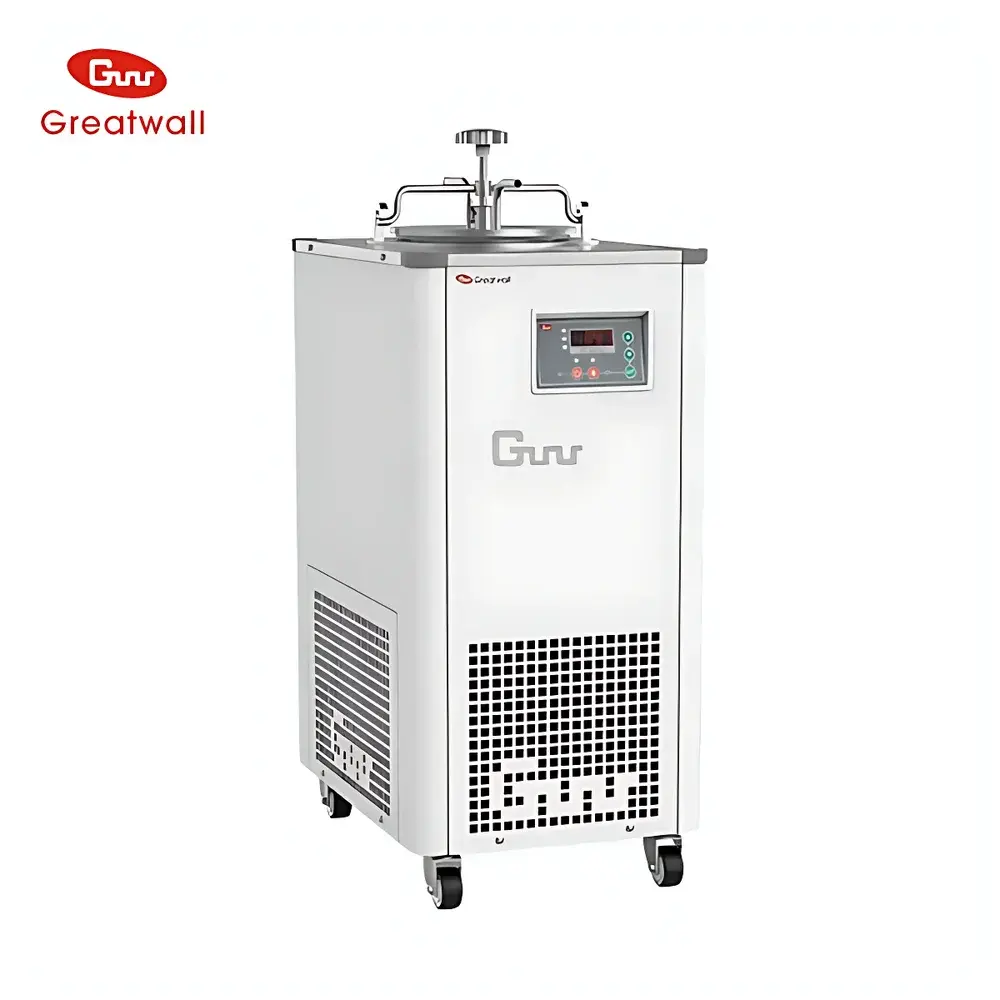
The Great Wall VT-2000H Cryogenic Vapor Trap
| Brand | The Great Wall |
|---|---|
| Origin | Henan, China |
| Manufacturer Type | Direct Manufacturer |
| Model | VT-2000H |
| Cooling Capacity | 640 W at −10°C, 400 W at −20°C, 200 W at −30°C, 20 W at −40°C |
| Ultimate Temperature (No Load) | −40°C |
| Cooling Method | Direct refrigeration |
| Temperature Display | Digital, Pt100 sensor |
| Temperature Setting Range | Adjustable within operational range |
| Safety Protections | Delay start, overcurrent, overtemperature |
| Moisture Capture Capacity | Max. 1 kg (water-based systems) |
| Refrigerant | R404A |
| Trap Chamber Dimensions | Ø160 × 240 mm |
| Chamber Material | 06Cr19Ni10 (AISI 304 stainless steel) |
| Vacuum Interface | Flexible hose connector, OD Ø12 mm |
| Ambient Operating Conditions | 5–35°C, ≤70% RH |
| Power Supply | 220–240 V~, 50 Hz |
| Total Power Consumption | 819 W |
| Input Current | 3.7 A |
| Unit Dimensions (W×D×H) | 360 × 590 × 889 mm |
| Net Weight | 60 kg |
Overview
The Great Wall VT-2000H Cryogenic Vapor Trap is a purpose-engineered condensation unit designed to intercept and immobilize water vapor and volatile organic compounds (VOCs) generated during vacuum drying, lyophilization, rotary evaporation, and low-pressure thermal processing. Operating on the principle of cryogenic condensation—where vapors are thermodynamically driven to phase-change upon contact with a sub-zero surface—the VT-2000H functions as an in-line cold trap positioned between the process chamber and the primary vacuum pump. Its −40°C ultimate no-load temperature ensures efficient capture of water, ethanol, acetone, ethyl acetate, and other common solvents with dew points above −40°C. By removing condensable vapors upstream of the pump, the device significantly reduces backstreaming contamination, extends pump oil service life, lowers maintenance frequency, and supports compliance with environmental emission limits under ISO 14001-aligned laboratory practices.
Key Features
- Direct-contact cooling architecture with high-efficiency hermetic compressor and R404A refrigerant circuit, optimized for stable thermal performance across −10°C to −40°C operating range
- Dual-mode condensation configuration: stainless steel trap chamber (AISI 304 / 06Cr19Ni10) for aqueous and ethanol-based applications; optional borosilicate glass cold finger assembly compatible with acidic and aggressive organic media
- Integrated digital temperature monitoring system with Pt100 RTD sensor, offering ±0.5°C accuracy and real-time display for precise process synchronization
- Intelligent safety subsystem including compressor delay protection, thermal cutoff at ≥85°C, and electronic overcurrent detection—designed for unattended operation in GLP-compliant environments
- Modular vacuum interface with standardized Ø12 mm flexible hose connection, enabling rapid integration into existing vacuum manifolds without custom adapters
- Structural design compliant with IEC 61000-6-3 (EMC emissions) and IEC 61010-1 (electrical safety for laboratory equipment)
Sample Compatibility & Compliance
The VT-2000H accommodates diverse sample chemistries through material-selective trapping pathways. The 304 stainless steel chamber resists corrosion from neutral and mildly alkaline aqueous solutions, buffer systems, and polar protic solvents such as methanol and ethanol—making it suitable for pharmaceutical lyophilization pre-chamber conditioning and battery electrode drying per GB/T 36276–2018. For hydrochloric acid, nitric acid, or chlorinated solvent applications, the optional glass cold trap assembly provides inert surface exposure and visual condensate observation. All configurations meet mechanical integrity requirements outlined in ASTM F2697–22 (Standard Practice for Cold Trap Performance Verification) and support traceability documentation required under FDA 21 CFR Part 11 when paired with validated data logging software.
Software & Data Management
While the VT-2000H operates as a standalone hardware unit, its digital temperature output (0–5 V analog or RS485 Modbus RTU signal, optional upgrade) enables integration into centralized lab control networks. When connected to SCADA or LIMS platforms, temperature logs can be time-stamped, archived, and cross-referenced with vacuum gauge readings and process timers—fulfilling ALCOA+ data integrity criteria. Audit trails, user access levels, and electronic signature capability are implemented at the supervisory system layer, ensuring adherence to GMP Annex 11 and EU GDP guidelines for critical drying operations.
Applications
- Vacuum drying of hygroscopic APIs and excipients in pharmaceutical R&D and pilot-scale manufacturing
- Moisture removal from lithium-ion battery cathode/anode foils prior to cell assembly (aligned with UN 38.3 thermal preconditioning protocols)
- Condensate management in freeze-dryer secondary drying cycles to prevent ice re-deposition on product shelves
- Protection of turbomolecular pumps during solvent removal in thin-film deposition and CVD precursor purging
- Pre-concentration of volatile analytes in environmental air sampling workflows prior to GC-MS analysis
FAQ
Can the VT-2000H be used continuously for 24/7 operation?
Yes—the unit is rated for continuous duty under ambient conditions ≤35°C and ≤70% RH, provided adequate ventilation clearance (≥100 mm on all sides) and periodic condensate removal intervals are observed.
Is the stainless steel chamber suitable for acetic acid vapor capture?
It is conditionally suitable for dilute (<10% v/v) acetic acid at temperatures ≥−20°C; for concentrated or elevated-temperature exposures, the glass cold trap configuration is strongly recommended.
Does the device include vacuum leak detection functionality?
No—leak detection requires external instrumentation (e.g., helium mass spectrometer or pressure-rise test); however, the VT-2000H’s stable base temperature serves as an indirect indicator of system integrity during pump-down sequences.
What maintenance is required beyond defrosting?
Annual verification of refrigerant charge, calibration of Pt100 sensor against NIST-traceable reference, and inspection of hose coupling O-rings constitute the preventive maintenance protocol per manufacturer guidelines.
Can the unit be integrated into a PLC-controlled drying system?
Yes—via optional RS485 Modbus RTU interface, enabling remote setpoint adjustment, status polling, and alarm event reporting within industrial automation architectures.



