
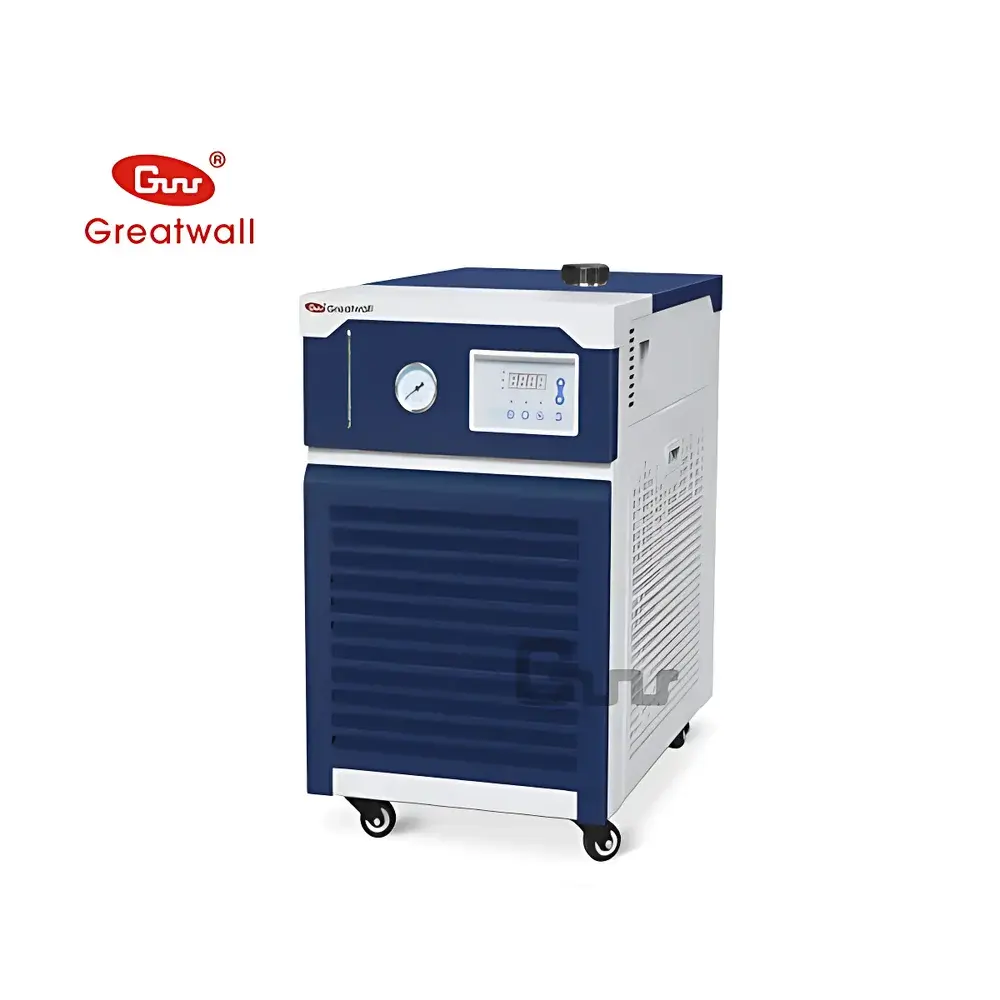
The Great Wall DL10-2000G Circulating Chiller
| Brand | The Great Wall |
|---|---|
| Origin | Henan, China |
| Manufacturer Type | Direct Manufacturer |
| Product Category | Domestic |
| Model | DL10-2000G |
| Instrument Type | Integrated Unit |
| Cooling Method | Air-Cooled |
| Temperature Control Range | −10 °C to 25 °C |
| Refrigeration Capacity | 2000 W @ 15 °C |
| Temperature Stability | ±2 °C |
| Circulation Pump Pressure | 1–10 bar |
| Circulation Flow Rate | 7 L/min |
| Reservoir Volume | 17 L |
| Operation Mode | Continuous |
Overview
The Great Wall DL10-2000G Circulating Chiller is an integrated, air-cooled temperature control system engineered for stable, continuous delivery of chilled heat-transfer fluid to external laboratory instruments and processes. It operates on a closed-loop refrigeration cycle using R404A or R507 refrigerant (subject to regional regulatory compliance), with a hermetic scroll or reciprocating compressor, copper-aluminum finned condenser, and precision expansion valve. Designed for ambient installation without external water infrastructure, the unit maintains setpoint temperatures within ±2 °C across its operational range of −10 °C to 25 °C—making it suitable for applications requiring sub-ambient thermal management but not deep cryogenics. Its 17-liter reservoir ensures sufficient thermal mass to buffer transient load fluctuations, while the 7 L/min flow rate at adjustable pressure (1–10 bar) supports both low-resistance bypass loops and high-backpressure systems such as vacuum deposition chambers or high-pressure reactor jackets.
Key Features
- Integrated air-cooled architecture eliminates dependency on facility cooling water, reducing installation complexity and permitting placement in standard laboratory environments.
- Hermetically sealed circulation system minimizes evaporation loss and prevents moisture ingress into the heat-transfer fluid—critical for maintaining long-term fluid integrity when using water-glycol mixtures or synthetic oils.
- Comprehensive safety protection suite includes high-pressure cut-off, compressor thermal overload protection, delayed restart logic (≥3 minutes after power interruption), overcurrent detection, and ground-fault monitoring per IEC 61000-6-3 EMC standards.
- Real-time liquid level sensing with visual LED indicator enables proactive maintenance and prevents dry-run damage to the circulation pump.
- Digitally adjustable pump pressure output allows fine-tuning of system backpressure to match diverse instrument interface requirements—from low-head spectrometers to high-resistance thin-film coating equipment.
- Front-panel digital display with intuitive menu navigation provides immediate access to setpoint, actual bath temperature, pump status, and active alarm codes.
Sample Compatibility & Compliance
The DL10-2000G is compatible with aqueous glycol solutions (e.g., 20–30% propylene glycol), silicone oils, and other non-corrosive, low-volatility heat-transfer fluids meeting ASTM D1384 corrosion inhibition specifications. Its stainless steel reservoir interior and EPDM/NBR-sealed wetted components ensure compatibility with common lab coolants. The unit conforms to GB/T 20218–2021 (Chinese national standard for industrial chillers), CE marking requirements under the Low Voltage Directive (2014/35/EU) and Electromagnetic Compatibility Directive (2014/30/EU), and carries IP20 enclosure rating for indoor laboratory use. While not certified to UL 61010-1, it incorporates design elements aligned with risk-based safety principles outlined in that standard for Class I, Pollution Degree 2 environments.
Software & Data Management
The DL10-2000G features RS485 Modbus RTU communication capability (optional RS232 or Ethernet module available), enabling integration into centralized laboratory monitoring systems. When paired with third-party SCADA or LIMS platforms, users can log temperature setpoints, actual bath readings, pump runtime, and fault events with timestamping. Audit trail functionality supports GLP-compliant workflows where traceability of thermal process parameters is required—though native data storage is limited to real-time display only. No embedded FDA 21 CFR Part 11-compliant electronic signature or user-access-level controls are included; such capabilities require external middleware implementation.
Applications
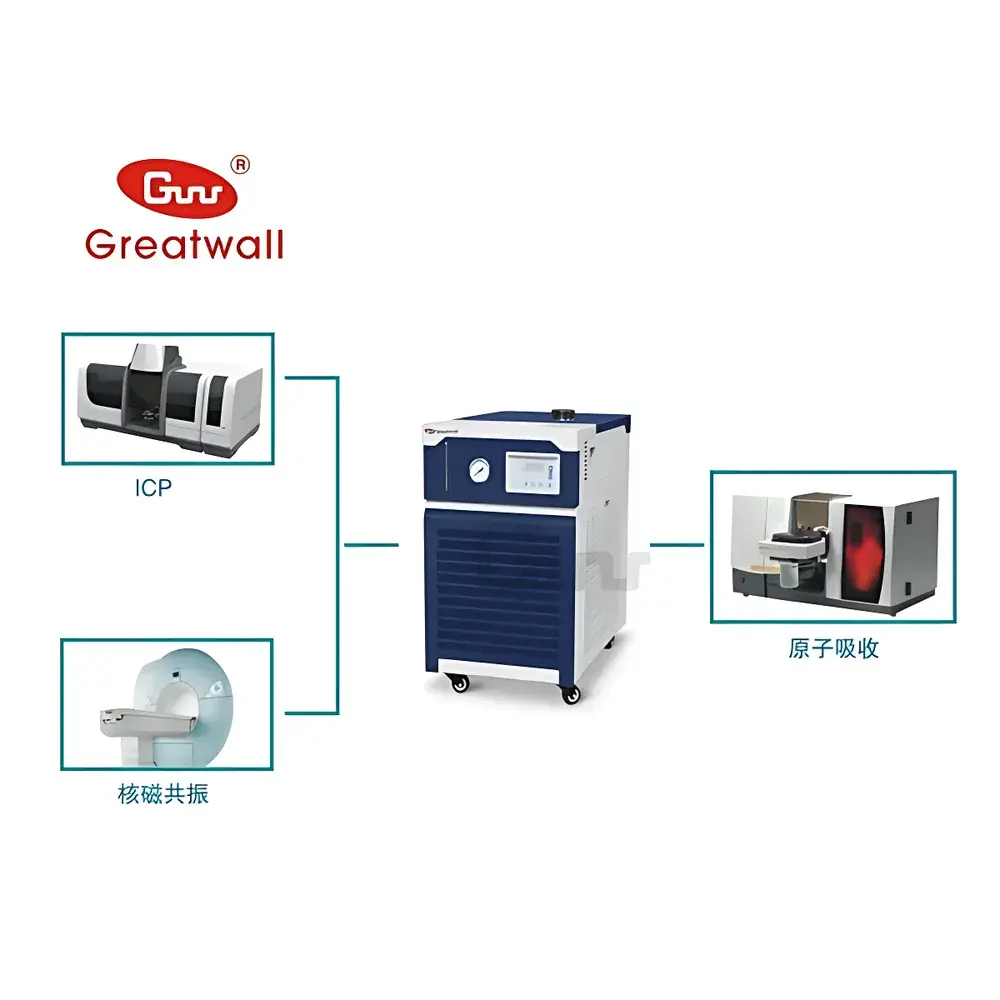
This chiller serves as a primary cold source for analytical instrumentation demanding precise thermal regulation, including atomic absorption spectrometers (AAS), inductively coupled plasma optical emission spectrometers (ICP-OES) and mass spectrometers (ICP-MS), where detector and nebulizer cooling directly impact signal stability and detection limits. It also supports NMR magnet cooling circuits (for non-superconducting auxiliary systems), biological fermentation control loops, electron microscopy specimen stages, physical property measurement rigs (e.g., rheometers, DSC autosamplers), and vacuum sputtering or evaporation deposition systems requiring consistent target cooling. Its −10 °C minimum setpoint accommodates exothermic reaction quenching protocols in synthetic chemistry and enzymatic assay stabilization.
FAQ
What heat-transfer fluids are recommended for use with the DL10-2000G?
Propylene glycol/water mixtures (20–30% v/v) are preferred for freeze protection down to −15 °C; deionized water may be used above 5 °C ambient if microbial growth is controlled.
Can the unit operate continuously for 24/7 laboratory shifts?
Yes—designed for uninterrupted duty cycle under rated load conditions, provided ambient temperature remains ≤35 °C and ventilation clearances (≥15 cm rear/side) are maintained.
Is remote monitoring supported out-of-the-box?
Standard configuration includes Modbus RTU via RS485; optional communication modules enable Ethernet or analog 4–20 mA output for PLC integration.
Does the chiller meet ISO/IEC 17025 calibration traceability requirements?
The unit itself is not a measuring instrument; however, its temperature sensor (PT100 class B) can be externally calibrated per ISO/IEC 17025 by an accredited lab using NIST-traceable references.
What maintenance intervals are recommended?
Condenser coil cleaning every 3 months in dusty environments; annual inspection of refrigerant charge, electrical connections, and pump seal integrity per manufacturer’s service manual.



