
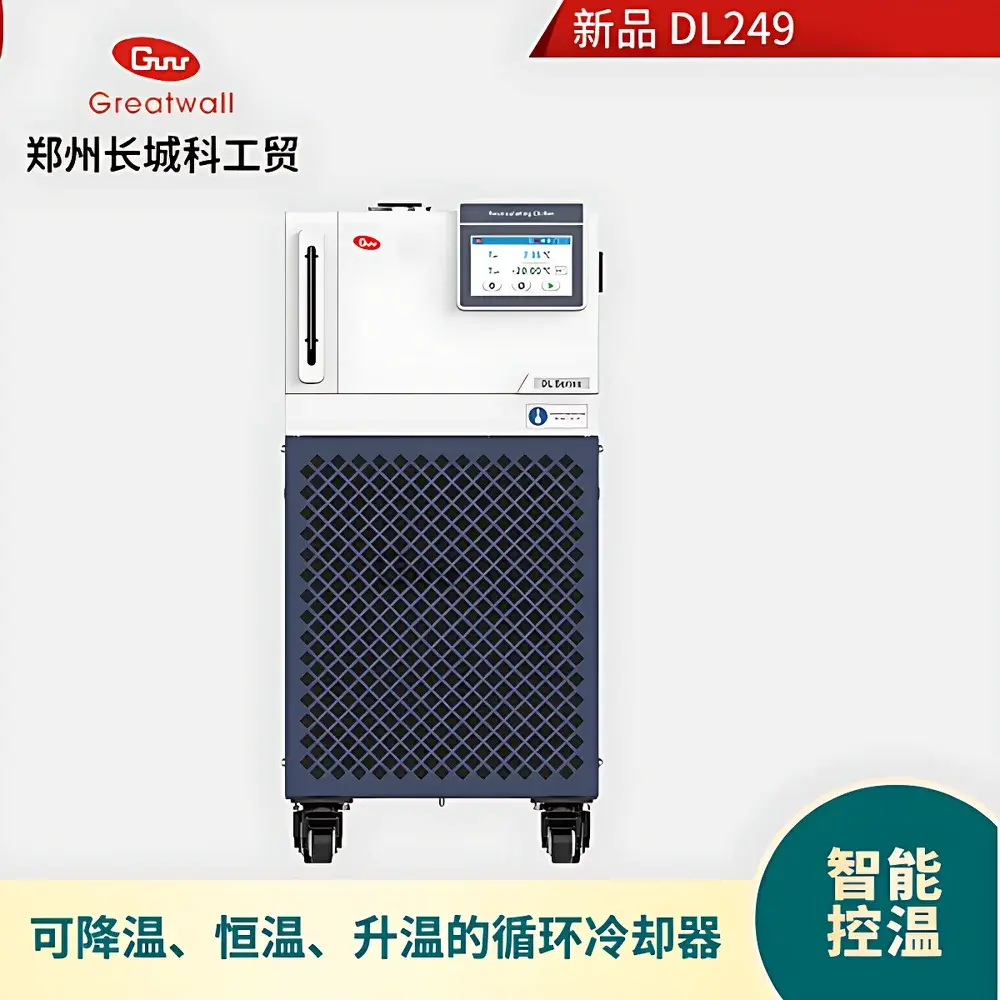
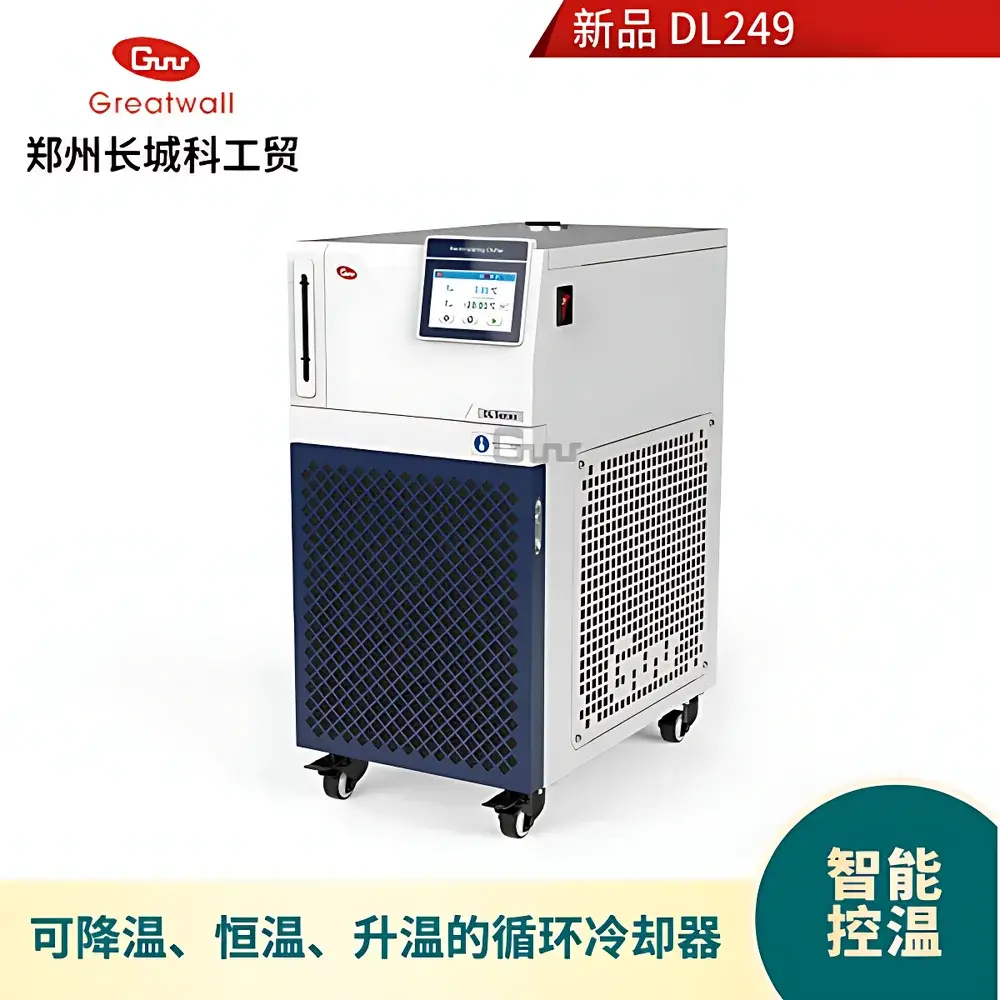
The Great Wall DL249 Circulating Chiller
| Brand | The Great Wall |
|---|---|
| Origin | Henan, China |
| Manufacturer Type | Direct Manufacturer |
| Region of Origin | Domestic (China) |
| Model | DL249 Circulating Chiller |
| Instrument Type | Integrated Unit |
| Cooling Method | Air-Cooled |
| Temperature Range | −20 °C to +40 °C |
| Refrigeration Capacity | 900 W |
| Temperature Stability | ±0.5 °C |
| Reservoir Volume | 9 L |
Overview
The Great Wall DL249 Circulating Chiller is an integrated, air-cooled refrigeration system engineered for precise thermal management in laboratory applications—particularly as a dedicated coolant source for rotary evaporators, reflux condensers, and other heat-exchange-intensive instruments. It operates on a closed-loop vapor-compression refrigeration cycle, utilizing a hermetically sealed reciprocating compressor, microchannel condenser, and a dual-stage throttling system comprising both an electronic expansion valve (EEV) and capillary tube. This architecture ensures stable temperature delivery across its full operating range of −20 °C to +40 °C, with high reproducibility and minimal thermal drift. Unlike passive cooling or tap-water-dependent systems, the DL249 eliminates dependency on municipal water supply, reduces lab water consumption, and prevents scaling or contamination risks associated with open-loop cooling. Its compact footprint and all-in-one design make it suitable for benchtop integration in QC labs, R&D facilities, and pilot-scale synthesis environments.
Key Features
- Hermetically sealed piston-type refrigeration compressor: low-noise operation (<65 dB(A)), high volumetric efficiency, and extended service life under continuous duty cycles.
- Microchannel aluminum condenser: 30% higher heat transfer coefficient vs. conventional finned-tube designs; lightweight and corrosion-resistant construction.
- Dual-mode throttling system: EEV enables dynamic superheat control and fine-grained refrigerant flow modulation; capillary tube provides mechanical redundancy and pressure stabilization during transient load conditions.
- Evaporator coil fabricated from seamless 06Cr19Ni10 (AISI 304) stainless steel, fully immersed in the reservoir to prevent freeze-induced cracking and ensure uniform thermal exchange.
- Brushless DC (BLDC) circulation pump: delivers up to 20 L/min at 0.3 MPa max head pressure; constructed with PPE/PK/PA composite housing for chemical resistance and long-term reliability with organic solvents and aqueous media.
- 9 L reservoir made of electropolished 06Cr19Ni10 stainless steel; integrated level sensor with real-time visual indication on the HMI display.
- 4.3-inch capacitive touchscreen interface with embedded PID temperature controller; supports user-defined ramp-soak profiles, sensor offset calibration, and anti-condensation mode activation.
- RS-485 serial interface compliant with Modbus RTU protocol for bidirectional communication with LIMS, SCADA, or centralized lab automation platforms.
Sample Compatibility & Compliance
The DL249 is compatible with common heat-transfer fluids including deionized water, 30% ethylene glycol/water mixtures, and silicone oils (viscosity ≤ 50 cSt). Its fluid-contact materials—including reservoir, pump wetted parts, and silicone tubing—meet USP Class VI and FDA 21 CFR 177.2600 requirements for indirect food contact and pharmaceutical use. While not certified for GMP manufacturing environments per se, the unit supports GLP-compliant workflows through audit-trail-capable data logging (when paired with external software), traceable temperature calibration records, and deterministic control logic. It complies with IEC 61000-6-3 (EMC emission standards) and IEC 61000-6-2 (immunity), and conforms to CE marking directives for laboratory equipment (2014/30/EU and 2014/35/EU).
Software & Data Management
The onboard controller stores up to 10,000 timestamped temperature readings (interval programmable from 1 s to 60 min) in non-volatile memory. Data export is supported via USB flash drive (CSV format) or RS-485 Modbus register polling. Third-party integration is enabled using standard function codes (e.g., FC03 for holding registers: temperature setpoint, actual bath temp, compressor status, reservoir level). Optional PC-based configuration software (available upon request) allows remote monitoring, alarm threshold definition, and batch-wise export for IQ/OQ documentation. All temperature control parameters are protected by password-level access control, and firmware updates follow secure signed-binary protocols to maintain integrity.
Applications
- Primary coolant source for rotary evaporation systems requiring sub-ambient condensation temperatures (e.g., low-boiling-point solvent recovery at 5–15 °C).
- Temperature stabilization of jacketed reactors, calorimeters, and UV-Vis spectrophotometer sample compartments.
- Supporting controlled crystallization studies where ±0.5 °C stability over 24 h is critical for polymorph selection.
- Integration into automated synthesis workstations via Modbus-triggered start/stop and temperature setpoint synchronization.
- Replacement for municipal water cooling in regions with seasonal water restrictions or high mineral content.
FAQ
What is the maximum ambient temperature for reliable operation?
The unit is rated for continuous operation at ambient temperatures up to 35 °C, provided minimum clearance (15 cm) is maintained around the condenser intake and exhaust vents.
Can the chiller operate with 50% propylene glycol solution?
Yes—fluids with viscosity ≤ 50 cSt and pH 5–9 are compatible; however, glycol concentration above 40% may reduce refrigeration capacity by ~12% and require recalibration of the temperature sensor’s immersion depth compensation.
Is the RS-485 interface optically isolated?
Yes—the interface includes galvanic isolation rated to 1500 VRMS, protecting connected devices from ground loop interference and ESD events.
Does the unit support external temperature probe input for cascade control?
No—the DL249 uses only its internal Pt100 sensor for feedback; external probe integration requires a separate process controller configured in master-slave mode.
What maintenance intervals are recommended?
Compressor oil inspection every 24 months; condenser coil cleaning every 6 months in dusty environments; reservoir fluid replacement every 12 months or after 1000 operational hours, whichever occurs first.



