
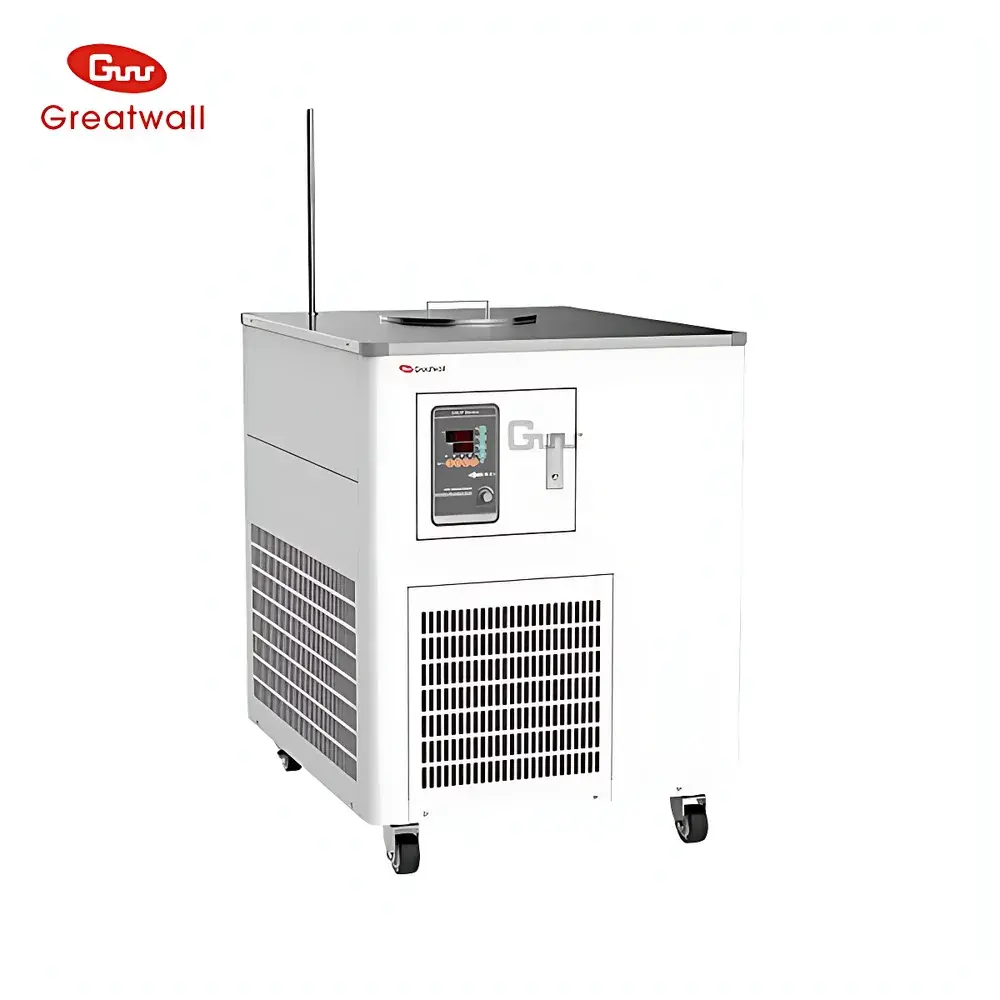
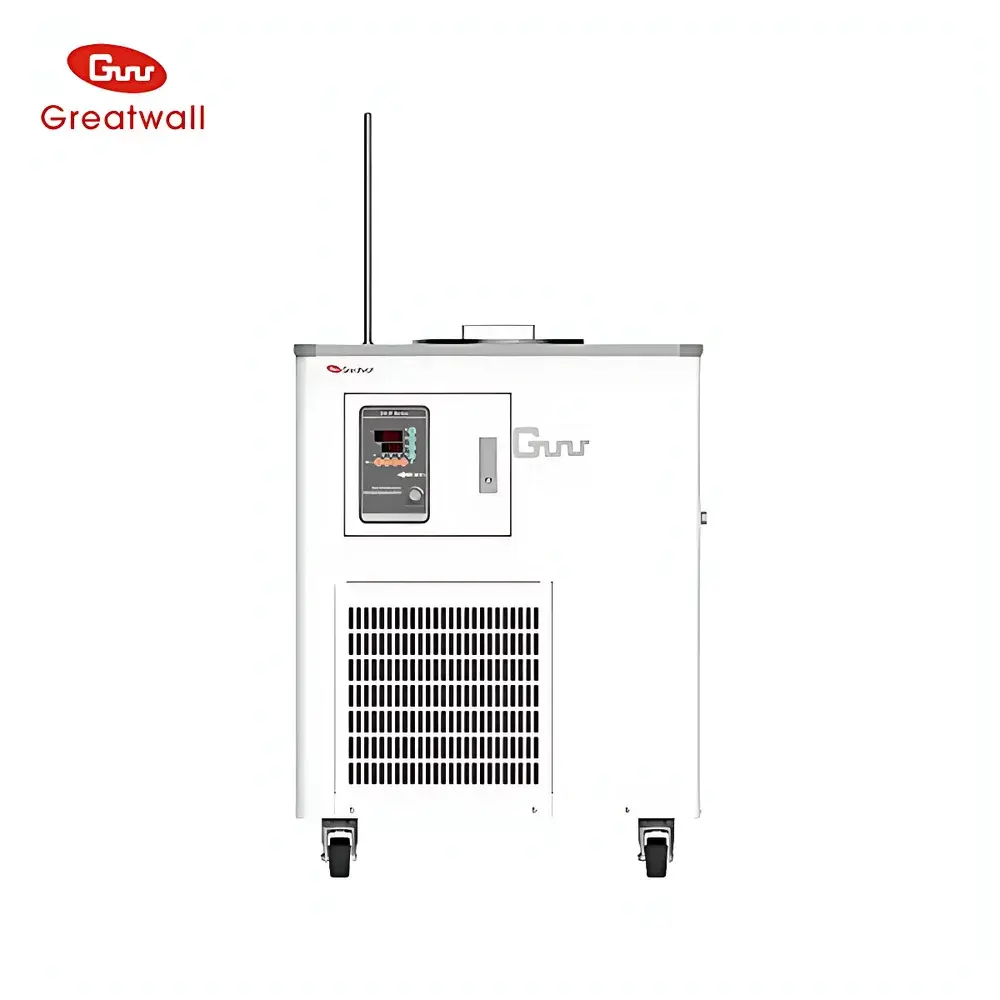
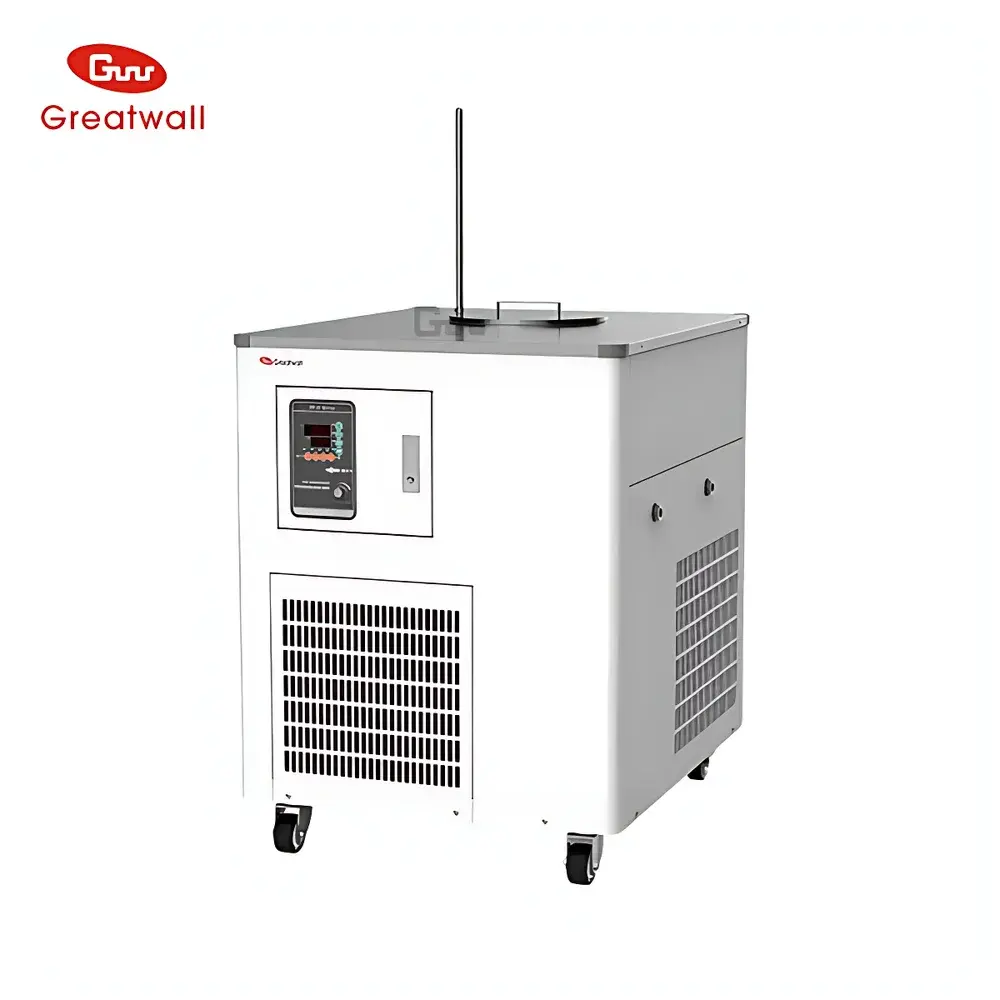
The Great Wall DHJF-8020 Cryogenic Circulating Thermostat with Integrated Magnetic Stirring
| Brand | The Great Wall |
|---|---|
| Origin | Henan, China |
| Manufacturer Type | Direct Manufacturer |
| Instrument Type | Vertical |
| Temperature Stability | ±0.5 °C |
| Operating Temperature Range | −80 °C to +99 °C |
| Bath Opening Diameter | Ø280 mm |
| Bath Volume | 20 L |
| External Dimensions | 760 W × 940 D × 1006 H mm |
| Net Weight | 200 kg |
Overview
The Great Wall DHJF-8020 Cryogenic Circulating Thermostat with Integrated Magnetic Stirring is a vertically oriented, dual-mode (cooling/heating) temperature control system engineered for precision thermal management in demanding laboratory applications. It operates on a closed-loop refrigeration cycle utilizing environmentally compliant R404A or R507 refrigerant (system-dependent), coupled with electric resistance heating and high-resolution PID feedback control. Unlike passive chillers or bath circulators without active stirring, the DHJF-8020 integrates a powerful submerged magnetic drive motor—capable of rotating both internal bath stirrers and reaction vessel stir bars—ensuring uniform thermal distribution across heterogeneous sample loads. Its −80 °C low-temperature capability enables cryogenic reaction studies, low-T crystallization, and controlled exotherm suppression, while its +99 °C upper limit supports elevated-temperature kinetic assays and solvent reflux simulations. Designed for continuous operation under load, the unit features reinforced stainless-steel bath construction, high-efficiency plate-type heat exchangers, and a thermally insulated cabinet minimizing ambient heat ingress.
Key Features
- Integrated dual-mode thermal control: precise cooling down to −80 °C and heating up to +99 °C within a single bath volume
- High-stability PID temperature regulation with ±0.5 °C uniformity across the 20 L working volume (measured at center, load-dependent)
- Submersible magnetic stirring system with adjustable speed (0–1200 rpm typical range) and torque-sensing overload protection
- Telescoping insulated cover with Ø280 mm aperture—mechanically adjustable to accommodate vessels from 50 mL vials to 5 L jacketed reactors, reducing coolant evaporation and ambient thermal interference
- Dedicated mounting rail and universal clamping interface for secure attachment of burettes, PT100 probes, pH electrodes, condenser supports, or external flow cells
- Dry-run protection circuitry for heating elements; refrigeration system includes high/low pressure cut-offs, compressor overheat sensors, and phase-loss monitoring
Sample Compatibility & Compliance
The DHJF-8020 accommodates standard laboratory glassware—including round-bottom flasks (up to 5 L), jacketed reactors, Schlenk tubes, and immersion-cooled spectrophotometer cuvette holders—via its large Ø280 mm opening and depth-optimized bath geometry. All wetted surfaces are electropolished 304 stainless steel, resistant to aqueous solutions, common organic solvents (e.g., acetone, THF, ethanol), and mild acid/base mixtures. The system complies with IEC 61010-1:2010 for electrical safety in laboratory equipment and meets CE marking requirements for EMC (EN 61326-1) and Low Voltage Directive (2014/35/EU). While not intrinsically rated for ATEX environments, optional grounding kits and explosion-proof stirrer configurations are available upon request for hazardous area integration. Documentation supports GLP-compliant validation protocols, including IQ/OQ templates aligned with ISO/IEC 17025 calibration traceability frameworks.
Software & Data Management
The DHJF-8020 operates via an embedded 4.3-inch capacitive touchscreen HMI with real-time graphing of bath temperature, setpoint deviation, stirring speed, and compressor duty cycle. Logged data (timestamped, 1-second resolution) is exportable via USB 2.0 to CSV format for post-processing in MATLAB, Origin, or LIMS platforms. Optional RS485 Modbus RTU or Ethernet TCP/IP interfaces enable integration into centralized lab automation systems (e.g., LabVantage, STARLIMS) and support remote monitoring via SCADA-compatible SCADA clients. Audit trail functionality records operator logins, parameter changes, and alarm events—meeting baseline requirements for FDA 21 CFR Part 11 compliance when deployed with validated user access controls and electronic signature workflows.
Applications
- Cryogenic asymmetric synthesis requiring strict −78 °C to −40 °C thermal control (e.g., organolithium additions, Diels–Alder cycloadditions)
- Enzyme kinetics assays where thermal ramping (e.g., 4 °C → 37 °C → 65 °C) must be executed with <±0.3 °C inter-run repeatability
- Calorimetric validation of DSC reference materials using isothermal holds at 0 °C, 25 °C, and 100 °C
- Continuous-flow chemistry systems requiring stable thermal coupling between reactor jackets and chiller loops
- Material science studies involving polymer solution viscosity measurements under shear-controlled, temperature-programmed conditions
- Biological sample preparation: controlled thawing of cryopreserved cell lines or cold-trap conditioning for rotary evaporation
FAQ
What refrigerant does the DHJF-8020 use?
The unit is factory-charged with R404A (GWP 3922) or R507 (GWP 3985), depending on production batch and regional regulatory alignment. Refrigerant type is specified on the nameplate and in the technical datasheet.
Can the stirring function operate independently of temperature control?
Yes—stirring speed and activation are fully decoupled from thermal setpoints, allowing mechanical homogenization during isothermal holds or rapid thermal transitions.
Is external circulation possible for remote temperature control?
The DHJF-8020 includes dual quick-connect ports (¼″ BSP) enabling closed-loop external circulation at flow rates up to 15 L/min (pressure head dependent), suitable for jacketed reactors or calorimeters.
What calibration standards are supported?
The integrated PT100 sensor is NIST-traceable; users may perform two-point calibration using certified reference thermometers (e.g., Fluke 1523/1524) per ASTM E74-22 guidelines.
Does the system support automated start/stop via digital input?
Yes—dry-contact terminals accept TTL-level or 24 VDC triggers for synchronized operation with reactors, pumps, or data acquisition systems.
Related Products



