
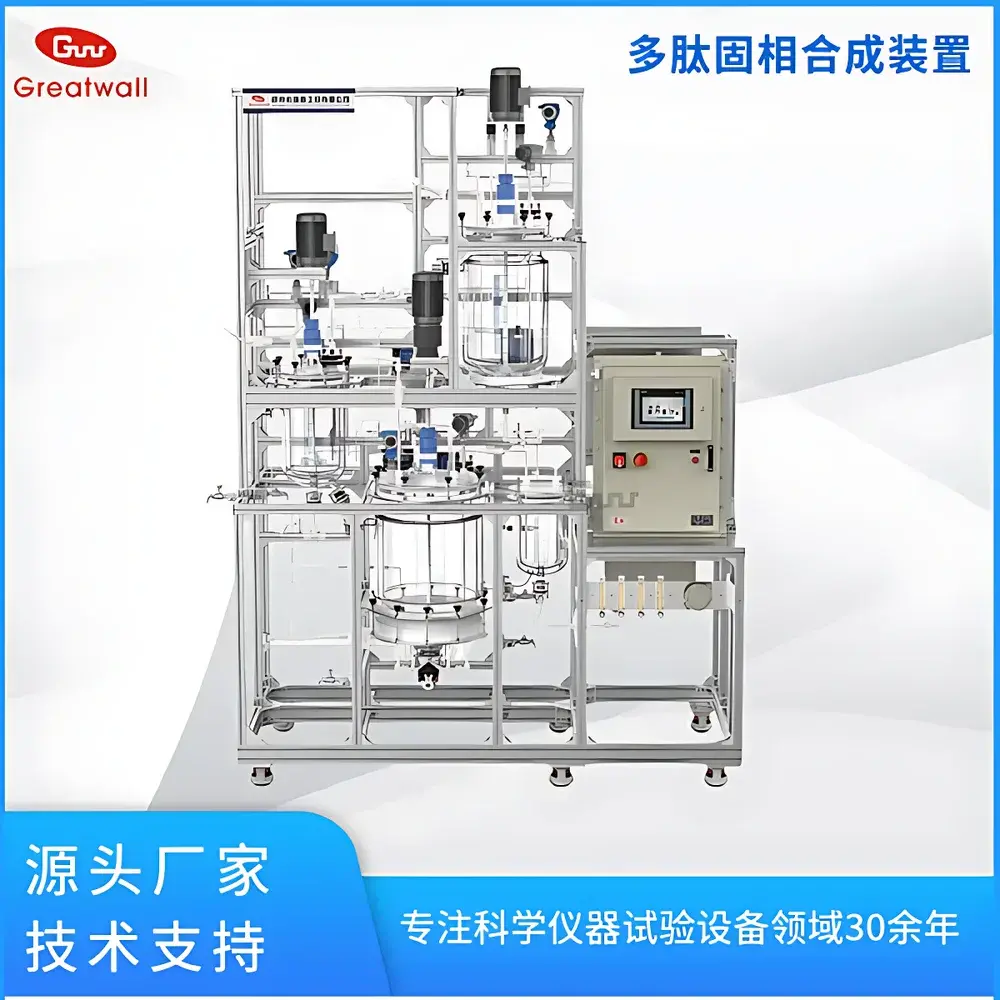
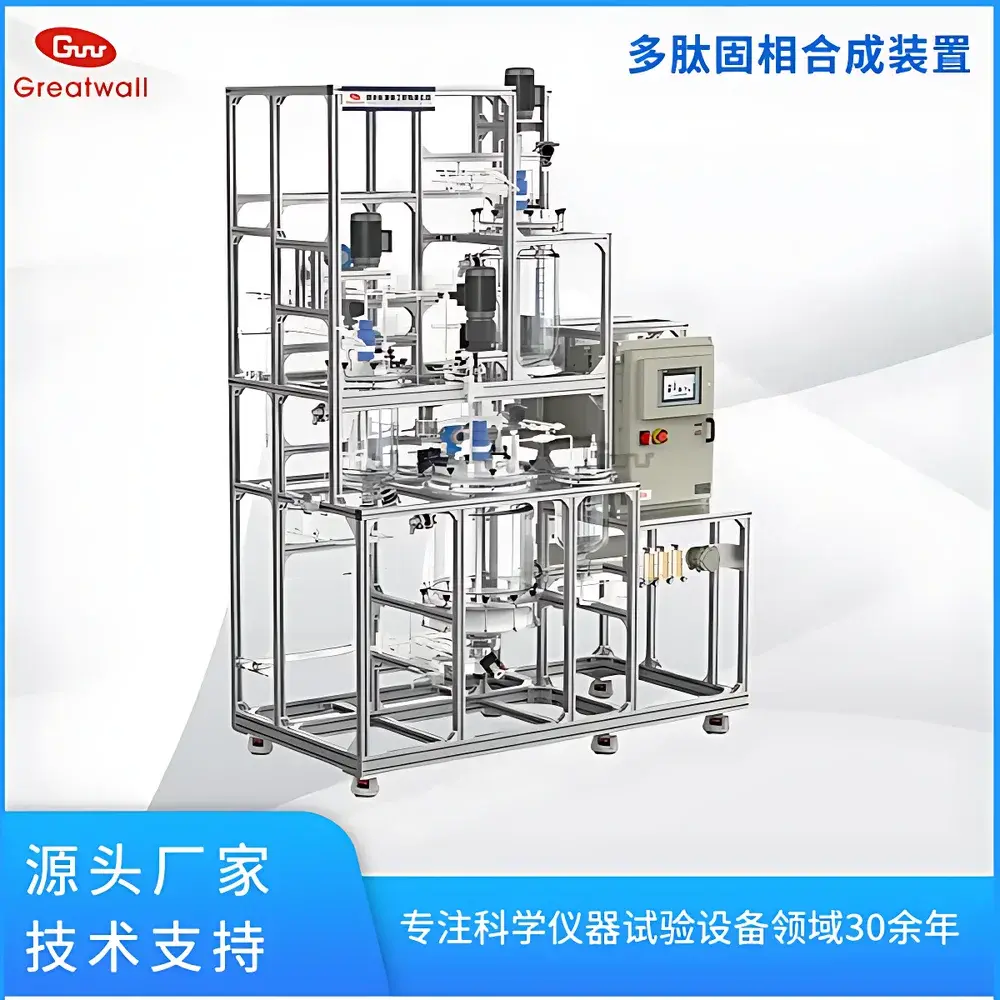
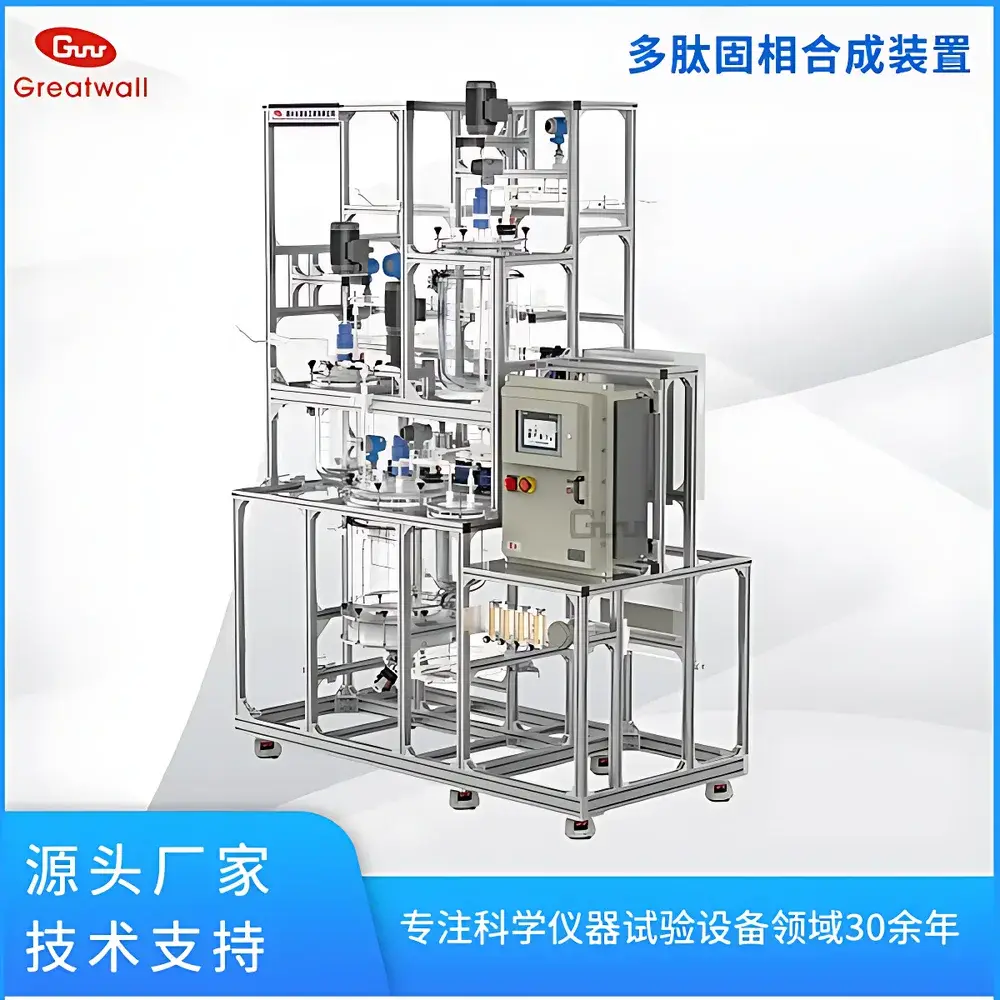
The Great Wall PSS-500 Series Solid-Phase Peptide Synthesizer
| Brand | The Great Wall |
|---|---|
| Origin | Henan, China |
| Manufacturer Type | OEM/ODM Manufacturer |
| Country of Origin | China |
| Model | PSS-500 Series |
| Capacity Options | 5 L, 10 L, 20 L, 50 L, 100 L, 200 L |
| Reactor Material | Borosilicate Glass 3.3 or ASTM A240 S31603 Stainless Steel |
| Lid Material | PTFE or 316L SS |
| Agitation | Top-mounted mechanical stirring (50–300 rpm) |
| Temperature Range | 0–70 °C |
| Filtration Plate | 316L SS or Polyethylene (PE) |
| Inert Gas Purging | Integrated N₂/Ar sparging at reactor base and headspace |
| Solvent Delivery Accuracy | ≤ ±1% FS |
| Control System | PLC-based with HMI interface |
| Data Logging | Real-time recording of temperature, agitation speed, flow rate, pressure |
| Safety Certification (Explosion-Proof Variant) | ATEX/IECEx Zone 2, Group IIB, T4 |
| Compliance | Designed per ISO 9001 |
| Power Supply | 220 V / 380 V AC, 50 Hz |
| Frame Material | Anodized aluminum alloy |
| Safety Features | Emergency stop, overtemperature alarm, flow deviation alert, pressure interlock |
| Customization | Fully configurable for resin loading, coupling/deprotection cycles, wash protocols, and solvent recovery integration |
Overview
The Great Wall PSS-500 Series Solid-Phase Peptide Synthesizer is an engineered platform for automated, scalable synthesis of peptides under controlled chemical environments. Based on the Merrifield solid-phase methodology, the system enables stepwise amino acid coupling onto insoluble polymeric resins—facilitating high-yield, sequence-specific assembly while minimizing side reactions and simplifying purification. Unlike benchtop parallel synthesizers, the PSS-500 series bridges laboratory-scale discovery and pilot-scale process development through its modular, skid-mounted architecture and volumetric scalability from 5 L to 200 L reaction capacity. Each unit integrates inert atmosphere management, precision fluid handling, thermal regulation, and real-time parametric monitoring—critical for reproducible synthesis of therapeutic-grade peptides, peptide antigens, and modified peptidomimetics used in biopharmaceutical R&D, diagnostics, and vaccine development.
Key Features
- Multi-material reactor configuration: Select between borosilicate glass 3.3 (for visual process monitoring and corrosion resistance with TFA, DMF, DCM) or electropolished ASTM A240 S31603 stainless steel (for high-pressure, high-temperature, or extended-cycle operation); lids fabricated from chemically inert PTFE or 316L SS.
- Top-mounted agitator with variable-speed control (50–300 rpm), optimized for uniform resin suspension and mass transfer without mechanical degradation of functionalized beads.
- Integrated inert gas management: Dual-point sparging (bottom diffuser + headspace purge) ensures O₂-free environment during deprotection (e.g., piperidine treatment) and coupling steps—reducing oxidation and racemization risks.
- Automated reagent delivery with gravimetric or Coriolis-based flow metering (±1% full-scale accuracy), supporting both pre-programmed and manually triggered additions of amino acids, activators (e.g., HBTU, DIC), solvents, and scavengers.
- PLC-driven control architecture with intuitive HMI interface: Enables creation, storage, and execution of multi-step synthesis protocols—including coupling time, deprotection duration, washing cycles, blow-down intervals, and resin swelling phases.
- Comprehensive data acquisition: Continuous logging of temperature (±0.5 °C), agitation speed (±2 rpm), flow rate (±1% FS), and system pressure (±0.02 bar); timestamped datasets exportable in CSV format for regulatory submission or process analytics.
- Configurable safety framework: Standard emergency stop, thermal cutoff at 75 °C, and pressure relief; explosion-proof variant certified for Zone 2 (IEC 60079-0, -10, -15) with II B T4 classification—suitable for facilities handling flammable solvents such as THF, ether, or low-boiling esters.
Sample Compatibility & Compliance
The PSS-500 accommodates standard polystyrene- and PEG-based resins (e.g., Wang, Rink amide, 2-CTC), including acid-labile, photolabile, and safety-catch linkers. Its filtration plates—available in sintered 316L stainless steel (10–25 µm pore) or chemically resistant PE (50–100 µm)—support efficient solvent exchange and resin retention across diverse swelling volumes and particle sizes (50–200 mesh). All wetted components comply with USP Class VI and FDA 21 CFR 177.1520 for repeated contact with pharmaceutical intermediates. The system supports compliance with ICH Q5C (peptide purity), USP <1058> (analytical instrument qualification), and Annex 11 (computerized system validation) when deployed with validated firmware and audit-trail-enabled software options.
Software & Data Management
Control logic resides in a CE-marked industrial PLC with non-volatile memory for up to 100 synthesis programs. The HMI provides dual-mode operation: fully automated sequence execution or semi-automatic “step-and-hold” mode for operator intervention. Data integrity is maintained via three-tier user permission levels (Operator, Supervisor, Administrator), password-protected parameter editing, and immutable electronic records—including event timestamps, operator ID, and modification history. Optional 21 CFR Part 11-compliant software adds digital signatures, electronic audit trails, and secure backup to networked NAS or cloud repositories—enabling alignment with GxP quality systems and FDA inspection readiness.
Applications
- Synthesis of linear and branched peptides up to 50+ residues for structural biology (NMR, X-ray crystallography), epitope mapping, and antibody production.
- Manufacture of peptide drug substance intermediates under cGMP pilot conditions, including APIs requiring strict impurity profiling (e.g., desamido, deletion, or truncated variants).
- Preparation of peptide-conjugated carriers (e.g., KLH, CRM197) for conjugate vaccine development.
- Scale-up studies supporting tech transfer from milligram-scale microwave synthesizers to kilogram-scale production.
- Process optimization of coupling efficiency, resin loading, and solvent recovery ratios—integrated with downstream cleavage and HPLC purification workflows.
FAQ
What resin types are compatible with the PSS-500 series?
Standard polystyrene (PS), polyethylene glycol-polystyrene hybrid (PEG-PS), and ChemMatrix® resins are supported; compatibility with specialty resins (e.g., Sieber amide, HMBA) is verified case-by-case based on swelling behavior and mechanical stability.
Can the system perform simultaneous synthesis of multiple sequences?
No—the PSS-500 is a single-reactor platform optimized for sequential, high-fidelity synthesis; parallel synthesis requires multiple units or dedicated multi-channel instruments.
Is remote monitoring supported?
Yes—via optional Ethernet/IP or Modbus TCP interface, enabling integration into plant-wide SCADA or MES systems for centralized batch tracking and alarm notification.
What validation documentation is provided?
Factory Acceptance Test (FAT) report, Installation Qualification (IQ) template, and Operational Qualification (OQ) protocol are included; Performance Qualification (PQ) support is available upon request.
How is cleaning and residue verification addressed?
The system supports automated solvent rinse cycles with programmable volume, dwell time, and drain sequencing; swab sampling ports and TOC-compatible surface materials facilitate residue limit verification per ICH Q5A and PDE guidelines.



