
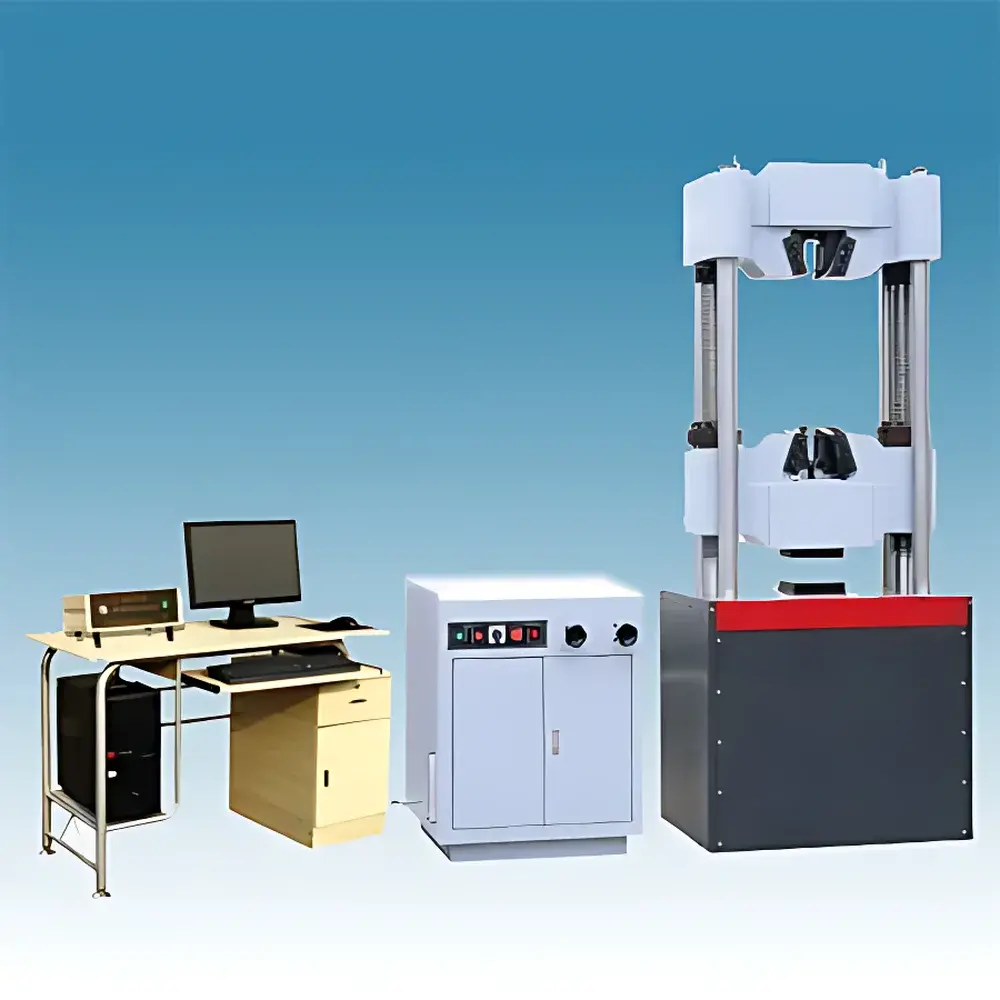
Hengyi HY(WE)100060E Electro-Hydraulic Servo Universal Testing Machine
| Brand | Hengyi |
|---|---|
| Origin | Shanghai, China |
| Manufacturer Type | Direct Manufacturer |
| Equipment Type | Electro-Hydraulic Servo Universal Testing Machine |
| Model | HY(WE)100060E |
| Max Load Capacity | 1000 kN |
| Load Accuracy | ±0.5% of reading |
| Resolution | ≤0.5% of full scale |
| Compression Space | 600 mm |
| Tensile Space | 600 mm |
| Round Specimen Grip Range | Φ20–Φ60 mm |
| Flat Specimen Thickness Capacity | 0–40 mm |
| Piston Stroke | 150 mm |
| Maximum Bend Span | 100–600 mm |
| Shear Specimen Diameter | Φ10 mm |
| Deformation Measurement Accuracy | ±0.5% of reading |
| Displacement Measurement Error | ±0.5% of reading |
| Stress Rate Control Range | 1–60 N/mm²/s |
| Strain Rate Control Range | 0.00025–0.0025 s⁻¹ |
| Closed-Loop Control Accuracy (Force/Displacement/Deformation) | ±1% of setpoint |
| Dimensions (W×D×H) | 880 × 580 × 2260 mm |
| Motor Power | 1.5 kW, 3-phase |
| Weight | 3500 kg |
Overview
The Hengyi HY(WE)100060E is a high-capacity electro-hydraulic servo universal testing machine engineered for precision mechanical characterization of metallic and non-metallic structural materials under static loading conditions. It operates on the principle of controlled hydraulic actuation combined with real-time digital closed-loop feedback—utilizing high-fidelity load cells, linear displacement transducers, and extensometry to deliver traceable, repeatable force-displacement-deformation data across tension, compression, bending, and shear test modes. Designed for compliance with international mechanical testing standards—including ISO 6892-1, ASTM E4, ASTM E8/E8M, and EN 10002-1—the system integrates a lower-mounted cylinder architecture with adjustable test space, enabling flexible specimen handling while maintaining structural rigidity and load train alignment. Its dual-mode control architecture supports both stress- and strain-rate-controlled ramping protocols, essential for evaluating yield behavior, plastic flow, and fracture resistance in structural alloys, reinforced concrete, composites, and civil engineering components.
Key Features
- 1000 kN maximum load capacity with ±0.5% load accuracy and ≤0.5% relative resolution, certified per ISO 7500-1 Class 1 requirements
- Electro-hydraulic servo actuation using an Italian AOTOS high-response proportional valve for smooth, low-noise, and highly reproducible load application
- Modular grip system accommodating round specimens (Φ20–Φ60 mm) and flat specimens (up to 40 mm thick), with quick-change jaw inserts for standardized tensile, compression, and bending fixtures
- Integrated high-precision electronic load cell and draw-wire displacement sensor, supplemented by optional clip-on or contacting extensometer for ASTM E8-compliant elongation measurement
- Real-time closed-loop control of force, displacement, and deformation at ±1% setpoint accuracy, supporting multi-step programmed tests including hold, ramp, and cyclic profiles
- Rigid four-column frame with precision-ground guide rods, optimized for minimal deflection under peak load; total mass of 3500 kg ensures vibration damping and operational stability
- Full 3-phase 1.5 kW hydraulic power unit with thermal management, enabling continuous operation within ambient temperature ranges of 10–35°C and humidity ≤80% RH (non-condensing)
Sample Compatibility & Compliance
The HY(WE)100060E accommodates standard and custom specimens conforming to ISO 6892-1 (metallic tensile), ISO 15630-1 (reinforcing steels), ASTM C39 (concrete compression), ASTM D7264 (flexural testing of composites), and GB/T 228.1–2021 (Chinese national standard for metallic tensile testing). Its 600 mm vertical test space—adjustable via motorized crosshead positioning—supports specimens up to 600 mm in height for compression and 600 mm gauge length for tension. Bending tests are executed with variable support spans (100–600 mm) and interchangeable rollers compliant with ISO 7438 and ASTM E290. All hardware and software configurations meet GLP documentation requirements, and test data files include embedded metadata (operator ID, timestamp, environmental conditions, calibration certificate IDs) for audit readiness under ISO/IEC 17025 and FDA 21 CFR Part 11 (when paired with validated user access controls and electronic signature modules).
Software & Data Management
The system runs Hengyi’s proprietary Windows-based test control and analysis suite, fully localized in English and compliant with IEC 62591 (WirelessHART) and IEEE 1451.2 data formatting conventions. The software provides real-time graphical display of multiple synchronized channels—including load vs. time, stress vs. strain, and displacement vs. extension—with auto-scaling, cursor-based measurement, and derivative calculation (e.g., modulus, yield point, ultimate strength). Test sequences are programmable via intuitive drag-and-drop workflow builder, supporting conditional branching and pass/fail logic based on ASTM E2384 criteria. Raw data exports to CSV, XML, and HDF5 formats; reports comply with ISO 14253-1 traceability templates and include digital signatures, version-controlled calibration logs, and uncertainty budgets derived from GUM (Guide to the Expression of Uncertainty in Measurement) principles. Optional cloud synchronization enables secure remote monitoring and centralized database archiving via TLS 1.3 encrypted REST API endpoints.
Applications
This testing platform serves as a primary mechanical verification tool in quality assurance laboratories, R&D centers, and third-party certification bodies engaged in structural material validation. Typical use cases include: tensile property evaluation of hot-rolled steel plates (ASTM A36, EN 10025-2), compressive strength testing of precast concrete elements (EN 12390-3), three-point bending of aluminum extrusions (ISO 7438), shear testing of riveted joints (ASTM D5379), and creep-resistant alloy qualification per ASME BPVC Section II. It is also deployed in academic settings for teaching fundamental mechanics of materials concepts—including Hooke’s law, Poisson’s ratio, strain hardening exponent (n-value), and reduction of area calculations—using calibrated reference specimens traceable to NIST SRM 2241.
FAQ
What standards does the HY(WE)100060E support out-of-the-box?
The system is pre-configured for GB/T 228.1–2021, ISO 6892-1:2019, ASTM E8/E8M, and EN 10002-1. Additional test methods can be added via software module licensing.
Is the system compatible with external extensometers?
Yes—it features analog and digital (LVDT, SSI, TTL) input interfaces supporting industry-standard contacting and non-contacting extensometers, including those from ZwickRoell, MTS, and Instron.
Can test data be exported for LIMS integration?
Absolutely. The software supports ASTM E1382-compliant structured data export and offers ODBC/JDBC drivers for direct ingestion into Laboratory Information Management Systems.
What maintenance intervals are recommended for hydraulic components?
Hydraulic oil and filter replacement is required every 2000 operating hours or biannually, whichever occurs first; annual verification of pressure transducer linearity and load cell calibration traceability is advised.
Does the system support automated batch testing?
Yes—through scriptable test sequences and barcode-triggered specimen identification, enabling unattended execution of up to 999 sequential tests with automatic report generation and folder-based archiving.



