
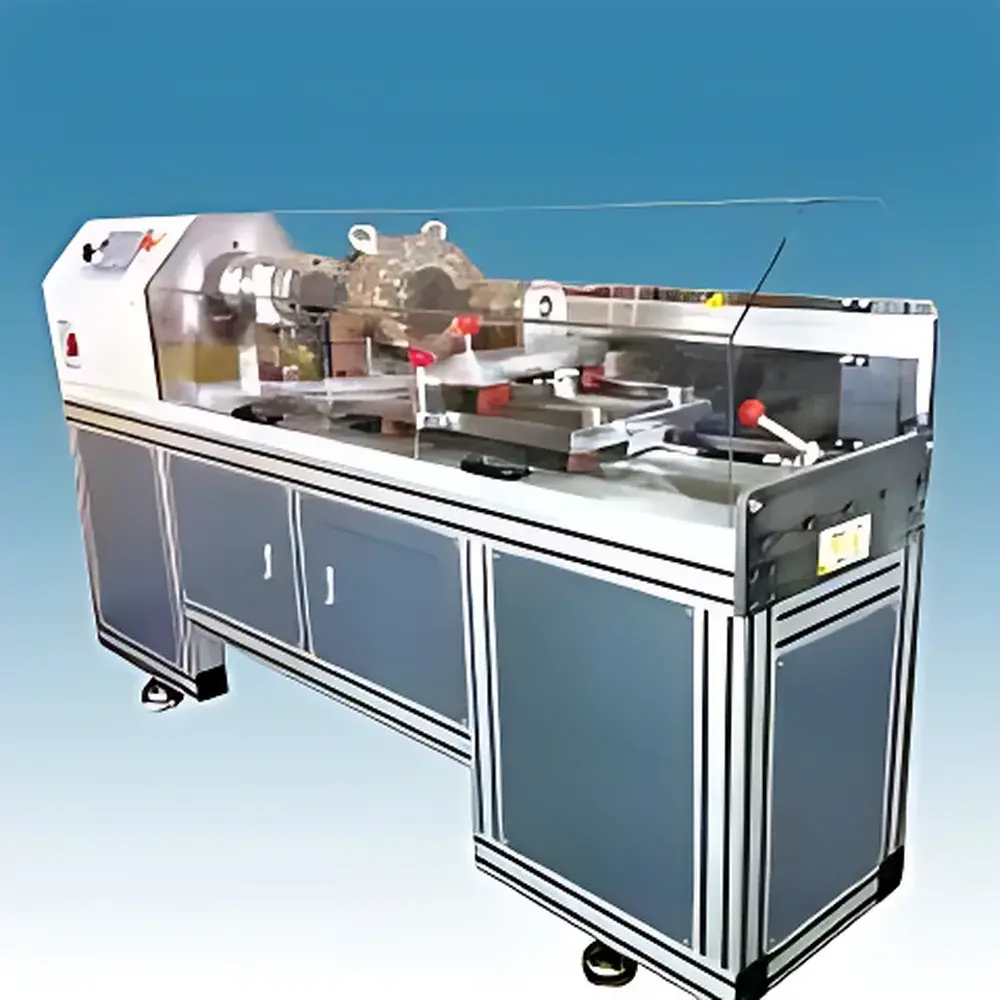
Hengyi HY-2000N·m(DN) Computer-Controlled Thread Friction Coefficient Tester
| Brand | Hengyi (Hengyitest) |
|---|---|
| Origin | Shanghai, China |
| Manufacturer Type | Direct Manufacturer |
| Model | HY-2000N·m(DN) |
| Torque Measurement Range (Primary Sensor) | 2000 N·m |
| Torque Measurement Range (Secondary Sensor) | 1000 N·m |
| Axial Force Range | 5–500 kN |
| Torque Measurement Accuracy | ±0.5% FS (typical) |
| Torsion Angle Range | 0–100,000° (or continuous) |
| Angular Position Accuracy | ±0.5% FS |
| Torsion Speed Range | 0–30 rpm |
| Speed Control Accuracy | ±0.5% |
| Gauge Length Adjustment | up to 1000 mm |
| Specimen Clamping Range | M10–M30 (customizable) |
| Power Supply | Single-phase 3 kW |
| Dimensions (L×W×H) | ≈2200×540×1250 mm |
| Weight | 1200 kg |
Overview
The Hengyi HY-2000N·m(DN) Computer-Controlled Thread Friction Coefficient Tester is a precision torsion testing system engineered for quantitative mechanical characterization of threaded fasteners and cylindrical components under combined axial-torsional loading. It operates on the principle of controlled torque application while simultaneously measuring axial preload, angular displacement, and rotational dynamics—enabling direct calculation of thread friction coefficient (μthread), bearing surface friction coefficient (μbearing), total coefficient of friction (μtotal), torque coefficient (K), yield torque, ultimate torque, proof load, and effective torque. Designed in a rigid horizontal configuration with high-stiffness frame architecture, the system complies with fundamental mechanical test methodologies defined in ISO 16047, ASTM F568M, DIN EN ISO 898-1, and GB/T 3098.1. Its dual-sensor torque measurement architecture (2000 N·m primary + 1000 N·m secondary) supports high-resolution calibration traceability across wide dynamic ranges, while integrated 500 kN axial load cell ensures synchronized force-torque correlation essential for ISO-compliant fastener verification.
Key Features
- High-fidelity dual-range torque sensing: 2000 N·m main sensor and 1000 N·m auxiliary sensor, both calibrated to ≤±0.5% full-scale accuracy per ISO 376 requirements
- Synchronized axial-torsional actuation: Precision-controlled coaxial loading with independent closed-loop regulation of torque (0–30 rpm) and axial force (5–500 kN)
- Sub-degree angular resolution: Imported high-accuracy optical encoder with ≤0.5% angular position error and real-time 100 Hz data acquisition
- Dedicated ARM32-based control architecture: Proprietary 32-bit microprocessor platform (ARM Cortex-M series equivalent) delivering deterministic real-time control, 115.2 kbps serial communication, and embedded PID loop stability
- Modular fixture system: Standardized M10–M30 thread clamping kits included; custom adapters available for non-standard fastener geometries and joint configurations
- Full compliance-ready test sequencing: Preconfigured test templates for ISO 16047 Annex A (nut-and-bolt method), Annex B (bolt-only method), and Annex C (preload-relaxation analysis)
Sample Compatibility & Compliance
The HY-2000N·m(DN) accommodates standard and non-standard threaded fasteners including bolts, screws, studs, and anchor rods from M10 to M30 diameter. With optional tooling, it supports extended sizing up to M42 or customized geometries such as flanged bolts, shear bolts, and composite-threaded assemblies. All mechanical measurements adhere to international metrological standards: torque sensors are calibrated per ISO 376 Class 0.5, axial load cells conform to ISO 376 Class 0.5, and angular encoders meet ISO 230-2 positional repeatability criteria. The system supports audit-ready documentation aligned with GLP and GMP environments, including electronic signature capability, user access levels, and full test parameter logging compliant with FDA 21 CFR Part 11 requirements when operated with validated software protocols.
Software & Data Management
The proprietary Windows-based test software provides ISO 16047-compliant friction coefficient derivation workflows, automatic K-factor computation, and multi-curve overlay for comparative fastener batch analysis. Real-time graphical display includes synchronized torque–angle, axial force–angle, and torque–axial force scatter plots. All raw data—including timestamped 100-Hz sampled values—are stored in structured binary format with XML metadata embedding test parameters, operator ID, calibration IDs, and environmental notes. Export options include CSV, PDF reports (with embedded charts and pass/fail annotations), and direct integration with LIMS via ODBC-compliant database schema. Audit trails record all parameter modifications, test aborts, and recalibrations with immutable timestamps and user attribution.
Applications
- Fastener development labs: Quantifying lubricant efficacy, coating performance, and thread geometry effects on μthread and μbearing
- Automotive Tier-1 suppliers: Validating bolted joint integrity per VDA 235-201 and VW 01131 specifications
- Aerospace OEMs: Supporting NASM1312-20 and SAE AS7450B qualification testing for critical structural joints
- Construction materials certification: Verifying high-strength anchor systems per ACI 318 Appendix D and ETAG 001
- Quality assurance departments: Routine production-line verification of torque-tension relationships and friction consistency across batches
- Academic research: Investigating tribological behavior of novel thread coatings (e.g., MoS₂, PTFE, ceramic composites) under variable humidity and temperature conditions
FAQ
What standards does this tester support for friction coefficient calculation?
It fully implements ISO 16047:2019 procedures for determining thread and bearing surface friction coefficients, and supports supplementary evaluation per ASTM F568M, DIN EN ISO 898-1, and GB/T 3098.1.
Can the system perform preload relaxation or embedment loss analysis?
Yes—the software includes dedicated modules for time-dependent relaxation profiling, including 1-minute, 5-minute, and 30-minute hold segments with automatic slope calculation per ISO 16047 Annex C.
Is the test software compatible with networked lab environments and LIMS integration?
The software supports ODBC-compliant database export and can be deployed on domain-joined Windows workstations; API-level integration with major LIMS platforms is available upon request with validation documentation.
What maintenance intervals are recommended for torque and axial load sensors?
Annual recalibration is recommended per ISO/IEC 17025 guidelines; sensor drift monitoring is supported through built-in zero-check and span-check routines accessible via administrator mode.
Does the system provide automated report generation meeting ISO/IEC 17025 documentation requirements?
Yes—each test generates a timestamped, digitally signed PDF report containing raw data plots, derived parameters, equipment calibration status, operator ID, and environmental notes, fully traceable for accreditation audits.



