
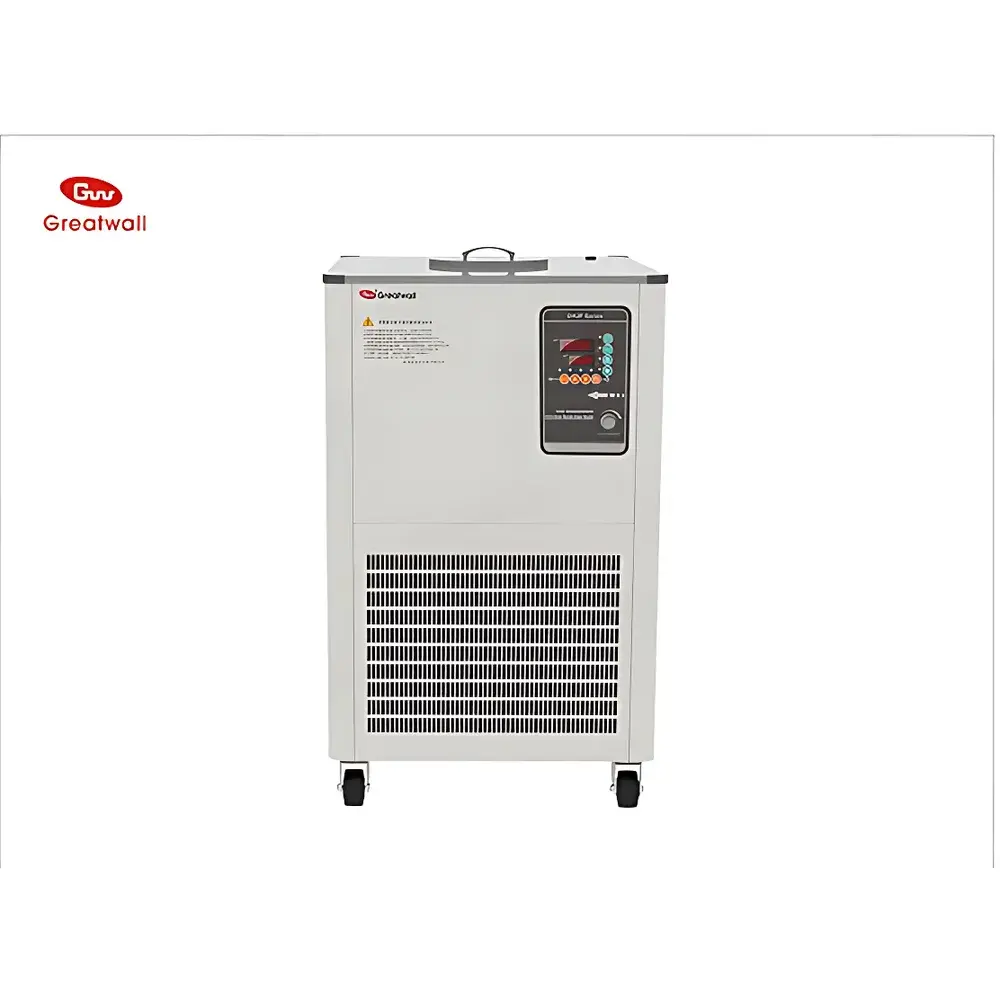
Great Wall DHJF-1205 Low-Temperature Constant-Temperature Stirred Reaction Bath
| Brand | The Great Wall |
|---|---|
| Origin | Henan, China |
| Manufacturer Type | Original Equipment Manufacturer (OEM) |
| Country of Origin | China |
| Model | DHJF-1205 |
| Quotation | Upon Request |
| Refrigeration System | Single-stage compression with cascade sub-cooling technology |
| Temperature Range | −120 °C to −60 °C |
| Temperature Stability | ±2 °C |
| Bath Volume | 5 L |
| Refrigerant | Mixed refrigerant blend |
| Cooling Capacity | 110 W at −60 °C |
| Stirring Power | 50 W |
| Stirring Speed | 100–1000 rpm |
| Display Resolution | 0.1 °C |
| Input Power | 820 W |
| Voltage/Frequency | 220–240 V~, 50 Hz |
| Bath Material | 304 stainless steel |
| External Dimensions (W×D×H) | 630 × 795 × 790 mm |
| Net Weight | 125 kg |
| Ambient Operating Conditions | 5–35 °C, ≤70% RH |
| Drain Port | 1/2″ BSP |
| Bath Opening Diameter | Ø210 mm |
| Bath Internal Dimensions | Ø220 × 180 mm |
| Max Flask Capacity | 2000 mL |
| Safety Protections | Delayed start, overcurrent, and overtemperature protection |
Overview
The Great Wall DHJF-1205 Low-Temperature Constant-Temperature Stirred Reaction Bath is an engineered solution for precise cryogenic reaction control in synthetic chemistry, low-temperature catalysis, and material science laboratories. It integrates a single-stage compression refrigeration system with cascade sub-cooling architecture—enabling stable operation down to −120 °C without requiring liquid nitrogen or multi-compressor setups. Unlike conventional cryostats, the DHJF-1205 employs a fully welded, all-copper refrigerant circuit with a custom mixed-refrigerant blend optimized for wide-range thermodynamic efficiency across its operational envelope (−120 °C to −60 °C). Its core thermal design centers on a helical coil evaporator immersed directly within the 304 stainless steel bath reservoir, ensuring uniform heat transfer and mechanical resilience—even during prolonged operation near the freezing point of common cryogenic media such as ethylene glycol/water or silicone oil mixtures. Temperature regulation is achieved via a PID-controlled digital microprocessor with 0.1 °C display resolution and real-time feedback from a calibrated Pt100 sensor embedded in the bath fluid.
Key Features
- Single-stage compression with cascade sub-cooling technology—eliminates need for auxiliary chillers or cryogens while achieving −120 °C with high energy efficiency
- Tecumseh-type hermetic piston compressor: compact footprint, low acoustic emission (30,000-hour MTBF under continuous duty
- Air-cooled condenser with oxygen-free copper spiral tubing—enhances thermal exchange coefficient and simplifies maintenance in non-cleanroom environments
- Fully welded refrigerant loop with minimal brazing joints—reduces leak risk and supports long-term vacuum integrity per ISO 8573-1 Class 4 standards
- Integrated magnetic stirrer (50 W, 100–1000 rpm) with sealed coupling—prevents solvent ingress and enables simultaneous temperature control and agitation
- Digital controller with password-protected parameter lockout, auto-calibration prompts, and configurable alarm thresholds for overtemperature, overcurrent, and compressor delay faults
Sample Compatibility & Compliance
The DHJF-1205 accommodates standard laboratory glassware up to 2000 mL (e.g., jacketed reactors, Schlenk tubes, and dual-neck flasks) through its Ø210 mm opening and deep 180 mm bath depth. Its 304 stainless steel reservoir resists corrosion from halogenated solvents, strong acids (e.g., HF-free etchants), and low-viscosity cryogenic carriers—including propylene glycol/water (60/40 v/v), methyl silicone oil (cSt 100), and fluorinated heat-transfer fluids (e.g., FC-40). The unit complies with IEC 61010-1:2010 for electrical safety in laboratory equipment and meets CE marking requirements for EMC (EN 61326-1) and low-voltage directive (2014/35/EU). While not certified for GMP production environments, its logging-capable controller supports GLP-aligned documentation when paired with external audit-trail software.
Software & Data Management
The DHJF-1205 operates autonomously via its onboard controller; no PC interface is included as standard. However, optional RS485 Modbus RTU output (add-on module) enables integration into centralized lab monitoring systems (e.g., LabVIEW, Ignition SCADA, or DeltaV DCS). When configured, the device transmits real-time temperature, setpoint, stir speed, compressor status, and fault codes at user-defined intervals (1–60 s). All internal alarms—including thermal runaway detection and phase-loss monitoring—are timestamped and stored in non-volatile memory for up to 72 hours. Data export requires manual USB dump (via optional adapter) and conforms to CSV format compatible with Excel, OriginLab, or MATLAB for post-hoc trend analysis.
Applications
- Low-temperature Grignard and organolithium reactions requiring strict thermal control below −80 °C
- Cryogenic crystallization studies of pharmaceutical intermediates under reproducible sub-zero gradients
- Photochemical synthesis using UV-transparent reactors immersed in temperature-stabilized baths
- Calibration of cryogenic sensors (e.g., thermistors, diode thermometers) against NIST-traceable references
- Material testing of polymer composites and battery electrolytes under controlled thermal stress profiles
- Pre-cooling of analytical instrumentation components—such as GC injectors or FTIR beam splitters—prior to operation
FAQ
What refrigerant blend is used in the DHJF-1205, and is it compliant with current F-Gas regulations?
The unit uses a proprietary zeotropic mixture of HFC-23/HFC-134a/R23, selected for optimal pressure-temperature characteristics across the −120 °C to −60 °C range. While not exempt from EU F-Gas Regulation (EU) No 517/2014, its total charge volume (<0.8 kg) falls below mandatory reporting thresholds for stationary refrigeration systems.
Can the DHJF-1205 maintain −120 °C continuously with a 2 L flask immersed?
Yes—under ambient conditions ≤25 °C and ≤60% RH, the system delivers 20 W of cooling capacity at −120 °C, sufficient to offset typical conductive/convective losses from a standard 2 L jacketed reactor filled with 30% ethylene glycol/water.
Is the magnetic stirrer compatible with PTFE-coated stir bars in aggressive solvents?
Yes—the drive mechanism is fully isolated from the bath fluid; only the stir bar contacts the medium. Standard PTFE-encapsulated bars (up to Ø10 × 40 mm) operate reliably across the full temperature range.
Does the unit support external temperature probes for sample-specific feedback control?
No—the controller regulates solely based on internal bath fluid temperature. For sample-centric control, users must implement external PID controllers with immersion probes and modulate the DHJF-1205’s setpoint via analog input (requires optional I/O module).



