
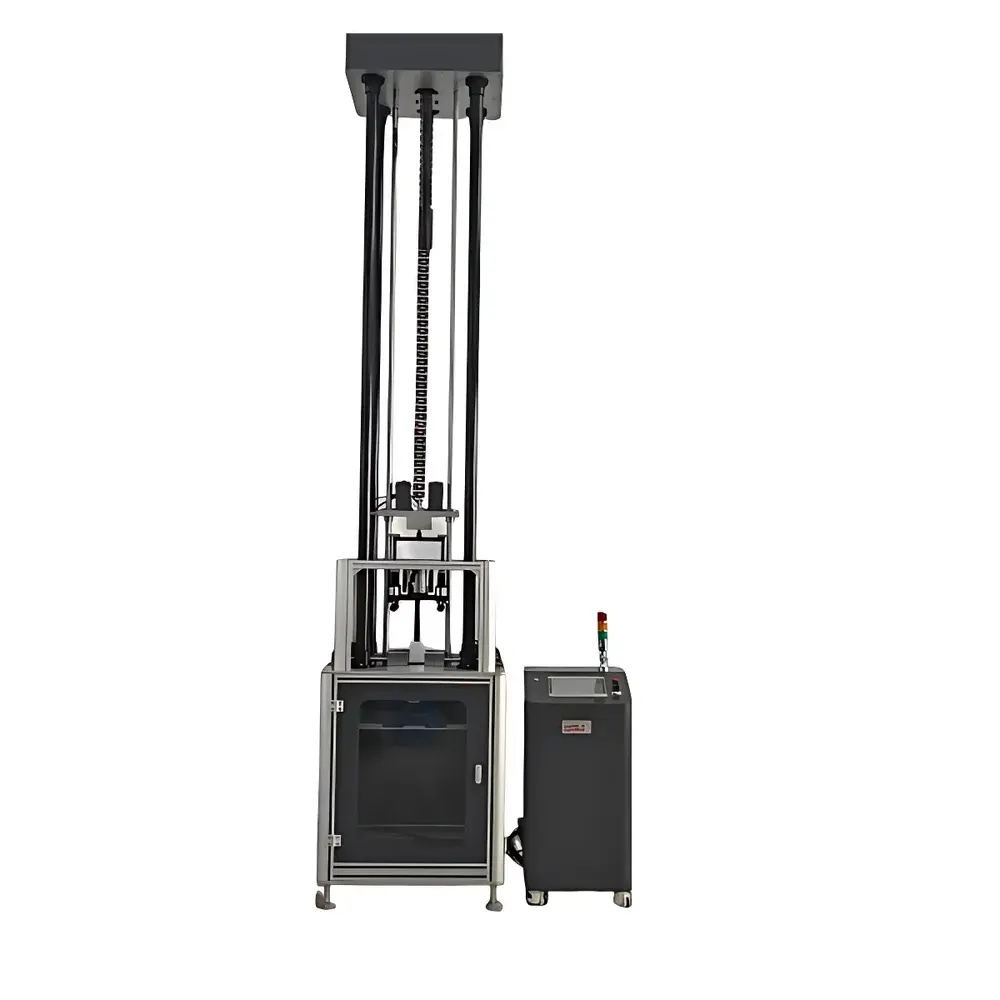
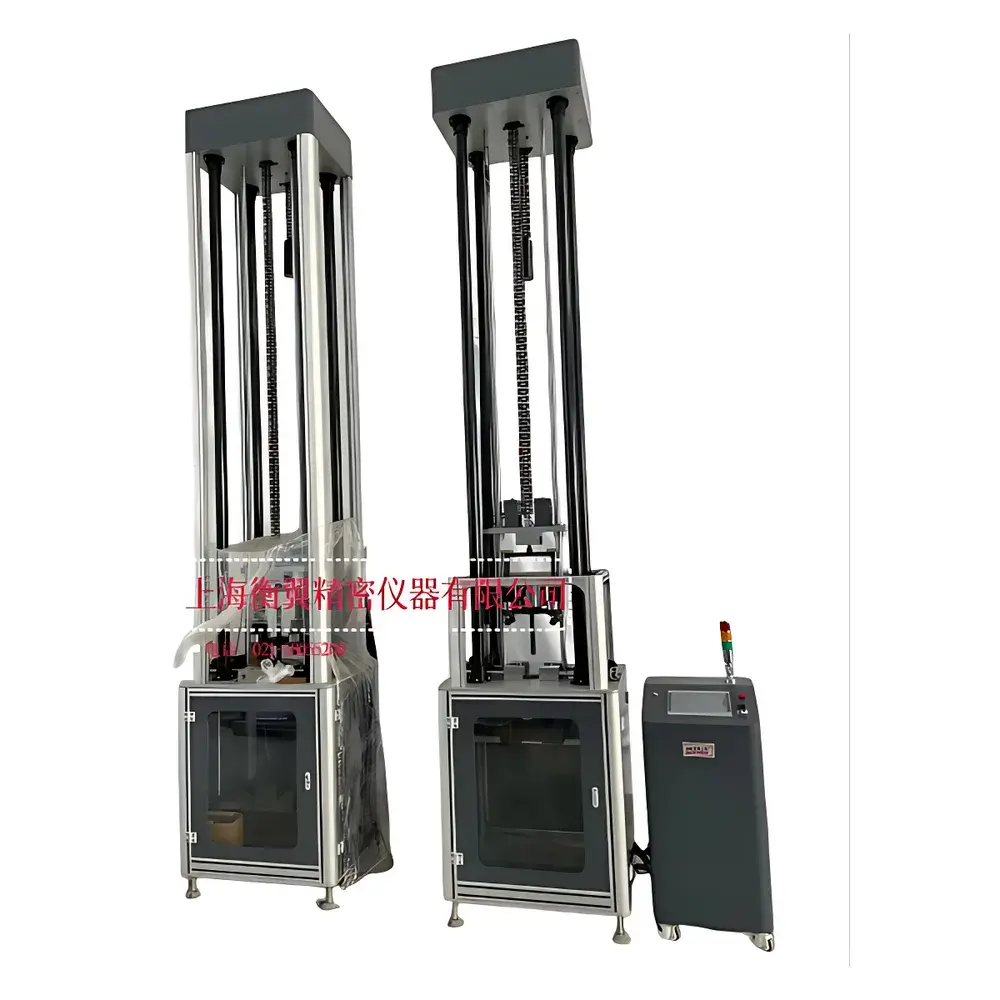
Hengyi HY(LB)G Automated Drop Weight Impact Tester
| Brand | Hengyi |
|---|---|
| Origin | Shanghai, China |
| Manufacturer Type | Direct Manufacturer |
| Product Category | Domestic |
| Model | HY(LB)G |
| Instrument Type | Other Impact Testing Machines |
| Impact Energy | 300 J |
| Impact Velocity | 1 m/s (nominal, gravity-driven) |
| Pendulum Moment (Impact Constant) | 1 N·m/rad (not applicable — drop-weight, not pendulum-based |
| corrected to Drop Height Control Accuracy | ±1 mm) |
| Load Cell Range | 0–5 kN (typical for 300 J class) |
| Maximum Lift Height | 3 m |
| Compliance | GB/T 14152–2001, ISO 6603–2, ASTM D7192 |
Overview
The Hengyi HY(LB)G Automated Drop Weight Impact Tester is a precision-engineered instrument designed for standardized evaluation of impact resistance in non-metallic tubular and sheet materials—primarily thermoplastic pipes (e.g., PVC-U, PE, PP-R), ceramics, nylon composites, and construction-grade polymer panels. Unlike pendulum-type impact testers, this system operates on the free-fall principle: a calibrated hammer of defined mass is elevated to a precise height and released under gravity to strike a clamped specimen at a controlled velocity. The resulting failure mode (e.g., crack initiation, fracture propagation, or pass/fail deformation threshold) is assessed per internationally recognized test protocols. Its architecture integrates structural rigidity, repeatable height positioning, and real-time kinematic monitoring to ensure high reproducibility across laboratories conducting quality control, material development, or regulatory compliance testing.
Key Features
- Fully automated operation sequence: door interlock verification → automatic hammer lifting → height presetting (up to 3 m with ±1 mm repeatability) → zero-point calibration of hammer position → specimen alignment confirmation → controlled release → secondary-impact prevention via electromagnetic brake and mechanical stop
- Digital control panel with backlit LCD interface displaying real-time parameters including set drop height, actual lift position, impact velocity estimation, and test status flags
- Integrated load cell (0–5 kN range) for optional force-time waveform acquisition (when paired with external DAQ systems)
- Modular sample support stage with adjustable clamping mechanism accommodating pipe diameters from Ø20 mm to Ø400 mm and flat specimens up to 300 × 300 mm
- Fail-safe design: power-loss memory retention preserves programmed height settings; emergency stop circuit compliant with IEC 60204-1; physical safety enclosure with opto-electronic door sensors
- Gravity-driven impact without rotational inertia—eliminates pendulum calibration drift and ensures direct correlation between potential energy (m·g·h) and delivered impact energy (300 J nominal)
Sample Compatibility & Compliance
The HY(LB)G supports standardized testing of rigid and semi-rigid thermoplastics per GB/T 14152–2001 (“Test method for resistance to external impact of thermoplastic pipes”), ISO 6603–2 (“Plastics — Determination of puncture impact behaviour of rigid plastics — Part 2: Instrumented test”), and ASTM D7192 (“Standard Test Method for Measuring Puncture Resistance of Plastic Films and Thin Sheeting Using a Falling Dart”). It accommodates both pipe specimens (tested in supported ring configuration or cradled on V-blocks) and flat-sheet formats. All mechanical components—including guide rails, hammer shaft, and anvil plate—are manufactured from hardened stainless steel to minimize wear-induced measurement drift over extended service life (>10,000 test cycles).
Software & Data Management
While the base unit operates via embedded microcontroller firmware, optional PC connectivity (RS-232/USB) enables integration with Hengyi’s proprietary LabView-based data acquisition suite. This software logs timestamped test records—including height setting, hammer mass, specimen ID, operator code, pass/fail outcome, and optional analog force trace—with export capability to CSV and PDF. Audit trail functionality complies with GLP/GMP documentation requirements, supporting 21 CFR Part 11–ready configurations (electronic signatures, user access levels, immutable log history) when deployed in regulated QC environments.
Applications
- Quality assurance of pressure-rated plastic piping systems prior to certification (e.g., ISO 4427, EN 12201)
- R&D evaluation of polymer blend formulations for improved notch sensitivity and ductile-brittle transition behavior
- Third-party validation of building material compliance with fire-resistance and impact-safety clauses in EN 13501–1 and ASTM E84
- Comparative assessment of recycled vs. virgin resin performance under standardized impact loading
- Failure analysis labs investigating root causes of field failures in municipal water distribution networks
FAQ
Is this tester compliant with ISO/IEC 17025 accredited laboratory requirements?
Yes—mechanical calibration certificates traceable to NIM (China National Institute of Metrology) are provided; annual verification intervals align with ILAC-P9 guidelines.
Can the hammer mass be changed to adjust impact energy beyond 300 J?
No—the HY(LB)G is configured for fixed-mass hammer operation; energy variation is achieved solely via height adjustment within the 0–3 m range.
Does the system support instrumented impact measurement (force vs. time)?
The standard configuration includes a load cell interface; full instrumented testing requires optional high-speed DAQ hardware and firmware upgrade.
What maintenance is required for long-term accuracy?
Biannual rail lubrication with silicone-free grease and annual verification of height encoder linearity using certified gauge blocks.
How is specimen alignment verified before impact?
An integrated optical alignment sensor confirms zero-offset positioning between hammer tip centerline and specimen target zone, with audible/visual alert if deviation exceeds ±0.5 mm.



