Rocktek RTK-BMP Automated Biochemical Methane Potential (BMP) Test System
| Brand | Rocktek |
|---|---|
| Origin | Hubei, China |
| Manufacturer Type | Authorized Distributor |
| Country of Origin | China |
| Model | RTK-BMP |
| Price | Upon Request |
| Application Domain | Environmental Engineering (Wastewater Treatment, Activated Sludge Assessment) |
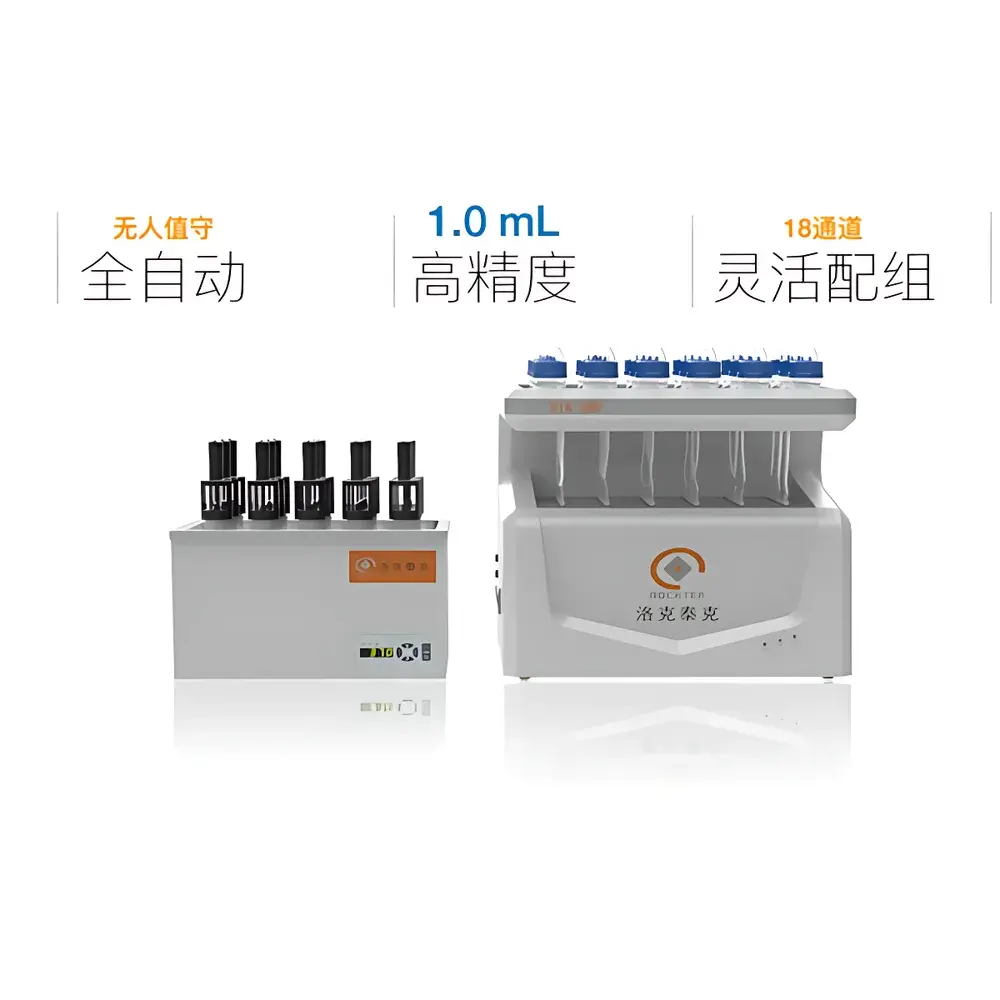
| Digestion Reactors | 18 × 500 mL (optional 1000 mL / 2000 mL, borosilicate glass) |
| Temperature Control | 25–99.9 °C (±0.15 °C), water bath, 2 kW heating, 25 L internal volume |
| Stirring | Brushless motor, 0–200 rpm, software-programmable speed & interval |
| CO₂ Absorption | 18 × 100 mL bottles, >98% efficiency with 3 M NaOH + pH indicator (optional) |
| Gas Measurement Principle | GMC Ultra-Micro Gas Measurement Technology |
| Gas Volume Resolution | 1.0 mL per channel |
| Standardization | Real-time correction to STP (273.15 K, 101.325 kPa) using integrated temperature & pressure sensors |
| Nitrogen Compensation | Automatic headspace and N₂-purge offset correction |
| Data Acquisition | ARM® Cortex™-based multi-core industrial controller, FPGA-accelerated I/O, web-based server architecture |
| Power Backup | Built-in UPS support for data retention during grid failure |
| User Access | Multi-user concurrent login with isolated experiment workspaces |
| Remote Access | Browser-based interface compatible with Windows, macOS, iOS, and Android over LAN |
Overview
The Rocktek RTK-BMP Automated Biochemical Methane Potential (BMP) Test System is an engineered platform for standardized, high-reproducibility assessment of anaerobic biodegradability and methane yield from organic substrates under controlled mesophilic or thermophilic conditions. It operates on the fundamental principle of volumetric gas displacement coupled with selective CO₂ absorption and real-time STP normalization—enabling quantitative determination of cumulative CH₄ production (mL CH₄ g⁻¹ VS added) and kinetic parameters including lag phase, maximum specific methane production rate (Rmax), and ultimate BMP. Designed in accordance with ISO 11734:1995, ASTM D5210-92 (reapproved 2020), and EU Commission Regulation (EU) No 2017/1476 (for biodegradability verification), the system supports regulatory-compliant testing required for waste characterization, co-digestion feasibility studies, and process stability evaluation in full-scale biogas plants.
Key Features
- GMC ultra-micro gas measurement technology with ±1.0 mL resolution per channel—optimized for low-yield substrates and early-phase kinetics where precision at sub-10 mL volumes is critical;
- Simultaneous monitoring of 18 independent digestion reactors (500 mL standard; optional 1000 mL / 2000 mL borosilicate glass vessels), each equipped with programmable mechanical stirring (0–200 rpm) and integrated temperature/pressure sensing;
- Dual-mode gas quantification: total biogas volume (CH₄ + CO₂) and CH₄-only volume via inline NaOH absorption (≥98% CO₂ removal efficiency); residual gas remains chemically unaltered for downstream GC-TCD/FID analysis;
- Real-time STP conversion using embedded PT100 temperature and piezoresistive pressure transducers—eliminating manual correction and ensuring inter-laboratory comparability;
- Automated nitrogen compensation algorithm that corrects for initial headspace volume and N₂ purge bias, preventing overestimation of early-stage gas production;
- ARM® Cortex™-based industrial controller with FPGA-accelerated I/O subsystem—delivering deterministic response latency (<10 ms) and robust immunity to electromagnetic interference in shared lab environments;
- Embedded web server architecture requiring no client-side software installation—accessible via any modern browser on desktop, tablet, or smartphone within local network;
- Multi-user role-based access control with encrypted session isolation, audit-trail logging, and automatic data backup upon power interruption via integrated UPS interface.
Sample Compatibility & Compliance
The RTK-BMP accommodates diverse feedstock matrices including sewage sludge, food waste, agricultural residues, lignocellulosic biomass, industrial effluents, and formulated synthetic substrates. Dry matter content ranges from <5% TS (wet digestion) to >25% TS (dry digestion), supported by reactor configuration flexibility (wet/dry mode selection). All wetted components—including reactors, CO₂ scrubbers, and gas transfer lines—are constructed from borosilicate glass (DIN ISO 3585) and PTFE-sealed fittings to ensure chemical inertness and long-term calibration stability. The system meets functional requirements for GLP-compliant laboratories as defined in OECD Principles of Good Laboratory Practice (ENV/MC/CHEM(98)17) and supports 21 CFR Part 11-ready electronic records when deployed with time-stamped, user-authenticated log export.
Software & Data Management
The embedded web application provides real-time visualization of cumulative gas production, instantaneous volumetric production rates, and derivative curves (dV/dt vs. time). Experimental protocols are configured via guided workflow templates aligned with ISO 11734 and ADAS RB220 guidelines. Each run generates a timestamped, digitally signed dataset containing raw sensor readings, STP-corrected volumes, stirring logs, temperature profiles, and CO₂ absorption status. Export formats include CSV (for Excel/Python post-processing), PDF summary reports (with metadata, calibration certificates, and operator ID), and XML-compatible structured logs for LIMS integration. Audit trails record all user actions—including parameter changes, manual overrides, and data exports—with immutable timestamps and IP address attribution.
Applications
- Quantitative BMP determination for feedstock screening and co-digestion matrix optimization;
- SMA (Specific Methanogenic Activity) assays to evaluate inoculum viability and toxicity thresholds;
- RGP (Residual Gas Potential) profiling of digestate to assess process completion and residual organics;
- Anaerobic toxicity assays (ATA) for evaluating inhibitory effects of heavy metals, antibiotics, or industrial chemicals;
- Kinetic modeling input generation (e.g., modified Gompertz, first-order hydrolysis) for plant-scale digester design;
- Standardized biodegradability testing of novel biopolymers and organic contaminants per OECD 311 and ISO 14852;
- Rumen fermentation simulation for livestock feed digestibility studies;
- Anammox gas evolution monitoring under nitrogen-limited anaerobic conditions.
FAQ
What standards does the RTK-BMP comply with for BMP testing?
The system implements measurement protocols consistent with ISO 11734:1995, ASTM D5210-92 (2020), and EU Regulation (EU) 2017/1476, supporting traceable, inter-laboratory comparable results.
Can the system measure both CH₄ and CO₂ separately without external analyzers?
Yes—the integrated NaOH absorption unit enables selective CO₂ removal; differential volume measurement before and after absorption yields CH₄-only output, while pre-absorption volume represents total biogas.
Is remote monitoring possible outside the local network?
Remote access beyond LAN requires secure VPN tunneling or reverse proxy configuration with TLS 1.2+ encryption—no cloud hosting or vendor-controlled infrastructure is involved.
How is data integrity maintained during power failure?
On detection of mains loss, the system triggers immediate non-volatile memory write of all buffered sensor data and experiment state, resuming acquisition seamlessly upon power restoration.
Does the software support automated report generation for regulatory submissions?
Yes—PDF reports include instrument ID, calibration validity dates, operator credentials, test standard references, raw + STP-adjusted data tables, and signature fields compliant with GLP documentation requirements.
Related Products