
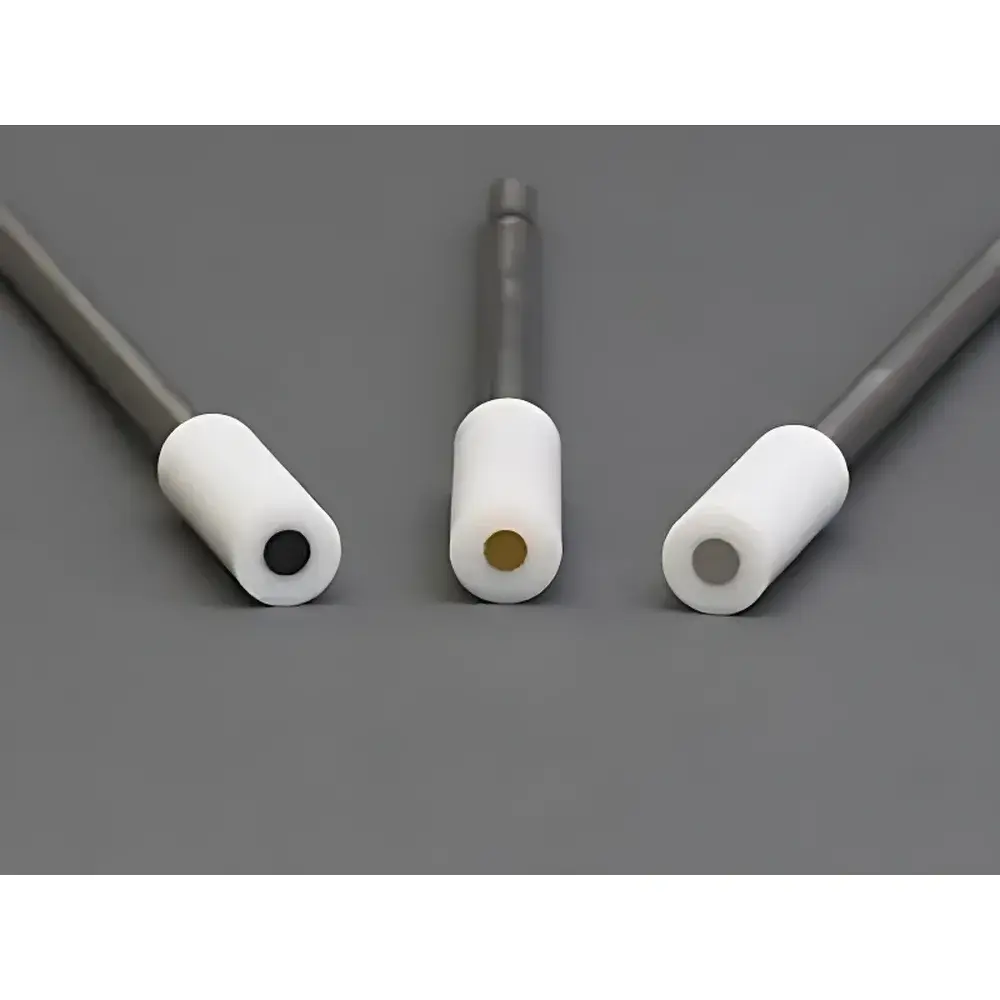
dc-energies DSR Rotating Disk Electrode (RDE) – Fast-Response Electrochemical Working Electrode
| Brand | dc-energies |
|---|---|
| Origin | Hubei, China |
| Manufacturer Type | Authorized Distributor |
| Product Category | Domestic |
| Model | DSR Rotating Disk Electrode (Fast-Response) |
| Electrode Materials | Glassy Carbon (GC), Gold (Au), Platinum (Pt) |
| Max Rotational Speed | 0–7000 rpm |
| Disk Diameter | 5 mm |
| Overall Electrode Outer Diameter | 12 mm |
| Operating Temperature Range | 10–25 °C |
| Electrode Construction | Monolithic (non-detachable shaft-electrode assembly) |
| Instrument Type | Electrochemical Working Electrode Accessory |
Overview
The dc-energies DSR Rotating Disk Electrode (RDE) is a precision-engineered electrochemical working electrode accessory designed for controlled hydrodynamic voltammetry and kinetic studies in aqueous and non-aqueous electrolytes. Based on the classical Levich equation and Koutecký–Levich analysis, this RDE operates under well-defined laminar flow conditions where mass transport to the electrode surface is governed by rotation-induced convection. The monolithic construction—integrating the electrode disk and shaft into a single rigid unit—eliminates mechanical play, minimizing eccentricity and vibration at high rotational speeds up to 7000 rpm. This structural integrity ensures reproducible diffusion-layer thickness control (δ ≈ 1.61 × 10⁵ ω⁻¹⁄² cm, where ω is angular velocity in rad·s⁻¹), critical for quantitative determination of electron transfer kinetics, catalytic turnover frequencies, and oxygen reduction reaction (ORR) mechanisms.
Key Features
- Monolithic shaft-disk architecture prevents misalignment and micro-vibration during rapid rotation, enhancing signal stability and long-term measurement repeatability.
- Three standard electrode material options—glassy carbon (GC), polycrystalline gold (Au), and platinum (Pt)—each polished to <0.05 µm RMS surface roughness and validated via cyclic voltammetry in standard redox couples (e.g., Fe(CN)₆³⁻/⁴⁻).
- Precision-machined 5 mm active disk diameter with tight tolerance (±0.02 mm), ensuring consistent geometric area (A = 0.196 cm²) across batches for reliable current normalization.
- Compact outer diameter (12 mm) enables compatibility with standard electrochemical cells (e.g., 3-electrode Teflon or glass H-cells) and commercial rotator chucks (e.g., Pine Research AFMSRX, BASi RDE-1).
- Thermally stable design rated for continuous operation within 10–25 °C ambient range—aligned with ISO 8573-1 Class 4 compressed air specifications for laboratory environments.
Sample Compatibility & Compliance
The DSR RDE supports a broad spectrum of electrocatalytic and corrosion-related investigations, including but not limited to: oxygen evolution/reduction reactions (OER/ORR), hydrogen evolution reaction (HER), CO₂ reduction, and chloride-induced pitting studies. Its inert GC, Au, and Pt surfaces exhibit minimal background current in pH 1–13 electrolytes and withstand repeated potential cycling between −1.0 V and +1.5 V vs. Ag/AgCl (3 M KCl). All materials comply with ASTM E200-22 (Standard Practice for Preparation of Aqueous Solutions) and are traceable to NIST SRM 2241 (Glassy Carbon Reference Material). The electrode body conforms to IEC 61000-6-3 (EMC emission limits) when used with certified potentiostats.
Software & Data Management
While the DSR RDE is a passive hardware component, its performance is fully leveraged through integration with industry-standard electrochemical software platforms—including BioLogic EC-Lab, CH Instruments CHI760E, and Metrohm Autolab NOVA—enabling automated rotation-speed ramping, Koutecký–Levich plot generation, and Tafel slope extraction. Experimental metadata (rotation speed, temperature, scan rate, electrolyte composition) can be embedded directly into data files (.mpt, .txt) for audit-ready traceability. When deployed in regulated environments (e.g., GLP-compliant battery R&D labs), the electrode’s batch-specific calibration certificates support 21 CFR Part 11 compliance when paired with electronic lab notebooks (ELNs) featuring digital signature and version control.
Applications
- Quantitative evaluation of heterogeneous electron transfer rates in fuel cell catalyst layers (e.g., Pt/C, Fe–N–C).
- Determination of diffusion coefficients (D) and solution-phase concentrations using Levich plots (limiting current vs. ω¹⁄²).
- In situ monitoring of electrode fouling or passivation via time-resolved rotating ring-disk electrode (RRDE) coupling.
- Accelerated stress testing (AST) of anode materials in Li-ion battery electrolytes under convective mass transport control.
- Validation of computational fluid dynamics (CFD) models simulating boundary layer behavior near rotating electrodes.
FAQ
Is the DSR RDE compatible with third-party rotator systems beyond Pine Research?
Yes—the 12 mm outer diameter and standardized M4 threaded interface conform to ISO 2768-mK general tolerances, enabling mechanical coupling with most commercial RDE rotators (e.g., ALS, Metrohm, Gamry) via adapter sleeves.
Can the electrode be cleaned and reused after exposure to viscous or polymer-containing electrolytes?
Yes—standard regeneration involves sequential ultrasonication (acetone → ethanol → deionized water), followed by electrochemical polishing in 0.5 M H₂SO₄ (for Pt/Au) or mechanical repolishing (for GC) using 0.05 µm alumina slurry on a microcloth pad.
Does dc-energies provide calibration data or certification for individual electrodes?
Each DSR RDE shipment includes a Certificate of Conformance listing batch number, material grade, disk diameter measurement (calibrated with Mitutoyo IP67 digital micrometer), and representative cyclic voltammograms in 5 mM K₃Fe(CN)₆ + 0.1 M KCl.





