
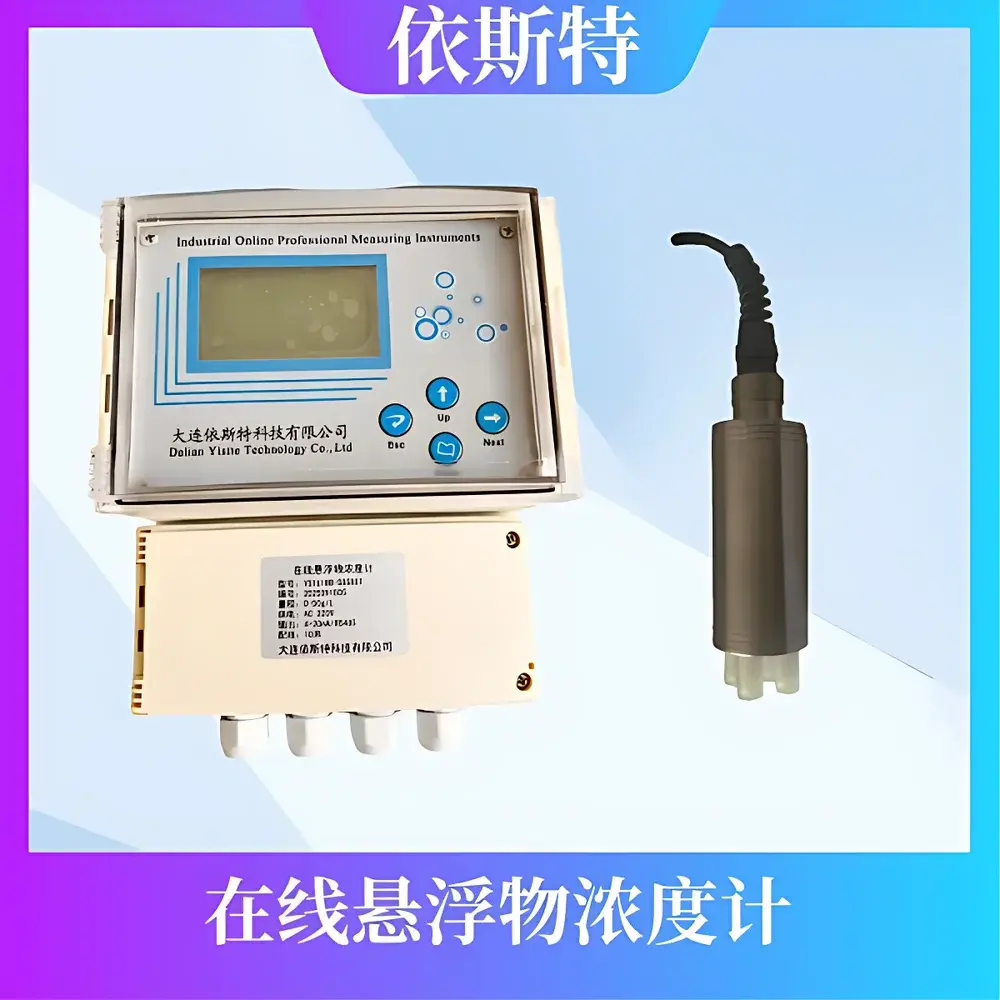
YST308B-MS880T Suspended Solids Analyzer by YST Instrument (Dalian)
| Brand | YST Instrument (Dalian) |
|---|---|
| Origin | Liaoning, China |
| Model | YST308B-MS880T |
| Measurement Principle | Transmittance-Scattering Hybrid Optical Method |
| Range | 0–5000 mg/L |
| Accuracy | ≤±2% FS |
| Resolution | 1 mg/L |
| Response Time (T90) | ≤10 s |
| Operating Temp. (Sensor) | −10–80 °C |
| Operating Temp. (Transmitter) | 0–50 °C |
| Humidity | ≤90% RH (non-condensing) |
| pH Compatibility | 2–12 |
| Output Signals | Isolated 4–20 mA analog + RS485 digital (Modbus RTU) |
| Power Supply | AC 220 V ±10% 50/60 Hz or DC 24 V ±10% |
| Enclosure Rating | Sensor IP68, Transmitter IP65 |
| Cleaning | Integrated Automatic Wiper System |
Overview
The YST308B-MS880T Suspended Solids Analyzer is an industrial-grade, in-line optical sensor engineered for continuous, real-time quantification of total suspended solids (TSS) concentration in aqueous media. It employs a hybrid optical detection principle combining transmittance and scattering measurements—simultaneously capturing both light attenuation and angular scattering intensity within the sample stream. This dual-signal approach mitigates measurement ambiguity caused by particle size distribution shifts, color interference, or varying turbidity-to-concentration ratios—common limitations of single-mode optical sensors. The device is calibrated traceably against gravimetric reference standards per ISO 11923 and ASTM D3730, ensuring metrological consistency across diverse wastewater, process water, and effluent applications. Designed for permanent installation in pressurized or open-channel configurations, it delivers stable performance under dynamic hydraulic conditions without requiring sample extraction, filtration, or chemical reagents—supporting unattended operation in compliance with long-term monitoring requirements defined in EPA Method 160.2 and ISO 5667-16.
Key Features
- Hybrid optical sensing architecture: Dual-wavelength LED sources and synchronized photodetectors enable simultaneous transmittance and 90° forward-scatter signal acquisition, improving robustness against fouling-induced drift and particle morphology variation.
- Integrated automatic cleaning system: Motor-driven wiper mechanism actuates at user-defined intervals (e.g., hourly or per cycle), removing biofilm, scale, or particulate buildup from the optical window—reducing manual intervention to ≤2 inspections per month under typical municipal wastewater conditions.
- Wide operational envelope: Sensor housing constructed from chemically resistant PEEK and 316L stainless steel withstands aggressive media (pH 2–12), while temperature-compensated electronics maintain measurement stability across −10 °C to 80 °C ambient and process temperatures.
- Dual-output interface: Galvanically isolated 4–20 mA analog output (HART-compatible) and RS485 serial port (Modbus RTU) support seamless integration into legacy PLCs, DCS platforms, SCADA systems, and cloud-based water intelligence dashboards.
- Field-configurable diagnostics: Onboard self-test routines monitor LED intensity decay, detector gain drift, and wiper motor status; diagnostic logs are accessible via Modbus register map for predictive maintenance planning.
Sample Compatibility & Compliance
The YST308B-MS880T is validated for use in municipal wastewater influent/effluent, activated sludge mixed liquor, industrial cooling water, food & beverage process streams (e.g., wort, juice, dairy whey), and stormwater runoff. Its optical path design minimizes sensitivity to air bubbles and flow turbulence, with flow-rate independence verified across 0.3–3.0 m/s in pipe-mounted installations (DN50–DN200). The analyzer complies with electromagnetic compatibility requirements per IEC 61326-1 (industrial environment), meets IP68 ingress protection for submersion up to 10 m, and supports GLP-aligned data integrity through configurable audit trail logging (timestamped configuration changes, calibration events, and alarm triggers). While not certified for FDA 21 CFR Part 11 out-of-the-box, its Modbus-enabled data export facilitates third-party validation for regulated pharmaceutical or biotech water systems.
Software & Data Management
No proprietary PC software is required for basic commissioning; all parameters—including zero/span calibration, cleaning schedule, damping factor, and alarm thresholds—are configured via ASCII command set over RS485 or via local LCD menu navigation. For centralized deployment, the device supports standard Modbus RTU register mapping (holding registers 40001–40100), enabling direct ingestion into industry-standard SCADA historian databases (e.g., Ignition, Siemens Desigo, or OSIsoft PI System). Raw sensor outputs (transmittance %, scatter intensity, compensated TSS value) and diagnostic flags (e.g., “window dirty”, “LED degradation warning”) are individually addressable—facilitating multivariate trend analysis and early fault detection. Data retention on internal flash memory spans ≥30 days at 1-minute sampling intervals, with cyclic overwrite behavior compliant with EN 62443-3-3 security guidelines for embedded devices.
Applications
- Wastewater treatment optimization: Real-time MLSS monitoring in aeration basins enables dynamic control of dissolved oxygen setpoints and return activated sludge (RAS) flow rates—reducing energy consumption by up to 15% while maintaining nitrification efficiency.
- Food & beverage process control: Inline wort clarity assessment during lautering allows adaptive adjustment of mash filter speed and recirculation duration, minimizing beta-glucan carryover and improving final beer colloidal stability.
- Industrial pretreatment verification: Continuous TSS tracking at plant influent points ensures compliance with local discharge permits (e.g., NPDES limits) and triggers automated diversion valves upon exceedance events.
- Stormwater quality management: Paired with rainfall gauges in combined sewer overflows (CSOs), the analyzer provides event-based sediment load quantification for regulatory reporting under EPA CSO Control Policy.
FAQ
Does the YST308B-MS880T require periodic calibration with reference suspensions?
Yes—initial field calibration using formazin or polymer-based standard suspensions (traceable to NIST SRM 2036) is recommended at commissioning. Subsequent verification intervals depend on application severity; monthly checks suffice for municipal secondary effluent, while weekly verification is advised for high-fouling industrial streams.
Can the sensor be installed in pressurized pipelines without flow restriction?
Yes—the compact insertion probe design (Ø36 mm × 180 mm) features a streamlined hydrodynamic profile compatible with ANSI B16.5 Class 150 flanged mounting or threaded NPT adapters. No bypass loop or flow conditioning is required.
Is the 4–20 mA output intrinsically safe for hazardous area installation?
No—the standard transmitter does not hold ATEX or IECEx certification. For Zone 1/2 environments, users must integrate a certified safety barrier (e.g., Pepperl+Fuchs KFD2-STC4-EX2) between the analyzer and control system.
How is temperature compensation implemented?
A Pt1000 RTD embedded adjacent to the optical chamber measures local thermal gradient; compensation coefficients are applied in real time using a second-order polynomial algorithm derived from multi-point thermal soak testing per IEC 60770-1.
What maintenance documentation is provided for regulatory audits?
The device generates timestamped calibration logs, cleaning event records, and firmware revision history—all exportable via Modbus as CSV-formatted reports suitable for inclusion in GMP/GLP audit packages.
Related Products







