
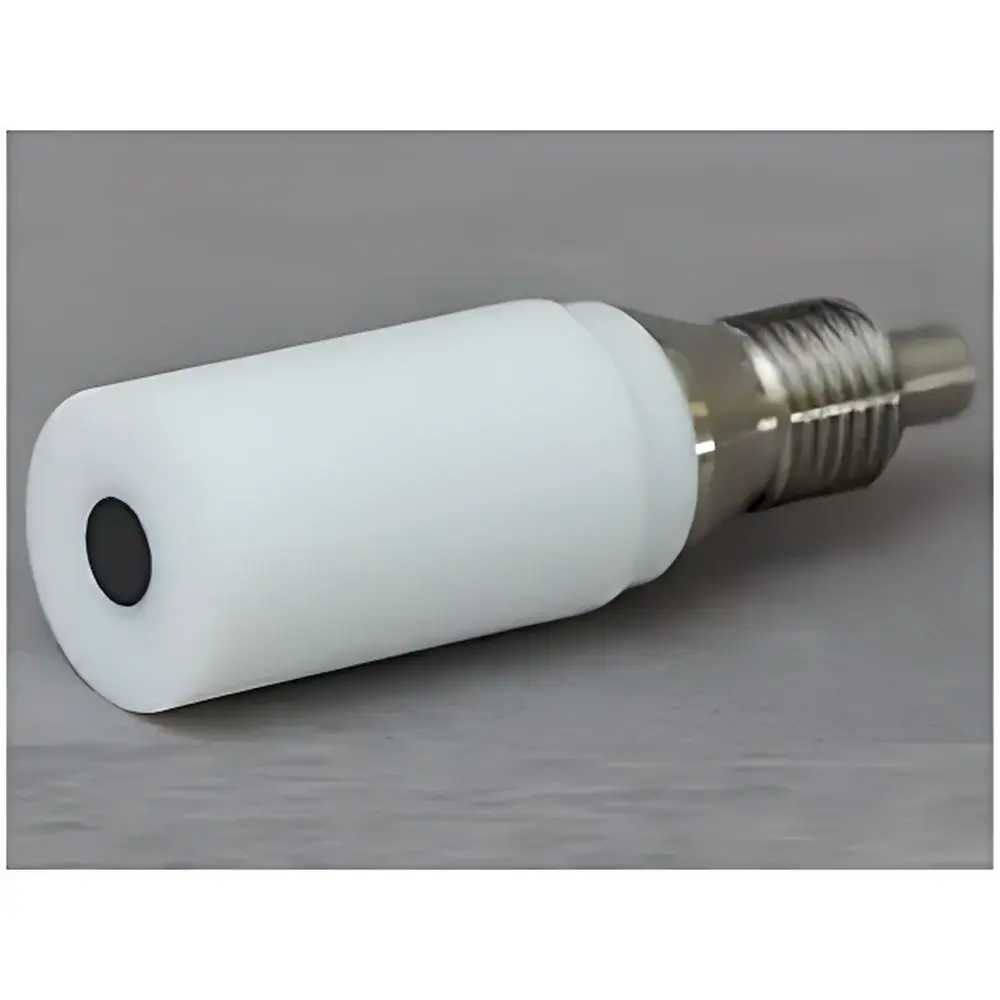
dc-energies RDE Rotating Disk Electrode
| Brand | dc-energies |
|---|---|
| Material Options | Glassy Carbon (GC), Gold (Au), Platinum (Pt) |
| Operating Temperature Range | 10–25 °C |
| Disk Electrode Diameter | 5.0 mm |
| Overall Electrode Outer Diameter | 15 mm |
| Housing Material | PTFE (Polytetrafluoroethylene) |
| Electrical Interface | External Threaded Contact |
| Compliance | Designed for ASTM G102, ISO 17475, and electrochemical standard cell configurations |
Overview
The dc-energies RDE Rotating Disk Electrode is a precision-engineered electrochemical working electrode designed for controlled hydrodynamic studies in fundamental and applied electrochemistry. Based on the Levich equation and rotating disk electrode theory, this device enables quantitative analysis of mass-transport-controlled reactions by establishing a well-defined, laminar diffusion layer at the electrode surface. Rotation generates a steady-state convective flow profile perpendicular to the disk plane, allowing accurate determination of kinetic parameters—including electron transfer rates, diffusion coefficients, and heterogeneous reaction mechanisms—under reproducible boundary conditions. The RDE is integral to mechanistic investigations in fuel cell catalysis, corrosion science, battery electrode kinetics, and sensor development, where precise control over mass transport is essential for deconvoluting kinetic and diffusional contributions.
Key Features
- Three standard electrode material options: high-purity glassy carbon (GC), polycrystalline gold (Au), and platinum (Pt), each polished to <0.05 µm Ra surface finish and validated for electrochemical reversibility using ferrocene/ferricenium redox couples.
- Monolithic disk geometry with precisely defined 5.0 mm active diameter, embedded in chemically inert PTFE housing (outer diameter 15 mm), ensuring dimensional consistency across batches and eliminating edge effects during rotation.
- External threaded electrical contact interface (M4 × 0.7 thread) provides low-resistance (<5 mΩ), vibration-resistant connection to commercial rotator shafts—compatible with Pine Research, BASi, and Metrohm Autolab RDE/RRDE systems.
- PTFE encapsulation delivers exceptional chemical resistance: stable in ≥18 M H₂SO₄, 12 M HCl, 15 M HNO₃, and alkaline solutions up to 10 M KOH at ambient temperatures (10–25 °C).
- Manufactured under controlled environmental conditions to maintain density uniformity and crystallographic homogeneity—critical for minimizing background current noise and ensuring ≤±2% deviation in Levich slope across replicate measurements.
Sample Compatibility & Compliance
The dc-energies RDE supports aqueous, non-aqueous, and ionic liquid electrolyte systems, including LiPF₆ in EC/DMC, EMIM-BF₄, and acetonitrile-based redox mediators. Its geometry conforms to ASTM G102-89 (Standard Practice for Calculating Corrosion Rates) and ISO 17475:2004 (Electrochemical Impedance Spectroscopy—Terminology and Definitions). When used with certified rotators operating at ±0.5% speed accuracy (e.g., 100–3000 rpm), the system meets GLP requirements for kinetic data traceability. Full documentation—including material certificates of conformance, surface roughness metrology reports, and cyclic voltammetry validation curves—is provided with each unit.
Software & Data Management
While the RDE itself is a passive transducer, its integration into electrochemical workstations (e.g., BioLogic SP-300, Gamry Interface 5000E) enables synchronized acquisition of current vs. rotation rate (Koutecký–Levich analysis), Tafel slopes, and rotating ring-disk electrode (RRDE) coulometric efficiency calculations. All dc-energies RDE units are compatible with standard potentiostat firmware supporting digital signal averaging, real-time Levich plot generation, and export of raw .txt/.csv datasets. For regulated environments, the electrode’s physical traceability (batch number, material lot ID) aligns with 21 CFR Part 11 audit trail requirements when paired with compliant data acquisition software.
Applications
- Oxygen reduction reaction (ORR) activity screening for Pt-alloy and Fe–N–C catalysts in PEMFC research.
- Quantitative evaluation of chloride-induced pitting initiation kinetics on stainless steel and Ni-based alloys.
- Determination of diffusion-controlled limiting currents for redox-active species (e.g., Ru(NH₃)₆³⁺/²⁺, [Fe(CN)₆]³⁻/⁴⁻) in sensor calibration protocols.
- In situ monitoring of lithium intercalation/deintercalation kinetics in cathode materials (e.g., NMC811, LFP) using non-aqueous RDE cells.
- Validation of computational fluid dynamics (CFD) models simulating boundary layer development at rotating electrodes.
FAQ
What rotational speeds are supported with this RDE?
The electrode is mechanically rated for continuous operation from 100 rpm to 3000 rpm; optimal performance is achieved within 200–2500 rpm for most aqueous electrochemical systems.
Can the RDE be used in high-temperature electrochemical cells?
No—the specified operating temperature range is strictly 10–25 °C. Elevated temperatures may compromise PTFE integrity and induce thermal drift in disk alignment.
Is the electrode suitable for RRDE configurations?
Yes—this RDE disk is dimensionally compatible with standard commercial ring-disk assemblies; users must specify required ring material (Pt, Au, GC) and gap distance separately.
How is electrode surface reproducibility verified before shipment?
Each unit undergoes cyclic voltammetry in 5 mM K₃[Fe(CN)₆]/0.1 M KCl, with peak separation ΔEp ≤ 65 mV and Ip ratio (anodic/cathodic) within 0.98–1.02 as acceptance criteria.
Does dc-energies provide calibration certificates?
Yes—NIST-traceable dimensional verification (disk diameter, thickness) and electrochemical validation reports are included with every order.







