
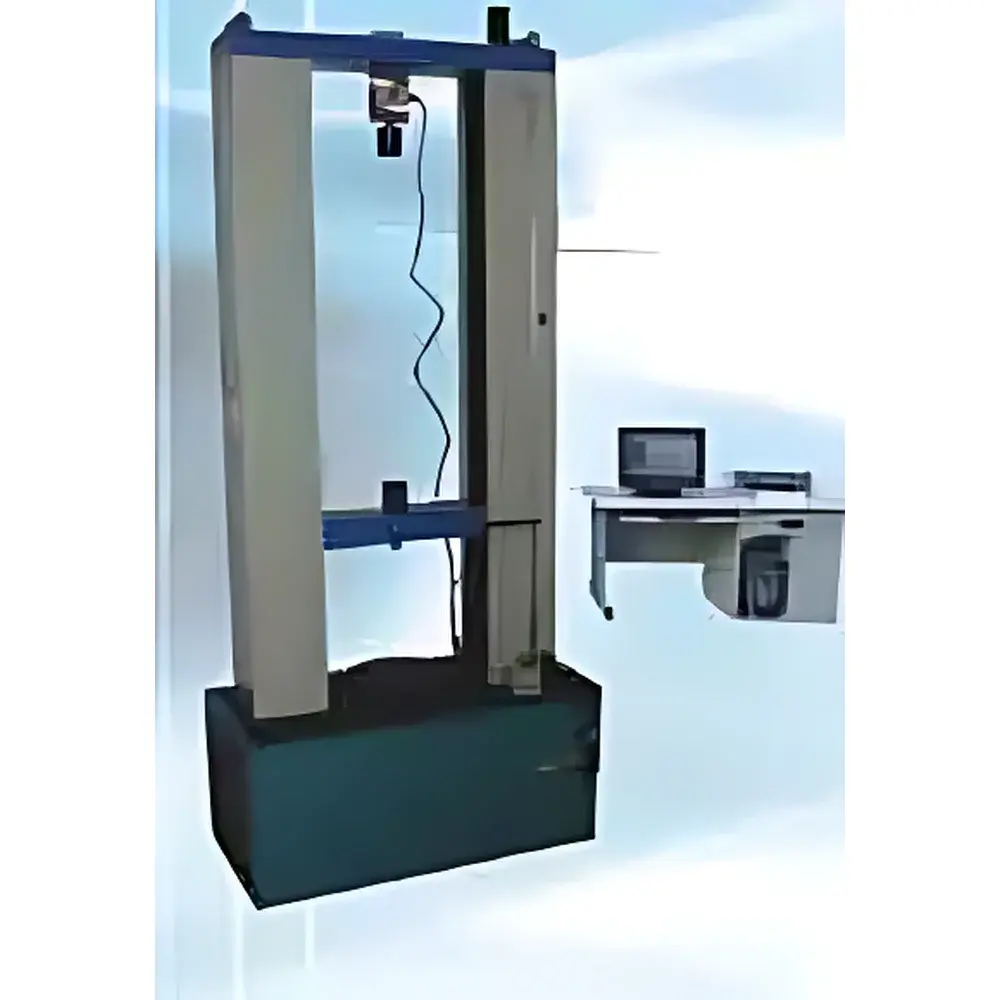
JByq JB-119A Universal Tensile and Compression Testing Machine
| Brand | JByq |
|---|---|
| Origin | Taiwan |
| Model | JB-119A |
| Load Capacity | 0–5 ton (selectable) |
| Force Sensing | High-precision load cell (USA-made) |
| Force Accuracy | ±0.5% FS |
| Effective Test Width | 380 mm |
| Max. Tensile Span | 1000 mm |
| Drive System | Servo motor (Japan-made) + AC motor (Taiwan-made) |
| Mechanical Transmission | Precision ball screw (Taiwan-made) + High-strength backlash-free screw (Korea-made) |
| Test Speed Range | 0.001–500 mm/min (stepless, programmable) |
| Displacement Accuracy | ±0.005% FS |
| Resolution | 1/200,000 |
| Safety Features | Upper/lower mechanical limits, emergency stop switch |
| Display | Dual-mode — PC-based GUI + embedded microcomputer display |
| Units | g, kg, N, kN, lb, lbf |
| Power Supply | 220 V / 380 V, 50 Hz |
| Net Weight | 1180 kg |
| Dimensions (W×D×H) | 1280 × 950 × 1800 mm |
| Fixture | Customizable per sample geometry |
| Optional Accessories | PC workstation, thermal/inkjet printer, extensometer, proprietary test software |
Overview
The JByq JB-119A Universal Tensile and Compression Testing Machine is an electromechanically integrated materials testing system engineered for precision mechanical property evaluation across industrial R&D, quality control, and production validation environments. It operates on the principle of controlled uniaxial force application—measuring load response under defined displacement or strain rate conditions—according to standardized quasi-static testing protocols (e.g., ASTM E4, ISO 7500-1, GB/T 228.1). The machine delivers repeatable, traceable force-displacement data for tensile, compressive, flexural (three-point bend), and shear loading configurations. Its modular architecture supports both manual and automated test sequences, with dual-display operation enabling real-time monitoring via embedded microcontroller interface and synchronized high-resolution PC-based visualization.
Key Features
- High-fidelity force measurement using a certified USA-manufactured load cell, calibrated to ±0.5% full-scale accuracy in accordance with ISO 376 Class 0.5 requirements.
- Dual-drive configuration: A Japan-sourced servo motor ensures fine-speed resolution (0.001 mm/min), while a Taiwan-sourced AC motor provides robust torque delivery at higher speeds (up to 500 mm/min), supporting both low-strain-rate creep studies and rapid yield-point detection.
- Mechanical transmission employs dual-stage precision components—a Taiwan-fabricated ground ball screw for smooth linear motion and a Korea-supplied zero-backlash high-strength screw assembly—to eliminate hysteresis and ensure positional repeatability within ±0.005% FS.
- Modular safety architecture includes redundant upper/lower mechanical limit switches, a fail-safe emergency stop circuit compliant with IEC 60204-1, and automatic load cutoff upon signal anomaly detection.
- 1/200,000 internal resolution enables sub-micron displacement tracking and high-fidelity stress–strain curve reconstruction—even during brittle fracture or low-force elastomer characterization.
- Configurable test environment support: Compatible with environmental chambers (−70 °C to +300 °C), video extensometry systems, and digital image correlation (DIC) hardware for non-contact strain mapping.
Sample Compatibility & Compliance
The JB-119A accommodates specimens ranging from thin polymer films (<0.1 mm thick) to structural metal coupons (up to 50 mm cross-section), including wires, rods, composites, adhesives, textiles, leather, rubber compounds, and electrical insulation materials. Standard fixtures include wedge-action tensile grips, compression platens, three-point bending fixtures, and shear adapters—all machined to ISO 26203-2 tolerances. The system meets mechanical verification requirements per ASTM E4 and ISO 7500-1 for class 1 universal testing machines. When equipped with optional audit-trail-enabled software, it supports 21 CFR Part 11-compliant electronic records and signatures, facilitating GLP/GMP-regulated laboratories in pharmaceutical packaging, medical device component validation, and automotive supplier qualification.
Software & Data Management
The proprietary Windows-based test software provides ISO 17025-aligned workflow management: test method definition (predefined templates for ASTM D638, ISO 527, EN 10002-1, etc.), real-time curve overlay, multi-specimen statistical reporting (mean, SD, CV%), and export to CSV, PDF, or XML formats. All test parameters—including speed profiles, hold times, trigger thresholds, and calibration metadata—are stored with timestamped audit trails. Raw data files retain full 20-bit analog-to-digital resolution; no interpolation or lossy compression is applied. Integration with LIMS platforms is supported via OPC UA and RESTful API endpoints. Software updates are version-controlled and documented per ICH Q9 risk management principles.
Applications
This system is routinely deployed for mechanical validation in aerospace fastener qualification (ASTM F606), automotive sealant peel strength (ISO 8510-2), battery electrode tensile integrity (IEC 62660-2), textile seam strength (ASTM D1683), and medical catheter burst pressure pre-screening (ISO 10555-1). In academic settings, it serves as a platform for constitutive modeling of hyperelastic polymers and viscoelastic damping characterization. Its wide speed range supports both quasi-static monotonic tests and slow-cycle fatigue precursor analysis (e.g., 10–100 cycles at 0.1 mm/min), bridging the gap between conventional tensile testers and advanced servo-hydraulic systems.
FAQ
What standards does the JB-119A comply with for force calibration and verification?
It conforms to ISO 7500-1:2018 (class 1) and ASTM E4-22 for static force verification, with traceability to NIST-certified reference standards via accredited third-party calibration certificates.
Can the system perform cyclic loading or fatigue testing?
While not a dedicated fatigue tester, it supports programmed load/displacement cycling up to 1,000 cycles at speeds ≤50 mm/min—sufficient for preliminary durability screening and hysteresis loop analysis.
Is the software validated for regulated industries?
Yes—when configured with 21 CFR Part 11 modules, it provides role-based access control, electronic signatures, change history logging, and data integrity assurance per ALCOA+ principles.
What is the maximum specimen height accommodated in compression mode?
With standard platens, vertical clearance is 1000 mm; custom-height columns can extend this to 1400 mm upon request.
Does the system support real-time data streaming to external SCADA or MES platforms?
Yes—via Ethernet TCP/IP with Modbus TCP or OPC UA protocol support, enabling direct integration into factory automation ecosystems without middleware dependency.



