
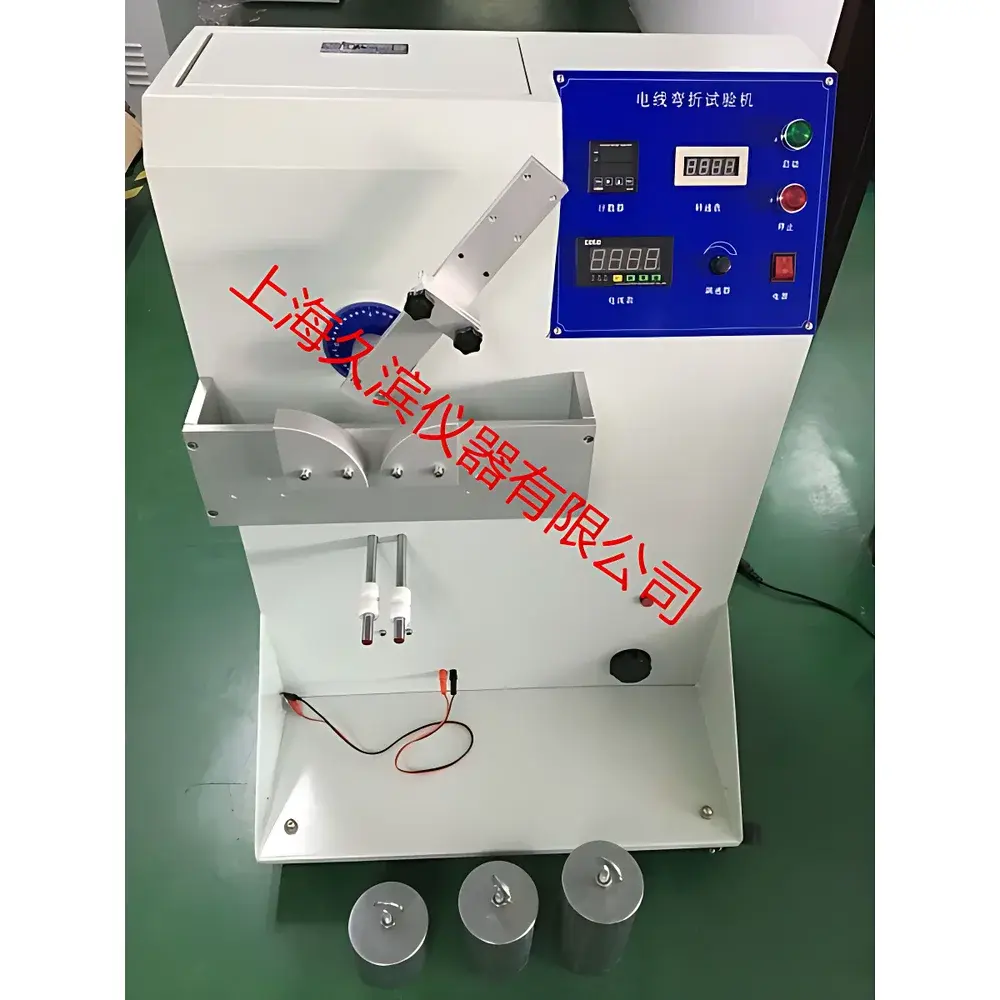
JB Instruments JB-TZ Special Cable Flexing and Bending Endurance Tester
| Brand | JB Instruments |
|---|---|
| Model | JB-TZ |
| Origin | Shanghai, China |
| Power Supply | AC 220 V / 50 Hz |
| Rated Power | ~90 W |
| Flexing Rate | 5–60 cycles/min (digital display) |
| Bend Angle Adjustment Range | 10°–180° |
| Maximum Pre-set Cycles | 0–1,000,000 |
| Test Stations | 1 station |
| Standard Weights | 50 N, 75 N, 100 N (1 each) |
| Bend Radius Fixtures | R80 mm, R120 mm, R200 mm (3 pairs) |
| Compliance Reference | GB/T 2423.42, IEC 60227-2, IEC 60245-2, UL 817 Annex F, ASTM D1329 (applicable sections) |
Overview
The JB Instruments JB-TZ Special Cable Flexing and Bending Endurance Tester is an electromechanical test system engineered for evaluating the mechanical durability of insulated electrical cables under repeated flexing stress. It operates on the principle of controlled cyclic bending—subjecting a fixed-length cable specimen to oscillatory motion about a defined radius while maintaining constant tensile load and electrical continuity monitoring. The device replicates real-world service conditions experienced by flexible cords in robotics, portable tools, medical equipment, and industrial automation systems where dynamic movement induces conductor fatigue and insulation microcracking. Unlike static tensile or compression testers, the JB-TZ implements a kinematically constrained pendulum-type actuation mechanism that ensures repeatable angular displacement, precise load application via calibrated weights, and synchronized cycle counting with real-time open-circuit detection.
Key Features
- Digitally adjustable flexing frequency (5–60 cycles per minute), displayed via integrated LED counter with ±1 cycle accuracy
- Wide-range bend angle control (10° to 180°), enabling simulation of both shallow arc and full U-bend deformation modes
- Modular radius-specific clamping fixtures (R80 mm, R120 mm, R200 mm) conforming to IEC 60227-2 and GB/T 2423.42 dimensional requirements
- Dual-mode termination: one end secured in rigid bending jig; the other loaded with traceable deadweights (50 N, 75 N, 100 N) to replicate specified mechanical tension
- Integrated continuity monitoring circuitry applying 0.1 A DC test current across conductors—automatically halts test upon open-circuit detection and logs final cycle count
- Non-volatile cycle memory retains pre-set target counts (0–1,000,000) and supports auto-stop at threshold or failure event
- Robust aluminum alloy frame with precision-ground linear guides and sealed stepper motor drive for long-term operational stability
Sample Compatibility & Compliance
The JB-TZ accommodates finished cables with nominal conductor cross-sections ≥6 mm² and outer diameters up to 85 mm. Specimens must be cut to minimum length of 600 mm, sampled from locations ≥1 m apart per GB/T 2423.42 Clause 5.2. Fixture selection is determined by measured outer diameter (D): R80 mm for D ≤ 35 mm; R120 mm for 35 mm < D ≤ 50 mm; R200 mm for 50 mm < D ≤ 85 mm. The system supports compliance verification per IEC 60227-2 (PVC-insulated cables), IEC 60245-2 (rubber-insulated cables), UL 817 Annex F (extension cord flexing), and ASTM D1329 (low-temperature flexibility assessment when combined with environmental chamber). All test parameters—including applied force, radius, rate, and duration—are documented in accordance with GLP audit requirements.
Software & Data Management
While the JB-TZ operates as a stand-alone benchtop instrument without proprietary software, it generates traceable physical test records via its front-panel digital interface. Cycle count, stop reason (target reached vs. open-circuit fault), and elapsed time are retained in non-volatile memory. For laboratory information management system (LIMS) integration, optional RS-232 or USB-to-serial output enables automated data export to CSV or Excel-compatible formats. All firmware adheres to IEC 62443-3-3 cybersecurity baseline requirements for industrial control devices. Audit trails comply with FDA 21 CFR Part 11 principles when paired with validated third-party data acquisition modules.
Applications
- Qualification testing of robot arm power/encoder cables subjected to >10⁶ flex cycles in production environments
- Verification of medical device cordsets (e.g., electrosurgical pencils, imaging probe cables) against IEC 60601-1 clause 8.10.3 mechanical integrity
- R&D evaluation of novel polymer insulations (TPU, TPE, ETFE) under accelerated flex-fatigue stress
- QC release testing for UL-listed portable appliance cords (e.g., vacuum cleaners, power tools)
- Comparative analysis of stranded vs. tinsel conductor architectures under identical bending kinematics
- Pre-validation of cable assemblies prior to HALT/HASS thermal-mechanical stress screening
FAQ
What standards does the JB-TZ directly support?
IEC 60227-2, IEC 60245-2, GB/T 2423.42, UL 817 Annex F, and relevant clauses of ASTM D1329.
Can the tester accommodate flat or ribbon cables?
Yes—provided the cable’s maximum thickness falls within the clamping jaw clearance and its bending stiffness allows uniform curvature around the selected radius fixture.
Is calibration certification included with delivery?
A factory-issued calibration report covering weight verification (±0.5% FS), angle repeatability (±0.3°), and cycle counter accuracy (±1 count) is supplied; ISO/IEC 17025-accredited calibration is available as an option.
How is electrical continuity monitored during testing?
A dedicated 0.1 A DC current source is applied across all conductors in series; interruption triggers immediate motor shutdown and latches the final cycle value on the display.
Does the system meet CE or UKCA marking requirements?
The JB-TZ complies with the EMC Directive 2014/30/EU and Low Voltage Directive 2014/35/EU; CE Declaration of Conformity is provided with shipment.



