
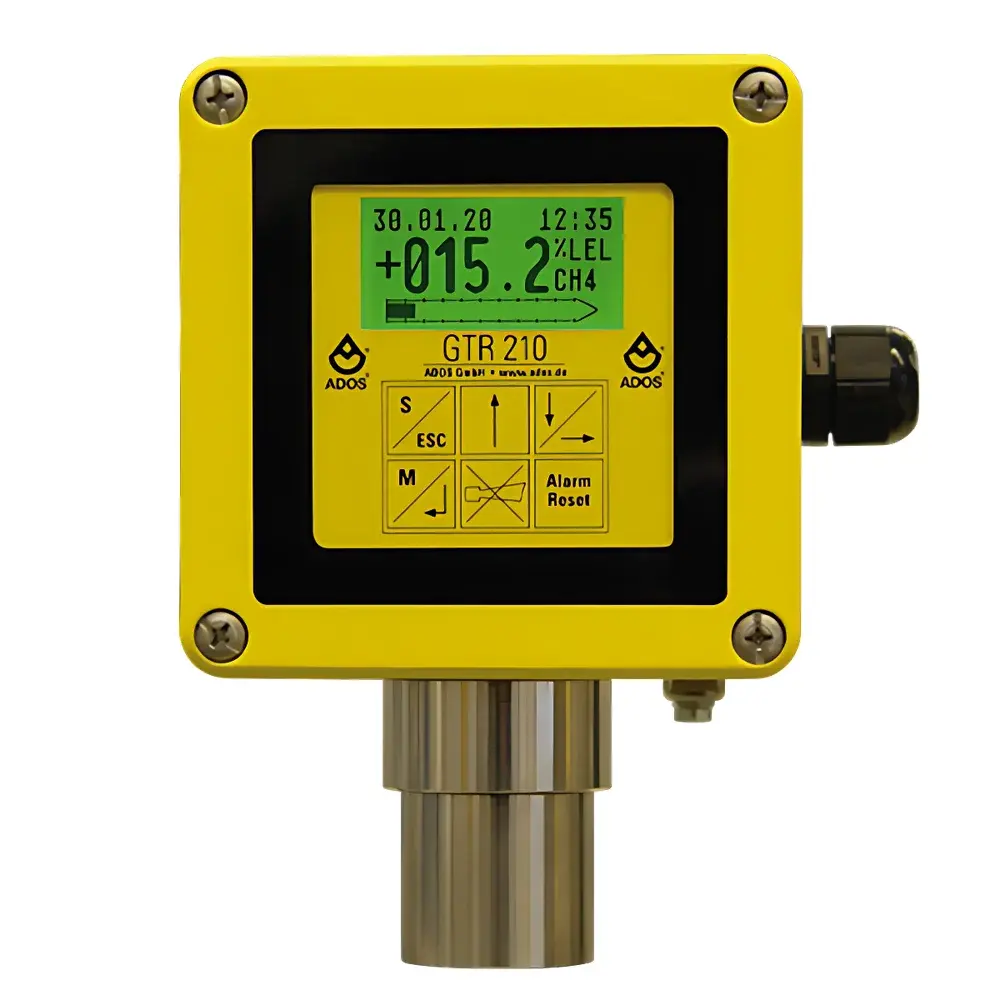
ADOS GTR210 / GTR210 MED Intrinsically Safe Gas Transmitter for Hazardous Areas
| Brand | ADOS |
|---|---|
| Origin | Germany |
| Model | GTR210 / GTR210 MED |
| Instrument Type | Single-Channel Intrinsically Safe Gas Transmitter |
| Explosion Protection | II 2G Ex db e ia mb IIC T4 Gb |
| ATEX Certificate | DEKRA 11 ATEX 0257 X |
| IECEx Certificate | IECEx DEK 11.0090 X |
| MED Certification | Directive 2014/90/EU, Approval No. MEDB00006EV |
| Power Supply | 24 V DC (+10% / −25%) / 230 V AC 50 Hz / 115 V AC 60 Hz (optional) |
| Output Signal | 4–20 mA (3-wire), LON (4-wire optional) |
| Relay Outputs | 4 dry-contact alarm/fault relays + 1 reset input |
| Enclosure Rating | IP66/IP67 (standard), IP54 (optional) |
| Operating Temperature | −25 °C to +60 °C |
| Weight | 2.3 kg (GTR210 EX), 1.8 kg (GTR210 standard), 2.0 kg (GTR210 MED) |
| Sensor Technologies | Semiconductor (TGS), Catalytic Bead (VQ), Thermal Conductivity (GOW), Electrochemical (TOX), Infrared (IR), Photoionization (PID), Paramagnetic (O₂) |
| Typical Response Times | 30–120 s depending on sensor type |
| Full-Scale Accuracy | ±2 % to ±5 % FS |
| Temperature Drift | ≤2 % to 5 % of reading per 10 K |
| Pressure Influence | ≤1 % FS per bar |
| Sensor Lifetime | 12 months (PID) to 7 years (electrochemical, IR, catalytic) |
| Mounting Options | Wall-mount, pipe-mount, flange-mount (vacuum or explosion-proof variants available) |
Overview
The ADOS GTR210 and GTR210 MED are certified intrinsically safe gas transmitters engineered for continuous, real-time monitoring of toxic, combustible, inert, and oxygen-deficient atmospheres in both non-hazardous and Zone 1/Zone 2 explosive environments. Designed and manufactured in Germany, the GTR210 platform leverages modular sensor architecture to support up to six distinct detection principles—catalytic bead (for LEL hydrocarbons), electrochemical (for H₂S, CO, NO₂, SO₂, NH₃), infrared (for CO₂, CH₄), photoionization (for VOCs such as toluene, xylene, chloroform), thermal conductivity (for H₂, He, N₂), semiconductor (for broad-spectrum reducing gases), and paramagnetic (for O₂)—within a single compact housing. Each sensor operates independently with dedicated signal conditioning, enabling simultaneous multi-gas analysis without cross-interference. The transmitter outputs a linear 4–20 mA analog signal proportional to gas concentration, compatible with distributed control systems (DCS), programmable logic controllers (PLC), and centralized alarm panels located in safe areas. Its robust aluminum die-cast enclosure meets IP66/IP67 ingress protection, ensuring reliable operation under marine spray, dust, vibration, and temperature extremes from −25 °C to +60 °C.
Key Features
- ATEX and IECEx certified for use in explosive gas atmospheres (II 2G Ex db e ia mb IIC T4 Gb); full compliance with EN 60079-0, -1, -11, -15, and -26
- SIL 1 functional safety certification per IEC 61508 and IEC 61511; includes diagnostic coverage, self-test routines, and fault logging for process safety integrity
- MED-certified variant (GTR210 MED) approved under EU Marine Equipment Directive 2014/90/EU for installation on seagoing vessels, including engine rooms, cargo holds, and bilge areas
- Modular sensor design allows field-replaceable cartridges with pre-calibrated electronics, minimizing downtime and eliminating need for re-zeroing after swap
- Configurable 4–20 mA output with HART-compatible protocol option; optional LON bus interface for integration into building automation or industrial IoT networks
- Four independent SPDT relay outputs for high/low alarm, fault indication, and system shutdown; one isolated digital input for remote alarm acknowledge/reset
- Wide power flexibility: 24 V DC (standard), 230 V AC 50 Hz, or 115 V AC 60 Hz (optional internal PSU)
Sample Compatibility & Compliance
The GTR210 supports detection of over 100 target gases across its sensor portfolio—including methane (CH₄), propane (C₃H₈), acetylene (C₂H₂), carbon dioxide (CO₂), carbon monoxide (CO), hydrogen sulfide (H₂S), ammonia (NH₃), sulfur dioxide (SO₂), nitrogen dioxide (NO₂), oxygen (O₂), benzene (C₆H₆), toluene (C₇H₈), and phosphine (PH₃). Sensor selection is application-specific and governed by gas physical properties: catalytic bead sensors respond to combustible gases within their lower explosive limit (LEL); electrochemical cells deliver ppb–ppm resolution for electroactive toxics; NDIR detectors provide stable %vol measurements for CO₂ and hydrocarbons; PID modules detect volatile organic compounds with ionization potentials below 10.6 eV; and paramagnetic O₂ sensors ensure drift-free oxygen monitoring in inerting or combustion control applications. All configurations comply with ISO 10156 (gas group classification), EN 50104 (toxic gas detectors), EN 50194 (combustible gas detectors), and US EPA Method TO-15 requirements for ambient air sampling where applicable.
Software & Data Management
Configuration, calibration, and diagnostics are performed via ADOS’ proprietary PC-based software suite (GTR ConfigTool), which runs on Windows OS and communicates via USB-to-RS485 adapter. The tool enables full parameterization of alarm thresholds, response delays, damping filters, zero/span calibration sequences, and relay logic. Audit trails—including calibration date/time, operator ID, span gas concentration, and before/after readings—are stored locally and exportable as CSV or PDF reports compliant with FDA 21 CFR Part 11 when used with electronic signature-enabled workstations. Firmware updates preserve configuration integrity and support future sensor firmware enhancements. For enterprise deployment, optional Modbus TCP or MQTT gateways allow seamless ingestion into SCADA, CMMS, or cloud-based predictive maintenance platforms—enabling trend analysis, deviation alerts, and lifecycle tracking of sensor health metrics (e.g., baseline drift, response decay, zero offset).
Applications
The GTR210 series is deployed globally in fixed-installation safety and environmental monitoring roles requiring long-term stability and regulatory traceability. Key use cases include: continuous emissions monitoring (CEM) at flare stacks and vent headers in petrochemical plants; confined space entry verification in offshore platforms and shipyards; inert gas monitoring in LNG carrier cargo tanks; leak detection in hydrogen refueling stations; indoor air quality (IAQ) surveillance in laboratories handling solvents or reactive gases; and process gas composition control in semiconductor fabrication cleanrooms. The GTR210 MED variant fulfills mandatory marine classification society requirements (DNV GL, LR, ABS, BV) for fire and gas detection systems aboard commercial vessels, particularly in machinery spaces where diesel vapors, refrigerant leaks, or battery off-gassing pose dual toxicity/explosion hazards.
FAQ
What certifications does the GTR210 hold for hazardous area use?
It carries ATEX (DEKRA 11 ATEX 0257 X), IECEx (IECEx DEK 11.0090 X), and SIL 1 (BVS 12 ATEX G 001 X) certifications, meeting Zone 1/2 requirements per IEC 60079 standards.
Can the GTR210 be used in marine environments?
Yes—the GTR210 MED variant is certified under EU Directive 2014/90/EU (MEDB00006EV) and accepted by major classification societies for permanent installation on seagoing vessels.
How often do sensors require calibration?
Electrochemical and catalytic sensors typically require bump testing every 30 days and full calibration every 3–6 months; IR and paramagnetic sensors may extend to 12-month intervals under stable conditions.
Is remote configuration supported?
Local USB-based configuration is standard; remote access requires integration via Modbus TCP or MQTT through an external gateway—no built-in Wi-Fi or cellular connectivity is provided.
What mounting options are available?
Standard wall-mount bracket included; optional pipe clamps, vacuum flanges (DIN 28403), and explosion-proof conduit entries (EN 60079-14) are available for specialized installations.
Related Products







