
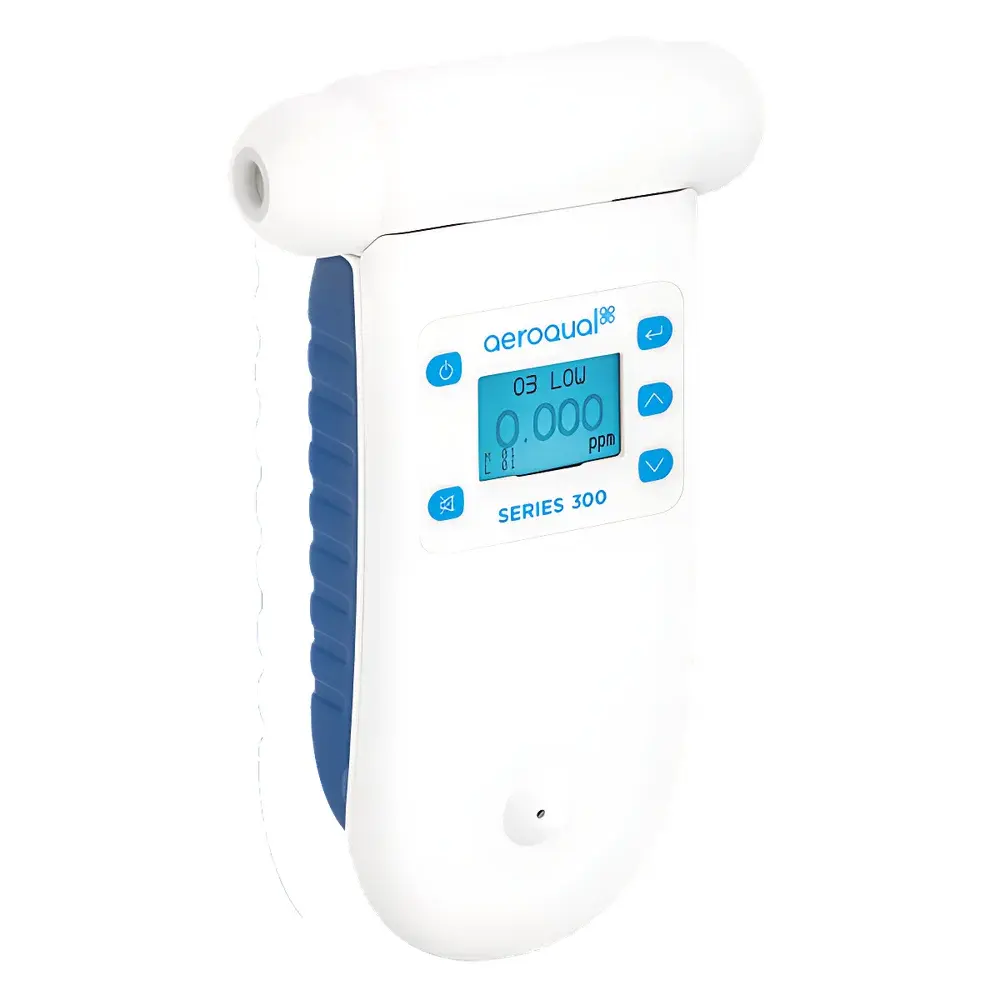
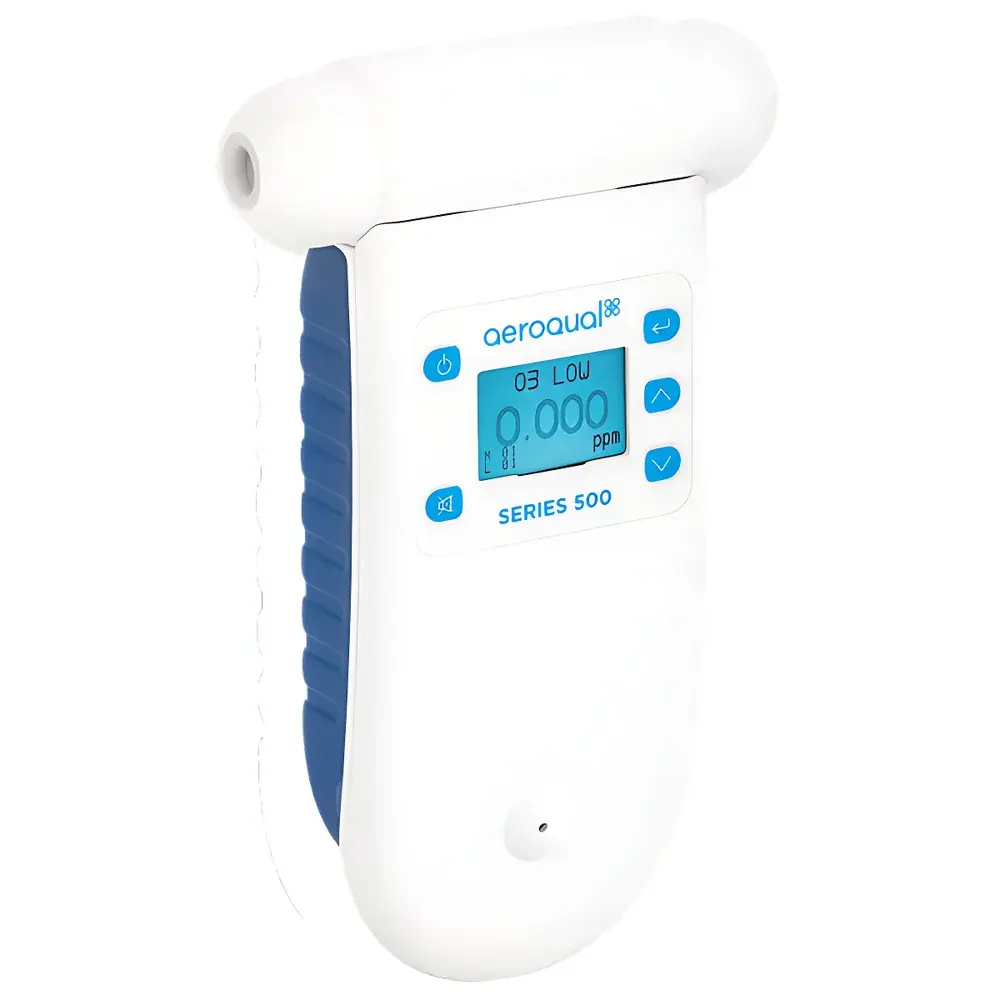
Aeroqual S300/S500 Handheld Air Quality Analyzer
| Brand | Aeroqual |
|---|---|
| Origin | New Zealand |
| Model | S300/S500 |
| Measurement Units | ppm, mg/m³, % RH, °C/°F |
| Display Functions | Current, Min/Max/Avg Values |
| Sampling | Active fan-assisted, interchangeable sensor heads |
| Calibration | Zero and span calibration supported |
| Temperature Range | −40 °C to 124 °C |
| Humidity Range | 0–100% RH (non-condensing) |
| Operating Temp. | 0–40 °C |
| Storage | −5 °C to 45 °C, 0–95% RH |
| Enclosure | PC/ABS, IP20 / NEMA 1 |
| Dimensions (w/sensor head) | 195 × 122 × 54 mm |
| Weight | <460 g (<16 oz) with battery & sensor |
| Power | Rechargeable 12 VDC Li-ion (2700 mAh) |
| Analog Output | 0–5 V |
| Digital Interface | RS-232 to USB |
| Data Logging Capacity | Up to 8,188 records |
| Clock | Real-time timestamping |
| Compliance | FCC Part 15 |
| EN 50082-1 | 1997 |
| EN 50081-1 | 1992 |
| Optional Accessories | Industrial protective housing, wall mount, IP41 remote sensor kit, carry case, humidity/temperature probe |
Overview
The Aeroqual S300 and S500 Handheld Air Quality Analyzers are field-deployable, multi-parameter environmental monitoring instruments engineered for precision, flexibility, and operational robustness in both indoor and outdoor air quality assessment. Built on a modular architecture, these analyzers employ plug-and-play sensor heads—each optimized for a specific gas or particulate species—enabling rapid reconfiguration across 16 distinct measurement parameters without hardware modification. The core measurement principles vary by sensor type: electrochemical (EC) cells for toxic gases such as H2S, NO2, Cl2, and SO2; non-dispersive infrared (NDIR) for CO2; photoionization detection (PID) for broad-spectrum volatile organic compounds (VOCs); semiconductor (MOS) sensors for H2, CH4, and NMHC; laser particle counter (LPC) technology for PM1, PM2.5, PM4, PM10, and TSP; and dedicated optical sensors for O3 and formaldehyde (CH2O). This hybrid sensor strategy ensures metrological appropriateness per analyte—balancing sensitivity, selectivity, response time, and long-term stability—while maintaining consistent data formatting and user interface logic across configurations.
Key Features
- Modular sensor platform supporting 16 interchangeable gas and particulate sensor heads—including EC, NDIR, PID, MOS, LPC, and optical chemiluminescence variants—enabling single-instrument deployment across diverse regulatory and occupational health use cases.
- Active fan-assisted sampling ensures representative air draw across all sensor types, minimizing boundary layer effects and enhancing measurement reproducibility—particularly critical for low-concentration VOC and ozone detection.
- Onboard real-time data processing delivers concurrent current, minimum, maximum, and time-weighted average values for all active parameters, with automatic timestamping aligned to internal RTC.
- Integrated temperature and relative humidity sensing (−40 °C to 124 °C; 0–100% RH) supports environmental compensation of gas sensor outputs per ISO 16000-23 and ASTM D6196 guidance.
- Rechargeable 12 VDC lithium-ion battery (2700 mAh) provides >12 hours continuous operation under typical multi-sensor use; hot-swappable capability allows uninterrupted field monitoring during battery exchange.
- Compliant analog (0–5 V) and digital (RS-232 → USB) interfaces enable seamless integration into facility SCADA systems, third-party data loggers, or custom QA/QC dashboards.
- Ruggedized enclosure constructed from UL94-V0-rated PC/ABS blend meets IP20 (NEMA 1) ingress protection—suitable for laboratory, industrial hygiene, and municipal field applications where dust exposure is controlled.
Sample Compatibility & Compliance
The S300/S500 system accommodates ambient air, workplace breathing-zone samples, and localized emission plumes without pre-conditioning—provided relative humidity remains within sensor-specific operating limits (typically 15–95% RH, non-condensing). Sensor cross-sensitivity profiles are documented per IEC 60079-29-1 and EN 45544-1, with built-in compensation algorithms activated when co-located humidity or temperature readings exceed defined thresholds. All factory calibrations are traceable to NIST-certified reference standards, and full calibration certificates—including zero and span verification data—are supplied with each sensor head. The instrument satisfies electromagnetic compatibility requirements per EN 50082-1:1997 and EN 50081-1:1992, and complies with FCC Part 15 Subpart B for unintentional radiators. While not intrinsically safe, optional IP41-rated remote sensor kits allow deployment in classified zones when paired with appropriate barrier systems.
Software & Data Management
Aeroqual’s proprietary LogBox software (Windows-compatible) provides secure, audit-ready data management: import, visualize, annotate, and export time-series datasets with embedded metadata (sensor ID, calibration date, operator ID, GPS coordinates if enabled via external module). Data files conform to ASTM E2500-18 structure, supporting direct ingestion into LIMS platforms compliant with 21 CFR Part 11 when configured with electronic signature and audit trail modules. Internal memory stores up to 8,188 timestamped records per parameter, with automatic overwrite protection for flagged events (e.g., excursion alerts). Firmware updates preserve calibration coefficients and user-defined alarm thresholds, ensuring continuity across maintenance cycles. Export formats include CSV, Excel (.xlsx), and PDF reports with customizable headers, footers, and compliance statements.
Applications
- Indoor Air Quality (IAQ) Audits: Quantitative assessment of CO2, CO, NO2, O3, VOCs, and PM fractions per ASHRAE Standard 62.1 and ISO 16000 series protocols.
- Occupational Hygiene Monitoring: Real-time personal exposure evaluation for H2S, Cl2, NH3, SO2, and formaldehyde against OSHA PELs and ACGIH TLVs®.
- Leak Detection & Emergency Response: Rapid identification and spatial mapping of CH4, H2, and NMHC releases during refinery inspections or hazmat incidents.
- Environmental Compliance Screening: Pre-audit surveys for landfill gas (CH4/CO2), wastewater treatment off-gas (H2S/NH3), and urban roadside NO2/O3 gradients.
- Educational & Research Fieldwork: Portable platform for student-led atmospheric chemistry experiments, building science investigations, and community air monitoring initiatives.
FAQ
Can the S300/S500 be used for regulatory compliance reporting?
Yes—when operated with factory-calibrated, NIST-traceable sensor heads and documented calibration records, data may support Tier 2 or screening-level compliance under EPA Method TO-15, ISO 16017-1, or local air quality ordinances. Full regulatory acceptance depends on jurisdiction-specific validation requirements.
What is the recommended calibration frequency?
Aeroqual recommends zero calibration before each day’s use and span calibration every 30 days—or after exposure to concentrations exceeding 80% of full scale—to maintain stated accuracy specifications.
Are sensor heads interchangeable between S300 and S500 units?
Yes. All sensor heads are mechanically and electrically compatible across both models; firmware updates ensure consistent communication protocol handling.
Does the instrument support GPS-tagged measurements?
The base unit does not include integrated GPS, but external Bluetooth GPS receivers (e.g., Garmin GLO 2) can be paired via serial interface to embed geolocation metadata in exported logs.
How is data integrity ensured during extended logging sessions?
Internal memory uses wear-leveling flash architecture with cyclic redundancy check (CRC) validation on every write operation; corrupted records are automatically quarantined and flagged in LogBox software.







