
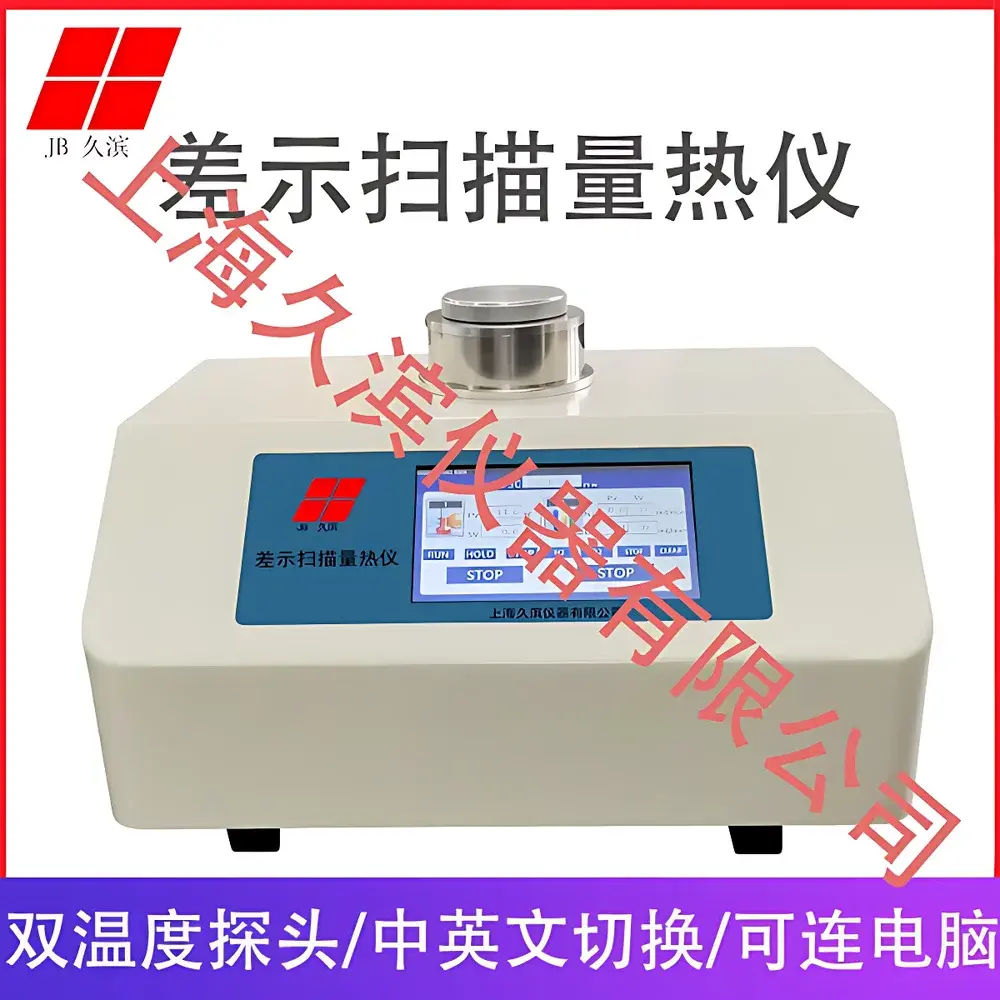
JB-DSC-800 Differential Scanning Calorimeter (DSC) by Jiubin Instruments
| Brand | Jiubin Instruments |
|---|---|
| Origin | Shanghai, China |
| Model | JB-DSC-800 |
| Temperature Range | Ambient to 800 °C (air-cooled) |
| Temperature Accuracy | ±0.1 °C |
| Heating/Cooling Rate | 1–80 K/min |
| Heat Flow Resolution | 0.1 μW |
Overview
The JB-DSC-800 is a high-performance differential scanning calorimeter engineered for precise thermal transition analysis of polymeric materials, including thermoplastics, elastomers, and composite granules. It operates on the fundamental principle of heat flux DSC—measuring the difference in heat flow between a sample and an inert reference as both are subjected to a controlled linear temperature program. This enables quantitative determination of glass transition temperature (Tg), crystallization onset (Tc), melting point (Tm), heat capacity changes (Cp), and enthalpy of phase transitions. Designed specifically for routine quality control and R&D applications in polymer science, the JB-DSC-800 delivers robust thermal stability and reproducible baseline performance across its full operating range from ambient to 800 °C—making it suitable not only for polymer Tg characterization but also for decomposition studies, oxidative induction time (OIT) testing, and curing kinetics evaluation.
Key Features
- Air-cooled furnace architecture eliminates dependency on liquid nitrogen or external chillers—reducing operational cost and footprint while maintaining thermal stability up to 800 °C.
- Precision temperature control with ±0.1 °C accuracy across the entire scan range, validated per ASTM E794 and ISO 11357-1 calibration protocols.
- Adjustable heating and cooling rates from 1 to 80 K/min, enabling method flexibility for rapid screening or high-resolution transition analysis.
- High-sensitivity micro-furnace sensor with 0.1 μW heat flow resolution ensures detection of subtle thermal events in low-mass samples (e.g., 1–10 mg plastic granules).
- Modular crucible system compatible with standard aluminum, gold-plated aluminum, and high-purity alumina pans—supporting both sealed and open configurations for volatile or reactive samples.
- Integrated real-time gas purge control (N2, air, O2) with mass flow regulation for atmosphere-dependent thermal stability assessments (e.g., oxidation resistance per ASTM D3895).
Sample Compatibility & Compliance
The JB-DSC-800 accommodates solid polymer granules, pellets, films, powders, and molded specimens without preprocessing—ideal for incoming raw material verification and batch-to-batch consistency checks in extrusion and compounding workflows. Sample holders support direct loading of 3–8 mg granules, minimizing handling-induced thermal history artifacts. The instrument complies with key international standards for thermal analysis instrumentation, including ISO 11357 series (Plastics — Differential Scanning Calorimetry), ASTM E1356 (Standard Test Method for Assignment of the Glass Transition Temperature by DSC), and USP <1151> for pharmaceutical polymer excipient characterization. Data acquisition meets GLP/GMP documentation requirements, with optional audit trail functionality supporting FDA 21 CFR Part 11 compliance when paired with validated software modules.
Software & Data Management
Controlled via proprietary Windows-based Thermal Analysis Suite (v4.2+), the JB-DSC-800 provides intuitive method setup, real-time curve monitoring, and automated peak identification using derivative and baseline interpolation algorithms. Raw data is stored in vendor-neutral ASCII format (.txt) and universal .qdx archives, ensuring long-term accessibility and third-party compatibility (e.g., with OriginLab, MATLAB, or Thermo Scientific™ OMNIC). Batch processing tools enable comparative Tg trend analysis across multiple samples, with statistical reporting (mean, SD, RSD%) exportable to Excel. All instrument operations—including calibration logs, user login timestamps, and parameter modifications—are recorded in an immutable event log for traceability in regulated environments.
Applications
- Determination of glass transition temperature (Tg) in PET, PC, ABS, PP, PE, and engineering thermoplastics per ISO 11357-2.
- Crystallinity assessment and cold-crystallization behavior in semi-crystalline polymers such as PEEK and PA66.
- Oxidative stability evaluation via OIT and Oxidative Onset Temperature (OOT) under dynamic air/N2 atmospheres.
- Curing exotherm analysis for thermoset resins and prepregs used in composites manufacturing.
- Thermal degradation profiling and char yield estimation for flame-retardant formulations.
- Quality assurance of recycled polymer streams—detecting contamination, blending ratios, or thermal history effects.
FAQ
What sample mass is recommended for accurate Tg measurement of plastic granules?
For optimal signal-to-noise ratio and thermal equilibrium, 3–5 mg of uniformly sized granules is recommended. Larger masses may cause internal thermal gradients; smaller masses reduce detection sensitivity.
Can the JB-DSC-800 perform modulated DSC (MDSC®)?
No—the JB-DSC-800 implements conventional heat-flux DSC only. It does not support temperature-modulated scanning modes.
Is calibration traceable to NIST standards?
Yes—temperature and enthalpy calibration are performed using certified reference materials (indium, zinc, tin) with NIST-traceable certificates included with each instrument shipment.
Does the system support automated sample changers?
Not natively—the JB-DSC-800 is a single-position manual-loading platform. High-throughput labs requiring unattended operation should consider integration with third-party robotic autosamplers compatible with standard DSC pan geometry.
What maintenance is required for long-term thermal accuracy?
Annual recalibration is recommended. Routine maintenance includes periodic cleaning of the sensor surface, verification of purge gas flow integrity, and inspection of furnace insulation integrity—no consumable parts require replacement under normal use.



