
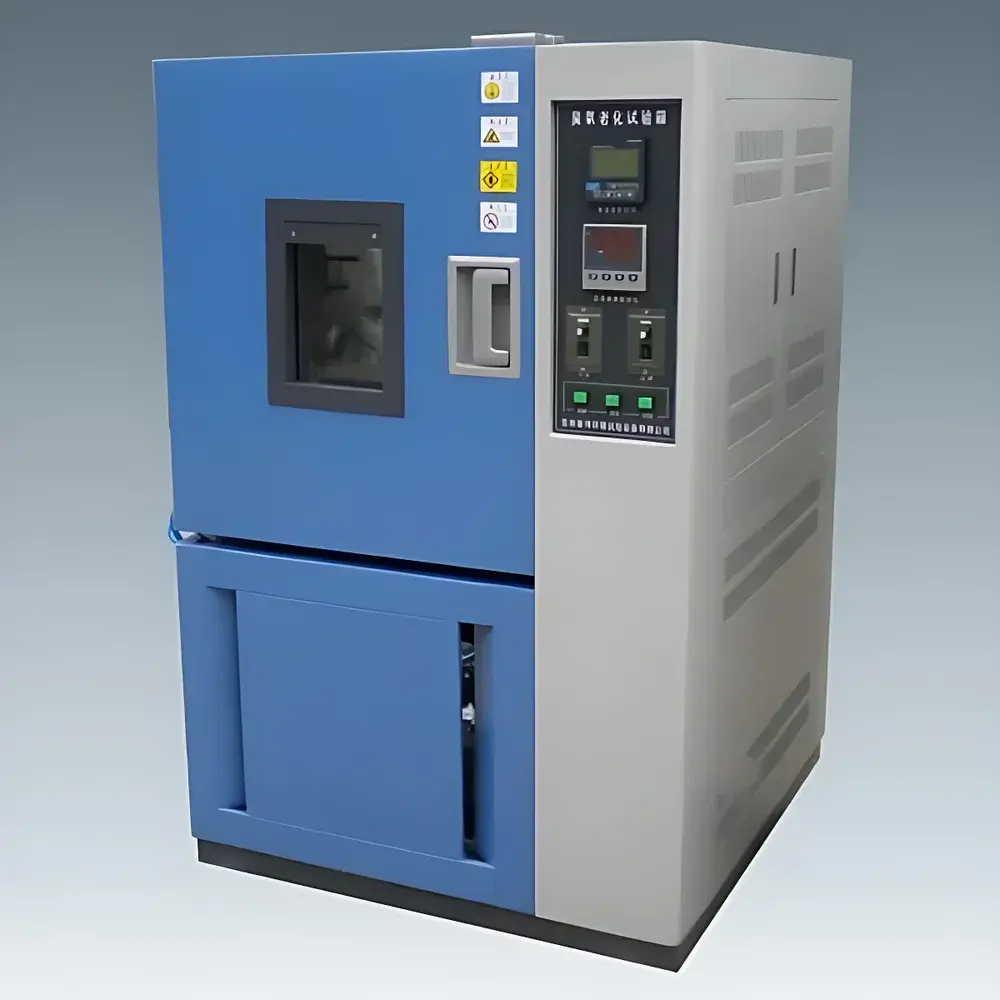
Jiubin Instruments JB-CY Series Ozone Aging Test Chamber
| Brand | Jiubin Instruments |
|---|---|
| Origin | Shanghai, China |
| Model | JB-CY |
| Ozone Concentration Range | 20–1000 pphm |
| Temperature Range | RT+5°C to 70°C |
| Temperature Uniformity | ≤2°C |
| Temperature Fluctuation | ≤±0.5°C |
| Gas Flow Velocity | 12–16 mm/s |
| Sample Rack Traverse Speed | 0–50 mm/s |
| Dynamic Stretching Frequency | 0.5 Hz |
| Test Gas Flow Rate | 0–60 L/min |
| Safety Compliance | Overload, short-circuit, ground-fault, over-temperature, and motor overload protection |
Overview
The Jiubin Instruments JB-CY Series Ozone Aging Test Chamber is an engineered environmental test system designed to accelerate and quantify ozone-induced degradation in elastomeric and organic polymeric materials. Based on the principle of controlled oxidative stress under precisely regulated ozone partial pressure, this chamber replicates atmospheric ozone exposure conditions—critical for evaluating material resistance to ozone cracking, surface embrittlement, and microstructural breakdown. Unlike ambient aging, which may require months or years, the JB-CY enables accelerated evaluation within days or weeks by maintaining stable ozone concentrations (20–1000 pphm) alongside tightly controlled temperature (RT+5°C to 70°C) and gas dynamics. Its design adheres to fundamental requirements of ASTM D1149, ISO 1431-1, and GB/T 7762–2003, supporting both static and dynamic mechanical loading protocols essential for simulating real-world service conditions in automotive seals, cable insulation, rubber gaskets, and aerospace elastomers.
Key Features
- Sealed, recirculating ozone generation loop utilizing silent-discharge ozone generators with voltage-controlled discharge tubes—ensuring operator safety and eliminating ambient ozone leakage.
- Double-beam, non-dispersive ultraviolet (NDUV) ozone analyzer (QUA-type), calibrated per ISO 1431-3, delivering continuous, traceable, and drift-compensated ozone concentration monitoring with ±10% accuracy relative to reference methods.
- High-resolution TEMI touchscreen controller (imported from Korea) with auto-tuning PID algorithms for simultaneous regulation of ozone concentration, temperature, and humidity—supporting multi-step programmable test profiles.
- Stainless steel inner chamber (AISI 304) with A3 carbon steel outer housing and high-density ultra-fine fiberglass insulation—optimized for thermal stability and corrosion resistance in aggressive oxidative environments.
- Motor-driven sample rack system enabling programmable traverse motion (0–50 mm/s) and dynamic stretching at 0.5 Hz, compliant with GB/T 13642–92 for cyclic strain application during exposure.
- Dual-stage gas conditioning: activated carbon adsorption + silica gel desiccation tower ensures consistent feed-gas purity; integrated constant-temperature bath stabilizes gas density and flow laminarity.
- Gas flow velocity maintained at 12–16 mm/s across the test zone—validated via calibrated anemometry—to guarantee uniform ozone mass transfer to specimen surfaces.
- Front-access safety interlock door with electromagnetic lock and audible/visual alarm activation upon unauthorized opening during active ozone generation.
Sample Compatibility & Compliance
The JB-CY accommodates standard test specimens including ASTM D1149 Type I dumbbell strips, GB/T 7762–2003 flat sheets, and custom-engineered components up to 800 × 1000 × 1000 mm (JB-CY800 model). Fixture geometry supports both uniaxial static tension and oscillatory dynamic strain configurations. All models are validated against national and international standards including GB/T 7762–2003 (static ozone cracking), GB/T 13642–92 (dynamic ozone fatigue), ISO 1431-1:2012, and ASTM D1149–19. The system architecture permits full traceability of operational parameters—temperature setpoints, ozone concentration logs, gas flow rates, and runtime—enabling compliance with GLP documentation requirements and internal QA audit trails.
Software & Data Management
The TEMI controller records time-stamped data at user-defined intervals (1 s to 60 min resolution) for ozone concentration, chamber temperature, and system status flags. Export formats include CSV and Excel-compatible .xls files, compatible with LIMS integration. Optional RS485/Modbus RTU or Ethernet TCP/IP interfaces support remote supervision and centralized lab monitoring platforms. While the base configuration does not include FDA 21 CFR Part 11-compliant electronic signatures or audit trail encryption, the firmware architecture supports third-party validation packages for regulated environments requiring GMP-aligned data integrity.
Applications
This chamber serves laboratories engaged in polymer formulation development, quality assurance of rubber compounds, and durability validation of coated substrates. Typical use cases include: comparative screening of antiozonant additives (e.g., p-phenylenediamine derivatives); qualification of EPDM, CR, NBR, and SBR formulations for automotive weatherstripping; aging studies of halogen-free flame-retardant cable jackets per IEC 60811-501; and validation of protective coatings for outdoor photovoltaic module encapsulants. It is routinely deployed in R&D centers, third-party testing labs (CNAS-accredited), and Tier-1 supplier QC departments where reproducible, standards-aligned ozone exposure is mandatory.
FAQ
What ozone generation method does the JB-CY use, and why is it preferred?
It employs silent-discharge (dielectric barrier discharge) ozone synthesis, which offers superior stability, low nitrogen oxide byproduct formation, and compatibility with closed-loop recirculation—critical for maintaining ppm-level precision without external ventilation.
Can the chamber perform both static and dynamic ozone tests simultaneously?
No—static and dynamic modes are mutually exclusive and selected via controller configuration. Each test requires dedicated fixture setup and calibration verification per GB/T 7762 and GB/T 13642 respectively.
Is ozone concentration verified independently during operation?
Yes—the dual-beam NDUV sensor provides real-time, in-situ measurement independent of generator settings, with periodic verification capability via standardized potassium iodide (KI) chemical titration using the provided sampling port.
What maintenance intervals are recommended for the ozone detection system?
The UV lamp and optical path require cleaning every 500 operational hours; full sensor recalibration is advised annually or after any chamber decontamination procedure involving solvents.
Does the system meet CE or UL certification requirements?
The JB-CY series complies with IEC 61000-6-2 (immunity) and IEC 61000-6-4 (emissions) but is not CE-marked as a complete unit; regional conformity assessments (e.g., UL 508A for control panels) must be performed locally prior to installation.



