
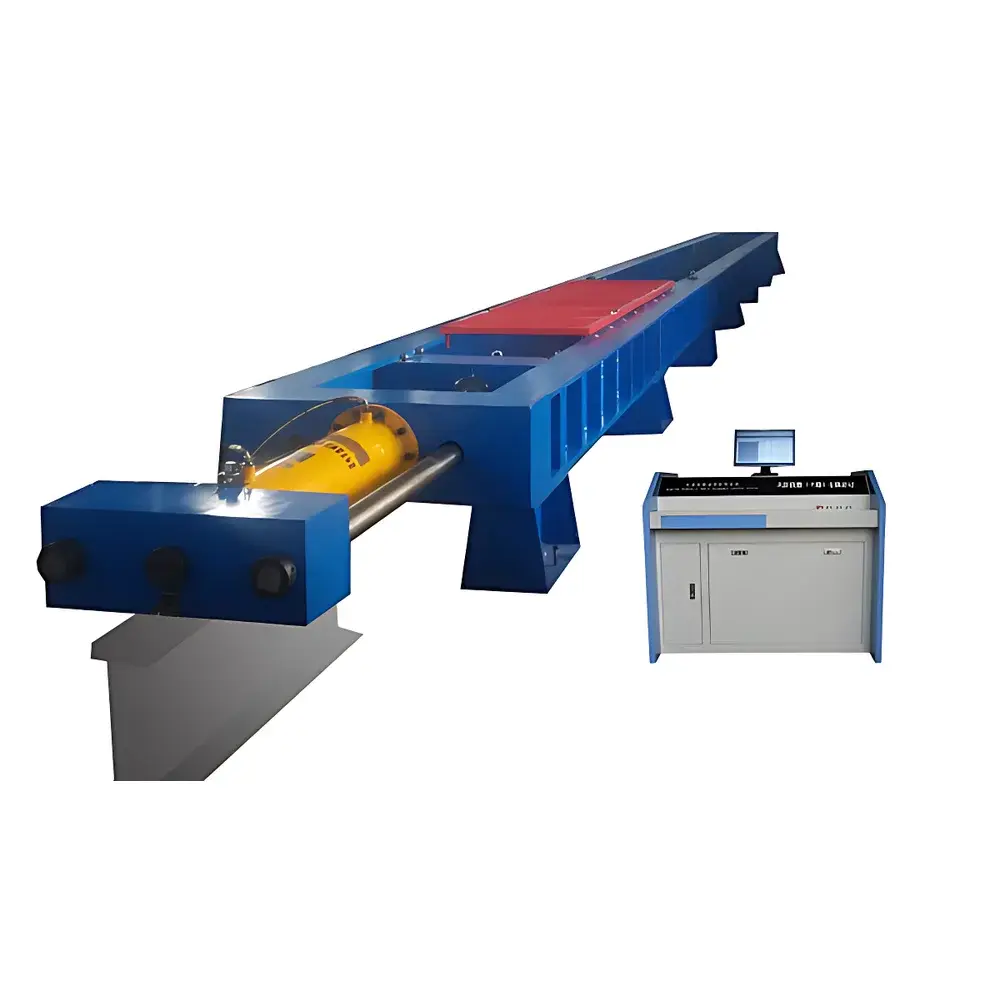
Jiubin Instruments WHT-600/1000 Hydraulic Horizontal Tensile Testing Machine
| Brand | Jiubin Instruments |
|---|---|
| Origin | Shanghai, China |
| Model | WHT-600KN / WHT-1000KN |
| Max Test Force | 600 kN / 1000 kN |
| Accuracy | ±1% FS |
| Adjustable Test Length | 500–1500 mm (in 500 mm increments) |
| Piston Stroke | 800 mm |
| Displacement Resolution | 0.01 mm |
| Crosshead Speed Range | 0–120 mm/min |
| Rapid Approach Speed | ≥200 mm/min |
| Load Measurement | High-Precision Load Cell |
| Control System | PC-Based Closed-Loop Servo-Hydraulic Control |
| Safety Compliance | Separated Control Console, Mechanical Guards, Emergency Stop Circuit |
| Structural Frame | Fully Welded Steel Monocoque Frame |
| Sample Clamping | Pin-Insertion Type Fixtures |
| Data Output | Real-Time Force–Displacement, Force–Time, Stress–Strain, and Force–Deformation Curves |
| Standards Support | ASTM E4, ASTM E8/E21, ISO 6892-1, GB/T 228.1, EN 10002-1 |
Overview
The Jiubin Instruments WHT-600/1000 Hydraulic Horizontal Tensile Testing Machine is an industrial-grade, servo-hydraulically actuated system engineered for high-force static tensile evaluation of heavy-duty flexible lifting components—particularly synthetic web slings, round slings, wire rope assemblies, and heavy-duty textile or polymer-based load-bearing elements. Unlike vertical tensile testers, its horizontal configuration enables safe, stable, and gravity-neutral loading of elongated specimens up to 30 meters in custom configurations, eliminating bending moments and ensuring pure axial force transmission. The machine operates on a dual-acting single-rod piston cylinder mounted within a rigid, fully welded steel monocoque frame—designed to minimize deflection under peak loads up to 1000 kN. Force is measured directly via traceable, temperature-compensated load cells calibrated per ISO 376 Class 1 requirements. Displacement is captured using high-resolution linear variable differential transformers (LVDTs) with 0.01 mm resolution over an 800 mm stroke range. All control logic, data acquisition, and real-time curve generation are executed via a dedicated industrial PC running deterministic real-time control firmware compliant with IEC 61131-3 architecture.
Key Features
- Rigid monolithic frame fabricated from high-strength structural steel plates with full-penetration welding—certified for fatigue life exceeding 10⁵ cycles at 80% of rated capacity.
- Dual-acting hydraulic actuation system with pressure-compensated flow control valves, enabling smooth, programmable crosshead velocity from 0.005 to 120 mm/min (±0.5% setpoint accuracy).
- Pin-insertion clamping mechanism with hardened alloy steel pins and replaceable jaw inserts—designed for rapid specimen mounting without torque tools and zero slippage during ramp-to-failure tests.
- Modular test length adjustment: discrete 500 mm increments between 500 mm and 1500 mm, achieved via precision-machined rail-mounted anchor brackets with locking shear pins.
- Separate safety-rated control console located ≥2 m from the test zone, featuring emergency stop circuitry meeting ISO 13850 Category 3 requirements and integrated light curtain interlock interface.
- Real-time multi-curve display including force–displacement, stress–strain (with user-defined cross-sectional area input), force–time, and force–deformation—exportable as CSV, XML, or PDF per ISO/IEC 17025 documentation protocols.
Sample Compatibility & Compliance
The WHT series accommodates flat-web slings (polyester, nylon, polypropylene), endless round slings (spliced or sewn), wire rope slings (6×19, 6×37, rotation-resistant), and hybrid composite lifting straps up to 300 mm nominal width. Specimen ends are secured via standardized pin-diameter compatibility (16 mm, 25 mm, 32 mm, 40 mm, 50 mm). The system supports full compliance with mandatory testing procedures defined in EN 1492-1 (textile slings), EN 1492-2 (round slings), ASME B30.9 (slings), and ISO 8793 (lifting accessories). Calibration traceability follows ISO/IEC 17025:2017 through NIST-traceable deadweight standards. Structural integrity verification includes third-party witnessed proof-load testing at 2× rated capacity prior to shipment.
Software & Data Management
The embedded test software (v5.3+) runs on Windows IoT Enterprise and provides full audit trail functionality compliant with FDA 21 CFR Part 11—including electronic signatures, operator login authentication, version-controlled method templates, and immutable raw data storage. All test sequences are stored with metadata: operator ID, calibration certificate number, environmental conditions (optional humidity/temperature sensor integration), and equipment identification. Raw ASCII data streams are timestamped at 1 kHz minimum sampling rate and archived in hierarchical file structure with SHA-256 checksum validation. Export modules support LIMS integration via ASTM E1384-compliant HL7 messaging or direct ODBC connectivity to enterprise SQL databases.
Applications
- Batch qualification testing of lifting slings per EN 1492-1 Annex C (proof load + destructive test).
- Material characterization of high-modulus polymers under sustained tensile loading (creep rupture analysis per ISO 2939).
- Validation of splice integrity and termination strength in synthetic fiber ropes used in offshore mooring systems.
- Verification of weld integrity and heat-affected zone performance in forged steel lifting hooks and shackles.
- Research-grade stress relaxation and hysteresis loop analysis for viscoelastic composite reinforcements.
- Third-party certification testing for CE marking, DNV-GL type approval, and Lloyd’s Register compliance audits.
FAQ
What standards does this machine support for sling certification?
It fully supports EN 1492-1, EN 1492-2, ASME B30.9, ISO 8793, and GB/T 228.1 for both proof-load verification and ultimate tensile strength determination.
Can the machine be configured for non-standard specimen lengths beyond 1500 mm?
Yes—custom configurations extend the effective test length up to 30 meters using modular rail extensions and reinforced anchorage foundations; engineering review required for >10 m spans.
Is the load cell calibration traceable to national metrology institutes?
All load cells ship with ISO/IEC 17025-accredited calibration certificates traceable to NIST or CNAS, including linearity, hysteresis, and repeatability data across all three force ranges.
Does the system meet GLP/GMP data integrity requirements?
Yes—the software implements ALCOA+ principles (Attributable, Legible, Contemporaneous, Original, Accurate, Complete, Consistent, Enduring, Available) with full 21 CFR Part 11 compliance including role-based access control and electronic signature workflows.
What maintenance intervals are recommended for hydraulic system integrity?
Hydraulic oil analysis and filter replacement every 2000 operating hours; annual verification of servo-valve linearity and accumulator pre-charge pressure per ISO 4406:2017 cleanliness code.



