
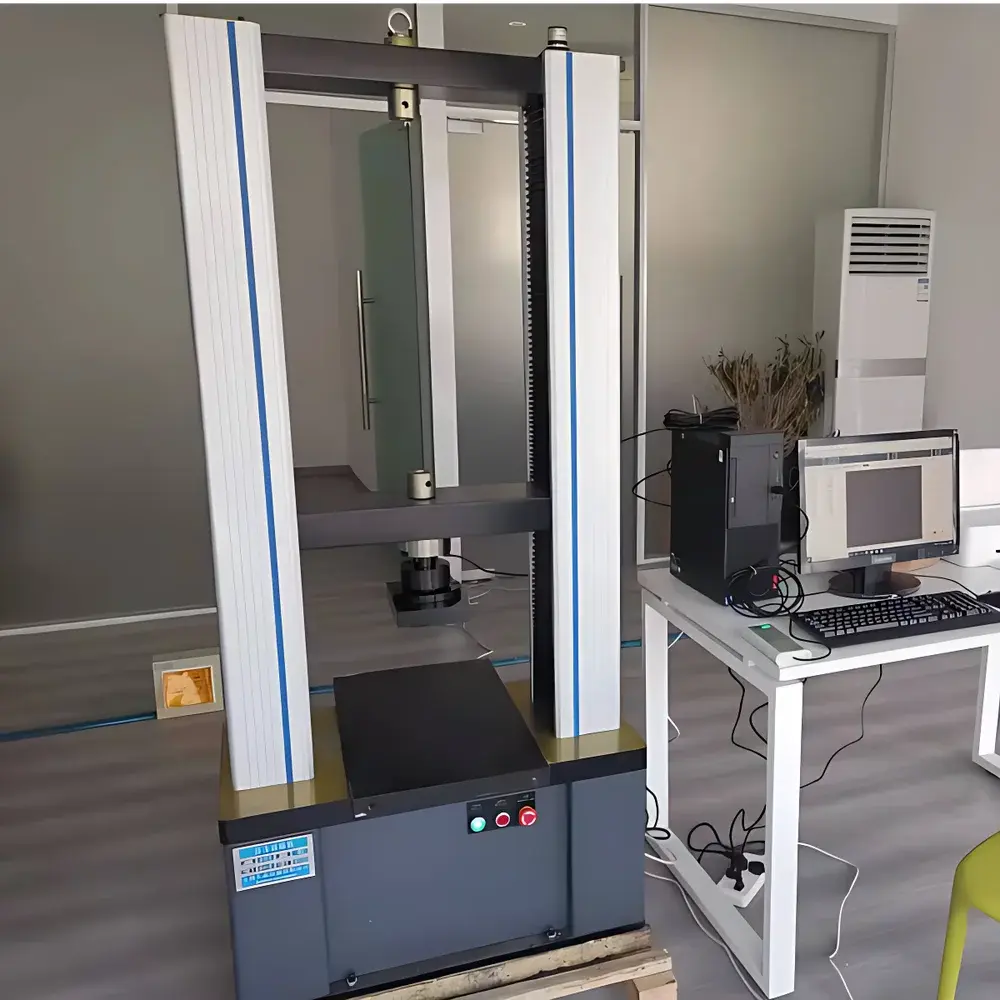
Jiubin JB-119 Series Universal Testing Machine
| Brand | Jiubin |
|---|---|
| Origin | Shanghai, China |
| Model | JB-119A / JB-119B |
| Load Capacity | 0–5 kN (user-selectable) |
| Force Sensing | High-precision load cell (U.S.-made) |
| Force Accuracy | ≤ ±0.5% of full scale |
| Effective Test Width | 380 mm |
| Max. Tensile Span | 1000 mm |
| Drive System | Servo motor (Japan-made) / AC motor (Taiwan-made) |
| Mechanical Transmission | Precision ball screw (Taiwan-made) / High-strength backlash-free screw (Korea-made) |
| Test Speed Range | 0.001–500 mm/min (infinitely variable) |
| Speed Options | 5–500 mm/min (preset or continuous) |
| Displacement Accuracy | ±0.005% |
| Resolution | 1/200,000 |
| Safety Features | Upper/lower mechanical limits, emergency stop button |
| Display | Dual-mode — PC-based GUI + embedded microcomputer interface |
| Unit Selection | g, kg, N, kN, lbf, ozf |
| Power Supply | 220 V / 380 V, 50 Hz |
| Net Weight | 1080–1180 kg |
| Dimensions (W×D×H) | 1280 × 950 × 1800 mm |
| Fixture Configuration | Customizable per sample geometry and standard (e.g., ASTM D638, ISO 527, GB/T 1040) |
Overview
The Jiubin JB-119 Series Universal Testing Machine is an electromechanically integrated materials testing system engineered for precision mechanical property evaluation across R&D laboratories, QC departments, and production environments. It operates on the fundamental principle of controlled uniaxial force application—applying tensile, compressive, flexural, peel, shear, or tear loads to specimens while simultaneously measuring real-time force, displacement, and strain responses. Designed to comply with internationally recognized test standards—including ASTM E4, ISO 7500-1, and GB/T 228.1—the JB-119 delivers traceable, repeatable results essential for material qualification, process validation, and regulatory documentation. Its modular architecture supports seamless integration into existing quality management systems, making it suitable for GLP-compliant testing workflows and ISO/IEC 17025-accredited laboratories.
Key Features
- High-fidelity dual-sensing architecture: U.S.-sourced load cells coupled with sub-micron displacement feedback ensure force accuracy within ±0.5% FS and positional resolution of 1/200,000 full-scale.
- Multi-speed actuation platform: Infinitely variable speed control from 0.001 to 500 mm/min enables precise replication of quasi-static, creep, relaxation, and high-rate deformation protocols.
- Robust mechanical design: Dual transmission options—precision-ground ball screws (Taiwan) and high-rigidity backlash-free lead screws (Korea)—guarantee long-term dimensional stability and minimal hysteresis under cyclic loading.
- Dual-display operation: Real-time test visualization via Windows-based software interface, backed by a dedicated microcomputer display panel for standalone operation and rapid parameter verification.
- Comprehensive safety infrastructure: Dual-limit mechanical stops, hardware-triggered emergency shutdown circuitry, and programmable software interlocks conform to EN ISO 13857 and IEC 61508 functional safety requirements.
- Modular fixture ecosystem: Standardized mounting interfaces accommodate ASTM-, ISO-, and GB-compliant grips—including wedge-action tensile clamps, pneumatic vise fixtures, bend supports, and peel adhesion assemblies—customized per client specimen geometry and test method.
Sample Compatibility & Compliance
The JB-119 accommodates a broad spectrum of solid-state materials—from metallic alloys and polymer composites to elastomers, textiles, thin films, and biomedical packaging—within its 380 mm effective test width and 1000 mm maximum traverse height. Specimen geometries range from ASTM D638 Type I bars to ISO 527-2 multipurpose samples, ASTM D882 thin films, and GB/T 7742 textile fabrics. The system supports standardized test modes including tensile strength, yield point, elongation at break, modulus of elasticity, compression yield stress, three-point flexural modulus, peel adhesion (ASTM D903), and shear strength (ASTM D1002). All calibration procedures adhere to ISO/IEC 17025 traceability chains, with optional NIST-traceable certificate packages available upon request.
Software & Data Management
The bundled testing software provides full lifecycle data governance: test method configuration, real-time curve plotting (force vs. displacement, stress vs. strain), automatic peak detection, statistical batch analysis, and multi-curve overlay for comparative trend assessment. Export formats include CSV, PDF, XML, and proprietary .JBT binary files compatible with LIMS integration. Audit trail functionality logs all user actions—including method edits, calibration events, and result modifications—with timestamped, non-erasable entries meeting FDA 21 CFR Part 11 requirements when deployed on validated Windows OS platforms. Optional add-ons include automated report templating (with company branding), electronic signature modules, and cloud-synced database backends for enterprise-wide QA analytics.
Applications
- Quality assurance of incoming raw materials (e.g., metal strips, polymer pellets, rubber compounds)
- Validation of heat treatment or curing processes via tensile modulus shifts
- Mechanical benchmarking of biodegradable packaging films against ASTM D882
- Adhesion performance verification of pressure-sensitive tapes per PSTC-101
- Structural integrity assessment of medical device components (e.g., suture anchors, catheter shafts)
- Failure mode analysis in automotive interior trim under ISO 14129 peel conditions
- Process capability studies (Cp/Cpk) for extrusion or injection molding lines
FAQ
What standards does the JB-119 support out-of-the-box?
Preconfigured test methods cover ASTM D638, D882, D1002, D903; ISO 527, 6892, 179, 1133; and GB/T 1040, 228.1, 9341, 7742. Custom method templates can be authored using the built-in scripting engine.
Is the system compliant with FDA 21 CFR Part 11?
Yes—when installed on a validated Windows environment with enabled audit trail, electronic signatures, and role-based access control, the software meets Part 11 requirements for electronic records and signatures.
Can the JB-119 perform cyclic fatigue testing?
While primarily optimized for static and quasi-static tests, optional waveform generation modules enable simple sinusoidal or trapezoidal load cycling up to 5 Hz with closed-loop displacement control.
What maintenance intervals are recommended?
Load cell recalibration every 12 months; ball screw lubrication every 6 months; annual mechanical alignment verification per ISO 7500-1 Annex B.
Do you provide installation and IQ/OQ documentation?
Yes—factory-certified engineers perform on-site commissioning, including Installation Qualification (IQ) and Operational Qualification (OQ) reports aligned with GAMP 5 guidelines.



