
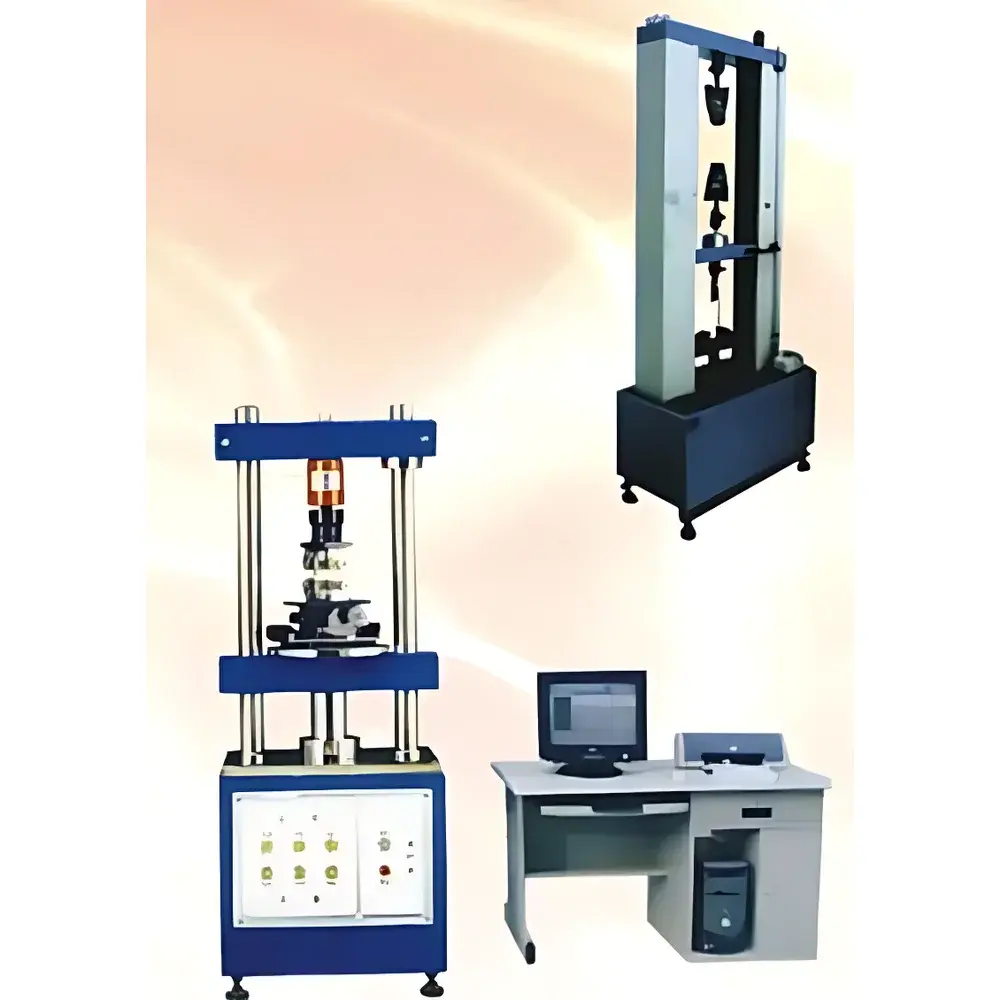
Jiubin JB-126A Hydraulic Universal Testing Machine
| Brand | Jiubin Instruments |
|---|---|
| Origin | Taiwan, China |
| Model | JB-126A |
| Type | Hydraulic Universal Testing Machine |
| Load Capacity | 0–200 kg (user-selectable) |
| Force Transducer | High-precision U.S.-made load cell |
| Force Accuracy | ≤ ±0.5% of full scale |
| Effective Test Width | 380 mm |
| Max. Tensile Travel | 1000 mm |
| Drive System | Japanese servo motor |
| Mechanical Transmission | Precision Taiwanese ball screw |
| Test Speed Range | 0.001–500 mm/min (infinitely variable, constant-rate mode) |
| Displacement Resolution | 0.005% of full stroke |
| Position Resolution | 1/200,000 steps |
| Safety Features | Upper/lower mechanical limits, emergency stop button |
| Display Interface | Dual-mode — PC-based software + embedded microcomputer display |
| Unit Options | g, kg, N, kN, lb, lbf |
| Power Supply | 220 V, 50 Hz |
| Net Weight | 160 kg |
| Dimensions (W×D×H) | 450 × 450 × 900 mm |
| Standard Fixture | One pair (customizable per sample requirements) |
| Optional Accessories | Desktop PC, thermal/inkjet printer, extensometer, proprietary test software |
Overview
The Jiubin JB-126A Hydraulic Universal Testing Machine is an electromechanically integrated materials testing system engineered for precision mechanical property evaluation under tension, compression, bending, and shear loading conditions. It operates on the fundamental principle of controlled displacement actuation via a high-torque hydraulic-servo hybrid drive train, coupled with real-time force feedback from a calibrated U.S.-manufactured load cell. The system conforms to standardized test methodologies defined in ASTM E4, ASTM E8/E8M (tensile), ASTM E9 (compression), ASTM D790 (flexural), and ISO 6892-1, enabling traceable, repeatable quantification of yield strength, ultimate tensile strength, modulus of elasticity, elongation at break, and compressive yield stress. Designed as a floor-standing unit with industrial-grade structural rigidity, the JB-126A supports both R&D validation and routine QC/QA workflows across manufacturing, academic laboratories, and third-party certification facilities.
Key Features
- Hydraulic-servo hybrid actuation system delivering smooth, low-noise motion control across the full speed range (0.001–500 mm/min), with programmable ramp-hold-step profiles.
- U.S.-sourced high-stability load cell with ≤ ±0.5% full-scale accuracy and 1/200,000 internal resolution, ensuring metrological integrity for ISO/IEC 17025-compliant reporting.
- Taiwanese precision-ground ball screw transmission mechanism with preloaded nut assembly, minimizing backlash and maintaining axial repeatability over extended operational cycles.
- Dual-display architecture: Embedded microcomputer interface for rapid setup and real-time parameter monitoring; Windows-based PC software for advanced curve analysis, multi-sample comparison, and audit-ready report generation.
- Comprehensive safety architecture including dual mechanical end-stop limit switches, redundant emergency stop circuitry (EN 60204-1 compliant), and automatic overload cutoff.
- Modular fixture interface supporting ASTM-standard wedge grips, compression platens, three-point bend fixtures, peel test clamps, and custom-engineered sample holders.
Sample Compatibility & Compliance
The JB-126A accommodates specimens ranging from thin polymer films (≥0.05 mm thickness) to metallic rods (≤25 mm diameter) and composite laminates (up to 380 mm wide × 1000 mm travel length). Its configurable load range (0–200 kg) suits non-ferrous metals, elastomers, textiles, leather, electrical insulators, and cable assemblies. The system meets essential regulatory expectations for GLP and GMP environments: data integrity is preserved through time-stamped, user-logged test records; software supports electronic signatures and 21 CFR Part 11-compliant audit trails when configured with optional validation packages. All mechanical components comply with RoHS Directive 2011/65/EU and CE machinery directive 2006/42/EC requirements.
Software & Data Management
The proprietary Jiubin TestSuite v3.2 software provides ISO 17025-aligned data acquisition, visualization, and post-processing capabilities. Real-time plotting includes stress–strain, load–displacement, and time-dependent creep/relaxation curves. Built-in statistical tools compute mean, standard deviation, coefficient of variation, and confidence intervals across test batches. Reports export in PDF, Excel, and XML formats—fully customizable with company headers, test standard references (e.g., “ASTM D638 Type I”), and pass/fail criteria overlays. Raw data files are stored in encrypted binary format with SHA-256 checksum verification to prevent tampering. Optional IQ/OQ documentation kits facilitate laboratory accreditation readiness.
Applications
- Metallic material qualification: Yield point detection in aluminum alloys, stainless steel strips, and spring wires per ASTM E8.
- Plastic & elastomer characterization: Tensile modulus and elongation at break for PP, PE, TPU, and silicone rubber per ISO 527-2.
- Textile & footwear testing: Seam strength, sole adhesion, and upper tear resistance per ISO 13934-1 and SATRA TM148.
- Electrical component validation: Terminal crimp pull-out force, insulation compression set, and wire jacket tensile integrity.
- Quality conformance screening: In-line batch verification against internal specifications or customer-facing standards (e.g., UL 758, IEC 60227).
FAQ
What standards does the JB-126A support out-of-the-box?
It natively implements test sequences aligned with ASTM E4 (force verification), ASTM E8/E8M (metal tensile), ASTM D638 (plastics tensile), and ISO 6892-1. Custom method templates can be imported via CSV or XML configuration files.
Is the system compatible with third-party data acquisition platforms?
Yes — analog output (±10 V) and digital RS-232/USB interfaces enable integration with LabVIEW, MATLAB, or SCADA systems using Modbus RTU or ASCII command protocols.
Can the machine perform cyclic loading or fatigue tests?
Not in base configuration. Cyclic testing requires optional closed-loop controller firmware upgrade and high-cycle-rated load cell calibration — contact technical support for retrofit feasibility assessment.
What maintenance intervals are recommended for hydraulic and mechanical subsystems?
Hydraulic oil replacement every 24 months; ball screw lubrication every 6 months; load cell recalibration annually or after 5,000 test cycles — documented in the included Maintenance Logbook.
Does the software meet FDA 21 CFR Part 11 requirements for electronic records?
Yes, when deployed with optional User Access Control (UAC) module, electronic signature workflow, and audit trail archiving enabled — validated per GAMP5 guidelines upon site-specific installation.



