
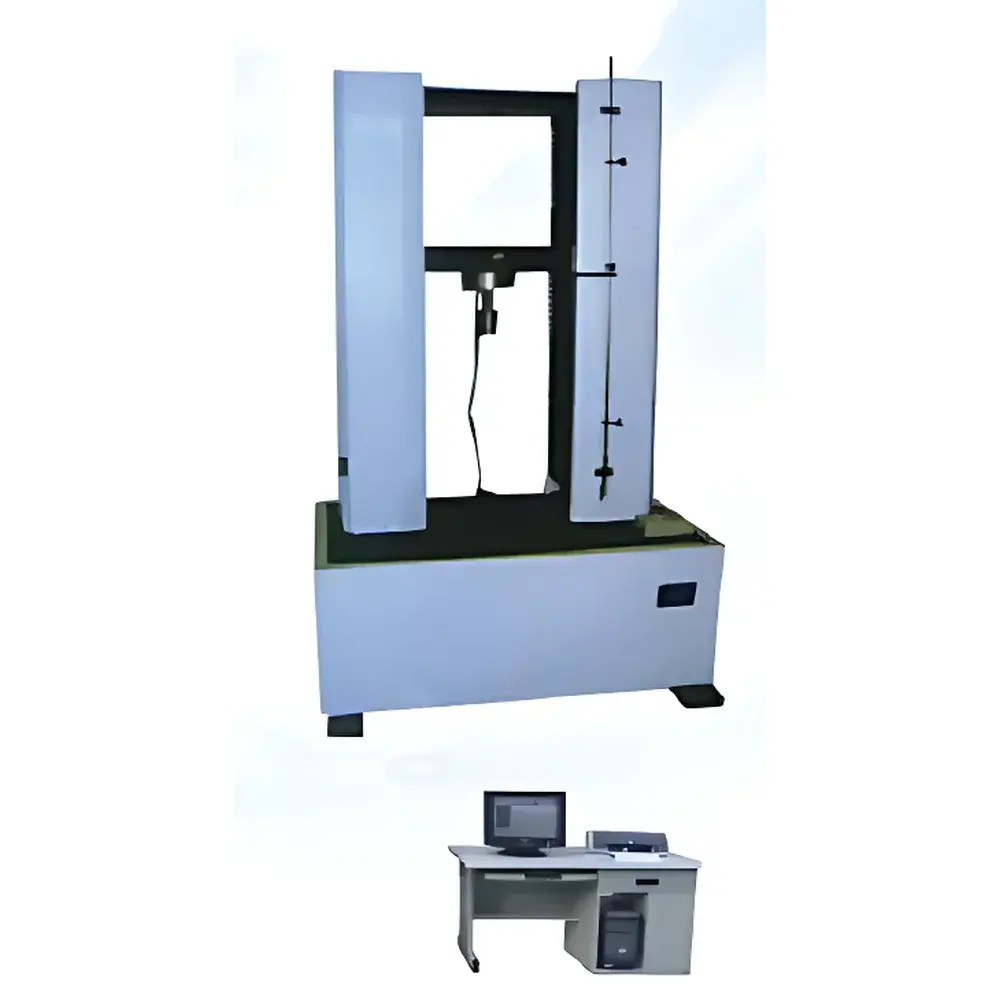
Jiubin JB-124 Universal Testing Machine
| Brand | Jiubin / JByq |
|---|---|
| Origin | Taiwan |
| Manufacturer Type | Authorized Distributor |
| Model | JB-124A / JB-124B |
| Load Capacity | 0–5 kN (user-selectable) |
| Force Sensing | High-precision load cell (USA-made) |
| Force Accuracy | ±0.5% of full scale |
| Effective Test Width | 380 mm |
| Max. Tensile Travel | 1000 mm |
| Drive System | Servo motor (Japan-made) + AC motor (Taiwan-made) |
| Mechanical Transmission | Precision ball screw (Taiwan-made) + High-strength backlash-free lead screw (Korea-made) |
| Test Speed Range | 0.001–500 mm/min (infinitely variable) |
| Displacement Resolution | 1/200,000 |
| Displacement Accuracy | ±0.005% of reading |
| Safety Features | Upper/lower mechanical limits, emergency stop button |
| Control Interface | Dual-mode display — PC-based software + embedded microcomputer panel |
| Unit Options | g, kg, N, kN, lbf, lb |
| Power Supply | 220 V / 380 V, 50 Hz |
| Net Weight | 1080–1180 kg |
| Dimensions (W×D×H) | 1280 × 950 × 1800 mm |
| Standard Fixture | One pair (customizable per specimen geometry) |
| Optional Accessories | Desktop PC, thermal/inkjet printer, extensometer (two-point), proprietary test software |
Overview
The Jiubin JB-124 Universal Testing Machine is an electromechanically integrated materials testing system engineered for precision mechanical property evaluation across research laboratories, quality control departments, and industrial R&D environments. Based on the fundamental principles of uniaxial force-displacement measurement under controlled loading conditions, the JB-124 complies with standardized test methodologies defined in ASTM E4, ASTM E8/E8M, ISO 6892-1, ISO 7500-1, and GB/T 228.1. Its modular architecture supports tensile, compression, flexural (3-point bend), shear, peel, and tear testing modes—enabling full characterization of metallic alloys, polymer composites, elastomers, textiles, leather, electrical insulation materials, and wire-and-cable assemblies. The system’s dual-control interface—comprising a dedicated microcomputer panel and PC-hosted software—ensures operational flexibility for both routine QC workflows and advanced material behavior analysis.
Key Features
- High-fidelity force measurement via NIST-traceable, USA-manufactured load cells with ±0.5% full-scale accuracy and 1/200,000 internal resolution.
- Infinitely variable speed control from 0.001 to 500 mm/min, driven by a Japan-sourced servo motor coupled with a Taiwan-built AC motor for robust low-speed stability and high-torque response.
- Mechanical transmission system combining a Taiwan-fabricated precision ground ball screw and a Korea-supplied zero-backlash lead screw assembly—minimizing hysteresis and ensuring repeatable positioning over extended service life.
- Dual-display operation: real-time synchronized monitoring via embedded microcomputer interface and Windows-based software with curve overlay, statistical batch analysis, and audit-ready data logging.
- Comprehensive safety architecture including upper/lower mechanical end stops, fail-safe emergency stop circuitry, and automatic overload cut-off protocols compliant with IEC 61800-5-2 functional safety guidelines.
- Modular fixture design accommodating ASTM-standard grips (e.g., wedge, pneumatic, vise, peel), extensometers (two-point contact type), and environmental chamber integration (optional).
Sample Compatibility & Compliance
The JB-124 accommodates specimens ranging from thin films (≥0.05 mm thickness) to structural metal coupons (up to 50 mm width × 10 mm thickness). Its 380 mm effective test width and 1000 mm vertical travel support standard ASTM D638 Type I–V, ISO 527-2, ISO 178, and EN 1311-1 geometries. All hardware and firmware components meet CE marking requirements under Machinery Directive 2006/42/EC and EMC Directive 2014/30/EU. Software modules support 21 CFR Part 11-compliant electronic signatures, ALCOA+ data integrity frameworks, and GLP/GMP-aligned audit trails—including user access logs, parameter change history, and raw-data immutability verification.
Software & Data Management
The proprietary JB-TestSuite software provides ISO/IEC 17025-aligned test method templates, automated calculation of modulus, yield strength, elongation at break, fracture toughness (via secant modulus derivation), and stress–strain hysteresis loop analysis. Raw data exports are available in CSV, XML, and PDF formats—with metadata embedding (operator ID, timestamp, calibration certificate ID, environmental conditions). Batch reporting includes statistical summaries (mean, SD, CV%), trend charts across production lots, and comparative overlay of up to 16 curves per session. Data archiving follows hierarchical storage protocols compatible with LIMS integration via ODBC and RESTful API endpoints.
Applications
- Metallic materials: Yield strength, ultimate tensile strength (UTS), reduction in area, and Young’s modulus determination per ASTM E8/E8M.
- Polymers & elastomers: Stress–strain profiling, creep compliance assessment, and cyclic loading fatigue evaluation (with optional extensometer).
- Textiles & composites: Peel adhesion (ASTM D903), seam strength (ASTM D1683), and interlaminar shear strength (ASTM D2344).
- Electrical components: Terminal crimp pull-out force validation (UL 486A-B), insulation jacket tensile integrity testing (UL 1581).
- Footwear & leather: Sole bonding strength, flex resistance (ISO 5423), and grain layer separation force quantification.
FAQ
What standards does the JB-124 comply with for force calibration?
The system adheres to ISO 7500-1 Class 0.5 accuracy requirements, with annual recalibration traceable to national metrology institutes (NMI) via accredited third-party labs.
Can the JB-124 perform cyclic or fatigue testing?
Yes—when equipped with the optional two-point extensometer and upgraded test software license, it supports programmed load-controlled or displacement-controlled cycling up to 10⁵ cycles within the 0.001–50 mm/min speed range.
Is the software validated for regulated environments?
JB-TestSuite offers IQ/OQ documentation packages and supports 21 CFR Part 11 compliance through role-based access control, electronic signature capture, and immutable audit logs.
What maintenance intervals are recommended?
Lubrication of ball screws every 500 operational hours; load cell verification every 6 months; full mechanical inspection and calibration annually—or per ISO/IEC 17025 internal procedure schedules.
Does the system support multi-language UI and report generation?
Yes—interface and report templates are configurable in English, Chinese, Spanish, German, and Japanese, with Unicode-compliant character rendering and localized unit conventions.
Related Products



