
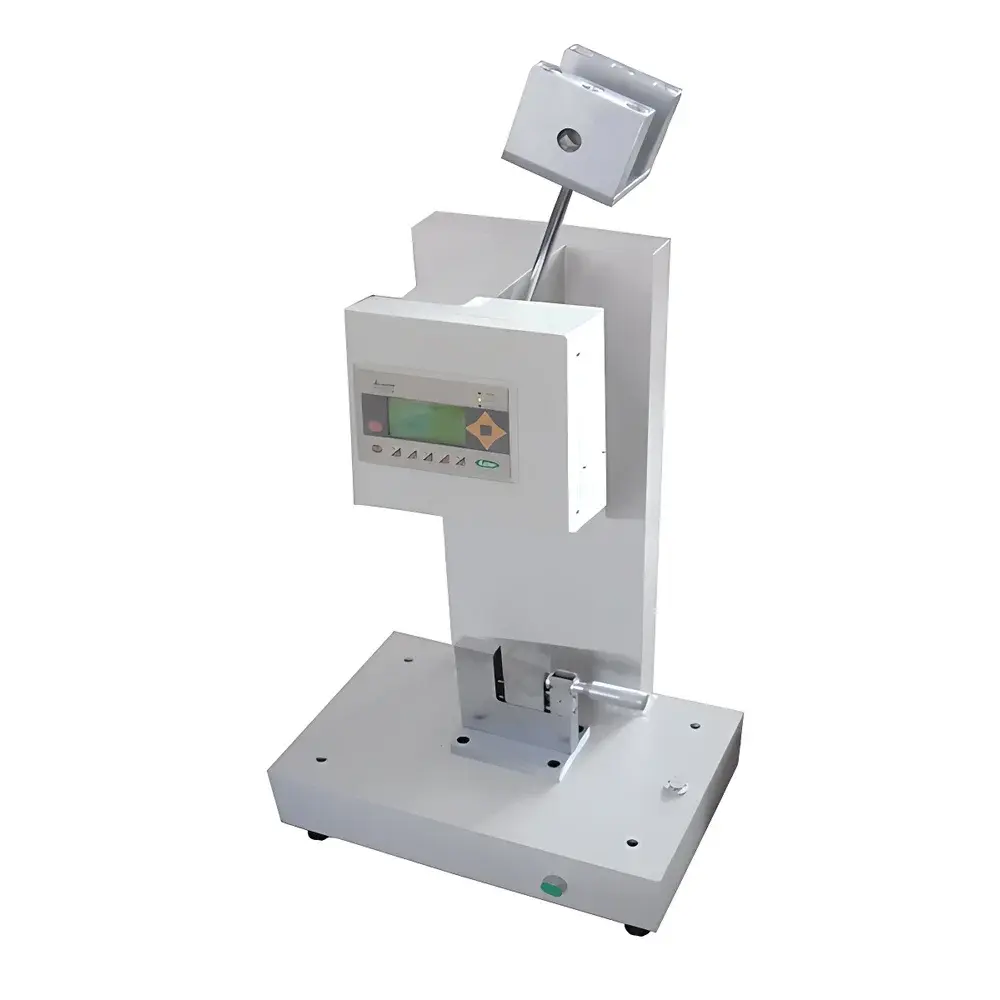
Jiubin JB/XJU-22B Digital Cantilever Beam Impact Tester
| Brand | Jiubin |
|---|---|
| Origin | Shanghai, China |
| Model | JB/XJU-22B |
| Impact Energy | 22 J |
| Impact Velocity | 3.5 m/s |
| Pendulum Constant (Hammer Moment) | R = 0.8 ± 0.2 mm |
| Maximum Lifting Height | 95 mm |
| Hammer Angle | 160° |
| Notch Knife Radius | R = 0.8 ± 0.2 mm |
| Distance from Knife Edge to Clamp Top | 22 ± 0.2 mm |
| Knife Included Angle | 30° ± 1° |
| Energy Loss in Null Impact (for 2.75 J & 5.5 J levels) | ≤1% and ≤0.5%, respectively |
Overview
The Jiubin JB/XJU-22B Digital Cantilever Beam Impact Tester is a precision-engineered mechanical testing instrument designed for the quantitative determination of impact resistance and notch sensitivity in rigid non-metallic materials. It operates on the principle of pendulum-type cantilever beam impact testing—where a calibrated pendulum strikes a notched specimen clamped at one end, and the energy absorbed during fracture is calculated from the difference between initial potential energy and residual swing height. This method conforms rigorously to internationally recognized standards including ISO 180 (Plastics — Determination of impact resistance using the cantilever beam method), GB/T 1843 (Chinese national standard equivalent to ISO 180), GB/T 2611 (General requirements for testing machines), and JB/T 8761 (Technical specifications for plastic impact testers). The JB/XJU-22B delivers consistent, repeatable results across diverse polymer composites, thermosets, ceramics, and fiber-reinforced materials—making it an essential tool for QC laboratories, R&D departments, and third-party material certification facilities operating under GLP or ISO/IEC 17025 frameworks.
Key Features
- Digital angle and energy readout with high-resolution optical encoder for real-time pendulum position tracking and automatic energy calculation.
- Modular pendulum system supporting dual nominal energy levels: 11 J and 22 J—enabling full-range testing without hardware reconfiguration.
- Precision-ground impact knife with certified radius tolerance (R = 0.8 ± 0.2 mm) and angular accuracy (30° ± 1°), ensuring strict compliance with ISO 180 geometrical requirements.
- Fixed clamp geometry maintaining exact specimen overhang (22 ± 0.2 mm) and controlled support distance—critical for minimizing boundary condition variability.
- Low-energy-loss pendulum architecture validated via null-impact calibration: ≤1% loss at 2.75 J and ≤0.5% at 5.5 J, meeting ISO 180 Annex B verification criteria.
- Ergonomic design with safety guard interlock, manual release lever, and vibration-damped base—optimized for operator safety and long-term mechanical stability.
Sample Compatibility & Compliance
The JB/XJU-22B is validated for standardized testing of rectangular bar specimens (typically 80 × 10 × 4 mm) with standardized U- or V-notches per ISO 180 Type 1A or 1B configurations. It accommodates common engineering polymers such as ABS, PC, POM, reinforced nylon (PA6/PA66-GF), phenolic resins, epoxy-based composites, glass-reinforced plastics (GRP), technical ceramics, and cast stone. All mechanical dimensions—including knife edge radius, clamp spacing, and pendulum trajectory—are traceably aligned with ISO 180:2019, GB/T 1843–2008, and ASTM D256 (when adapted for cantilever mode per Annex A2). The instrument supports audit-ready documentation workflows compliant with ISO/IEC 17025 clause 7.7 (result reporting) and facilitates integration into GMP environments where equipment qualification (IQ/OQ/PQ) is required.
Software & Data Management
While the JB/XJU-22B operates as a stand-alone digital tester with local LCD display and push-button control, its analog output interface (0–10 V or 4–20 mA optional) enables seamless integration with external data acquisition systems or LIMS platforms. Calibration certificates include traceability to national metrology institutes (e.g., SIMT, CNAS-accredited labs), and all critical parameters—including pendulum moment, knife geometry, and energy linearity—are documented per ISO/IEC 17025 requirements. For regulated environments, users may implement supplementary electronic recordkeeping solutions satisfying FDA 21 CFR Part 11 criteria (electronic signatures, audit trails, data integrity controls) through compatible SCADA or laboratory informatics software.
Applications
- Quality control of injection-molded plastic components for automotive interior trim and electrical housings.
- Comparative evaluation of toughening agents (e.g., elastomer modifiers, nanofillers) in thermoplastic formulations.
- Batch-to-batch consistency verification of FRP laminates used in aerospace secondary structures.
- Failure analysis of brittle polymer matrix composites under low-velocity impact conditions.
- Validation of material substitution in medical device housing applications requiring ISO 10993-1 biocompatibility-compliant mechanical performance.
- Academic research on temperature-dependent impact transition behavior in semi-crystalline polymers (when coupled with environmental chamber).
FAQ
What standards does the JB/XJU-22B comply with?
It fully satisfies ISO 180:2019, GB/T 1843–2008, GB/T 2611–2007, and JB/T 8761–2007 for cantilever beam impact testing.
Can this tester be used for both unnotched and notched specimens?
Yes—the machine supports both ISO 180 Type 1A (notched) and Type 1B (unnotched) configurations with appropriate knife and clamp setups.
Is calibration traceable to national standards?
All factory calibrations are performed using reference pendulums certified by CNAS-accredited metrology laboratories, with full uncertainty budgets provided in the certificate.
What maintenance is required to ensure long-term accuracy?
Routine checks include knife edge wear inspection (using profilometry), pendulum bearing lubrication every 6 months, and annual verification of zero-energy loss and angular encoder linearity.
Does the system support automated data export?
The unit features analog voltage/current output; digital export requires connection to a DAQ system or optional RS-232/USB interface module (sold separately).
Related Products



