
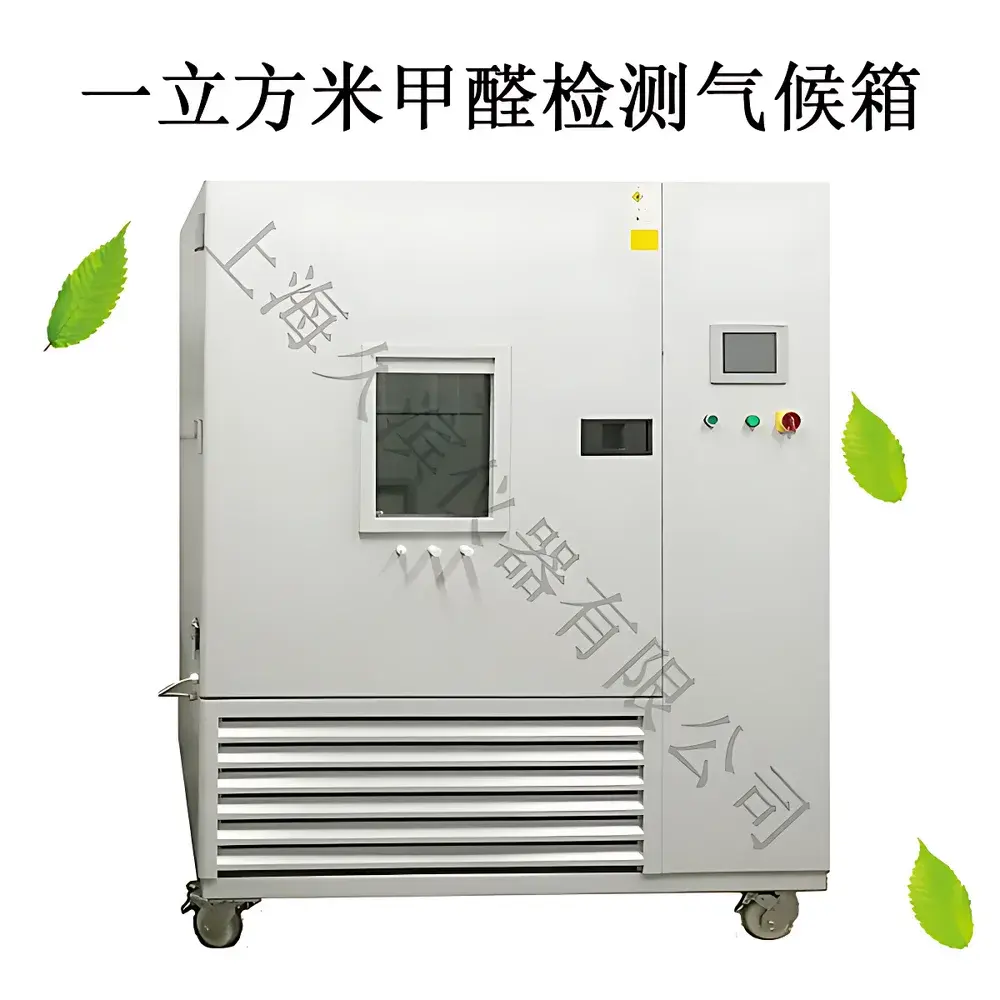
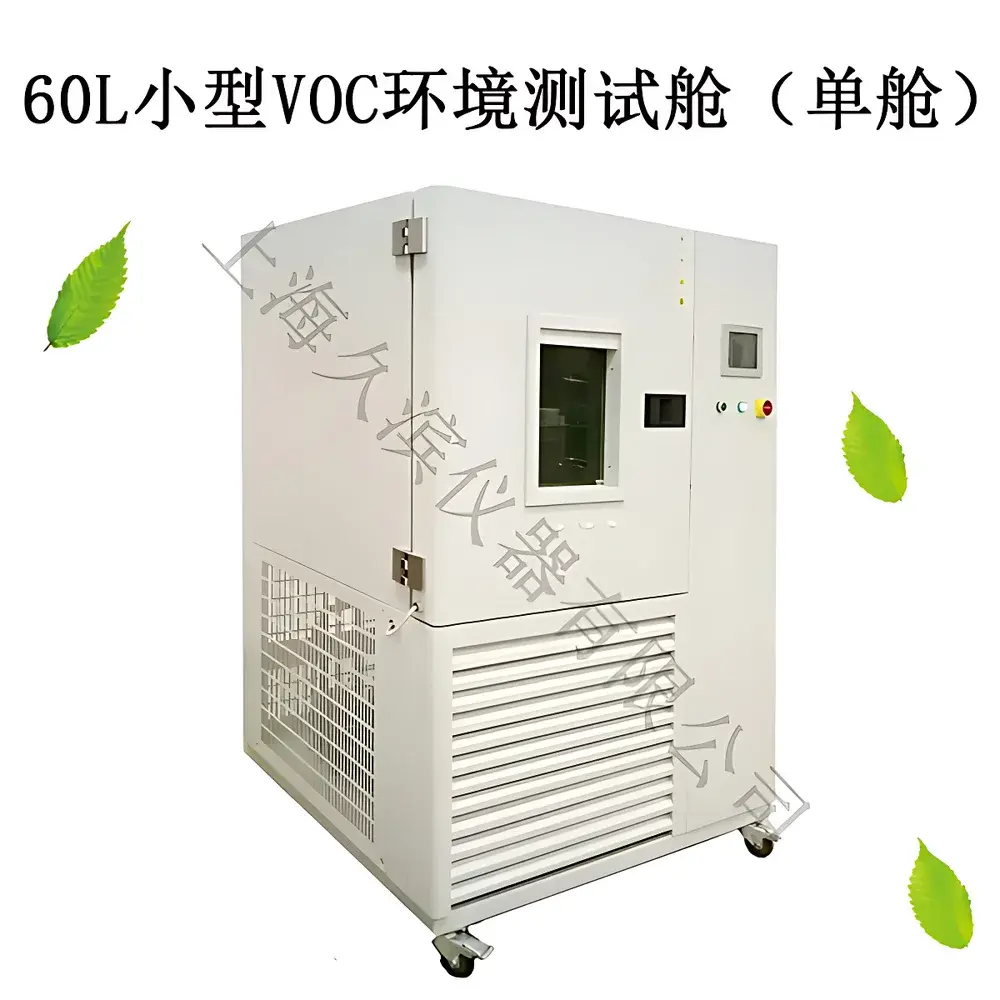
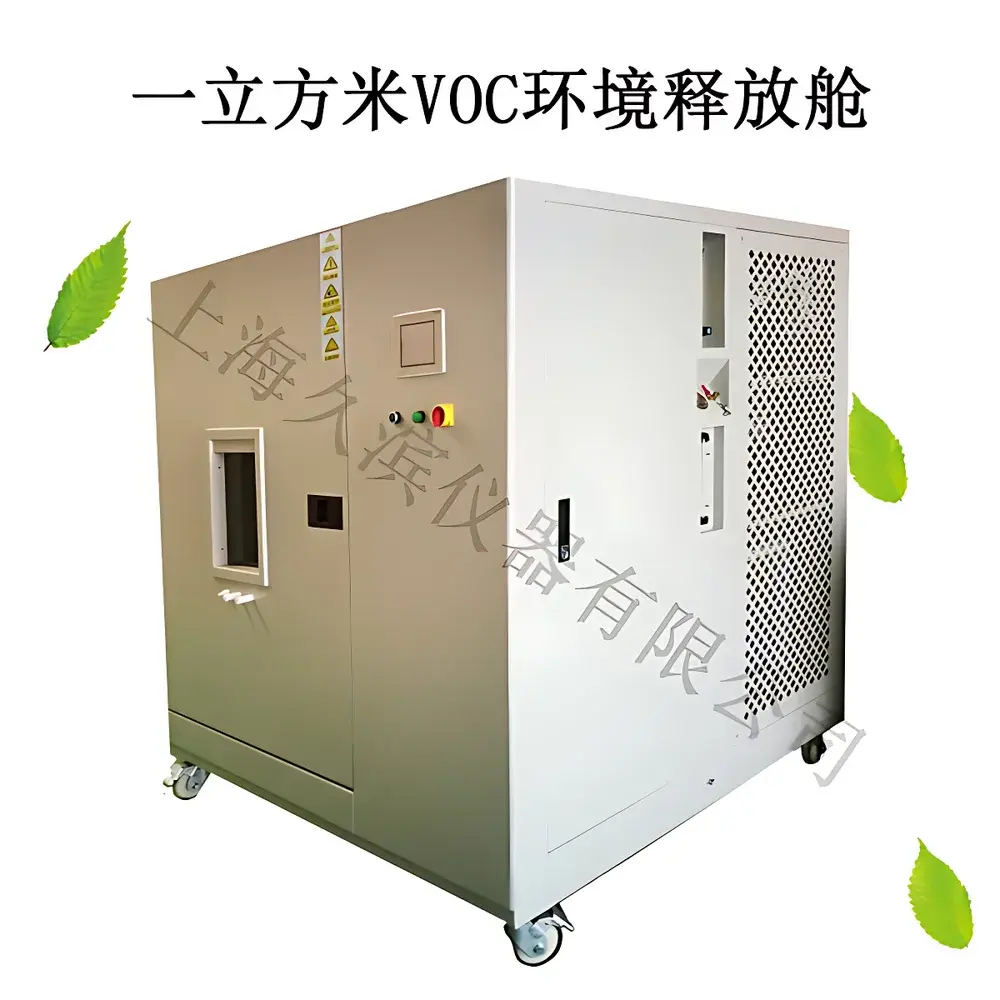
JB-60L 1 m³ Formaldehyde Emission Climate Chamber
| Brand | Jiubin Instruments |
|---|---|
| Origin | Shanghai, China |
| Model | JB-60L |
| Measurement Principle | Photometric Method (based on acetylacetone derivatization) |
| Chamber Volume | 1 m³ |
| Internal Dimensions | Approx. 1000 mm × 1000 mm × 1000 mm |
| Temperature Control Range | 15–30 °C (±0.5 °C uniformity) |
| Relative Humidity Control Range | 30–70 %RH (±3 %RH stability) |
| Air Exchange Rate | Adjustable from 0.5 to 1.5 h⁻¹ (±5 % accuracy) |
| Chamber Wall Material | Stainless Steel 304 with electropolished interior |
| Seal Integrity | ≤ 0.5 % volume loss per hour |
| Power Supply | 220 V AC, 50 Hz |
| Compliance | GB/T 17657–2013, GB 18580–2017, ISO 12460-1:2007, ASTM D6007–21 |
Overview
The JB-60L 1 m³ Formaldehyde Emission Climate Chamber is a precision-engineered environmental test system designed for standardized determination of formaldehyde emission rates from wood-based panels, laminates, flooring, furniture components, and other indoor construction materials. It operates on the principle of dynamic chamber testing—maintaining strictly controlled temperature, relative humidity, and air exchange rate while sampling the chamber’s exhaust air for subsequent photometric quantification of formaldehyde concentration. The measurement follows the acetylacetone derivatization method (Hantzsch reaction), where formaldehyde reacts under acidic heating to form a yellow chromophore measurable at 412 nm using a calibrated spectrophotometer. This methodology is fully aligned with national and international regulatory frameworks governing indoor air quality and material emissions, including GB/T 17657–2013 (China), ISO 12460-1:2007 (Wood-based panels — Determination of formaldehyde release — Part 1: Formaldehyde emission by the chamber method), and ASTM D6007–21 (Standard Test Method for Determining Formaldehyde Concentrations in Air from Wood Products Using a Small-Scale Chamber).
Key Features
- Stainless steel 304 chamber body with electropolished interior surfaces to minimize adsorption and ensure chemical inertness during long-term exposure tests.
- Precise dual-loop climate control system delivering stable temperature (15–30 °C ±0.5 °C) and relative humidity (30–70 %RH ±3 %RH) across the full working volume.
- Calibrated mass flow controller enabling accurate and repeatable air exchange rates from 0.5 to 1.5 h⁻¹, traceable to NIST-certified standards.
- Integrated sampling port with quick-connect fittings compatible with standard impinger bottles (e.g., 10 mL or 20 mL), Tedlar® bags, or online analyzers.
- Real-time monitoring interface displaying chamber setpoints, actual values, elapsed test time, and system status alarms.
- Passive thermal insulation and low-outgassing gasketing to maintain seal integrity (<0.5 % volume loss/hour) and prevent external contamination ingress.
Sample Compatibility & Compliance
The JB-60L accommodates flat specimens up to 1.0 m × 0.5 m × 0.05 m (L×W×H), supporting edge-sealing protocols per ISO 12460-1 and GB 18580–2017. Specimen loading area is optimized to achieve a surface-area-to-volume ratio of 1.0 m²/m³, as required for compliance testing. The chamber meets structural and operational requirements for GLP-compliant laboratories conducting formaldehyde emission assessments for CE marking, China Compulsory Certification (CCC), and Green Building evaluation systems (e.g., China 3-Star Rating, LEED IEQ credits). Its design facilitates audit readiness for ISO/IEC 17025 accredited testing labs performing third-party verification.
Software & Data Management
While the JB-60L operates as a hardware-controlled climate chamber without embedded data logging, it is fully compatible with external LIMS and laboratory automation platforms via analog 4–20 mA outputs and RS-485 Modbus RTU communication. Users routinely integrate it with UV-Vis spectrophotometers equipped with GLP-compliant software (e.g., Shimadzu UVProbe, Thermo Fisher NanoDrop) that support 21 CFR Part 11 audit trails, electronic signatures, and raw data archiving. All test parameters—including start time, duration, T/RH setpoints, airflow calibration logs, and sampling timestamps—are documented manually or imported into validated Excel-based templates aligned with CNAS-CL01:2018 reporting requirements.
Applications
- Formaldehyde emission certification of medium-density fiberboard (MDF), particleboard, plywood, and laminate flooring per GB 18580–2017 Class E0/E1 limits.
- Pre-market validation of low-emission adhesives, resins, and coating formulations used in engineered wood manufacturing.
- Quality assurance testing for automotive interior trim materials (e.g., door panels, headliners) supplied to OEMs including BYD, Geely, Chery, and FAW-Volkswagen.
- Research on emission kinetics under accelerated aging conditions (e.g., elevated T/RH cycling) conducted by academic institutions such as Tsinghua University, Shanghai Jiao Tong University, and the Chinese Academy of Sciences.
- Third-party conformity assessment for certification bodies including CTI, Huace Testing, and NAST.
FAQ
What formaldehyde detection method is supported by this chamber?
The JB-60L is designed for offline analysis using the photometric acetylacetone (Hantzsch) method; it does not include an integrated analyzer. Users collect air samples in impingers and quantify formaldehyde concentration via UV-Vis spectrophotometry at 412 nm.
Is the chamber suitable for ISO 12460-3 (gas analysis method) or ISO 12460-5 (desiccator method)?
No—the JB-60L implements only the dynamic chamber method (ISO 12460-1). It is not configured for desiccator or perforator-based extraction procedures.
Can the chamber be validated for ISO/IEC 17025 accreditation?
Yes—its mechanical specifications, calibration records for airflow and climate sensors, and documented SOPs for specimen conditioning meet key technical requirements for scope inclusion in accredited test reports.
What maintenance is required to ensure long-term performance?
Monthly verification of door seal integrity, quarterly recalibration of temperature/humidity sensors against NIST-traceable references, and annual inspection of airflow control valves and ducting for particulate accumulation.
Does the system support automated data export to LIMS?
It provides Modbus RTU and analog outputs for integration with external SCADA or LIMS platforms; no proprietary software or cloud interface is included.
Related Products







