
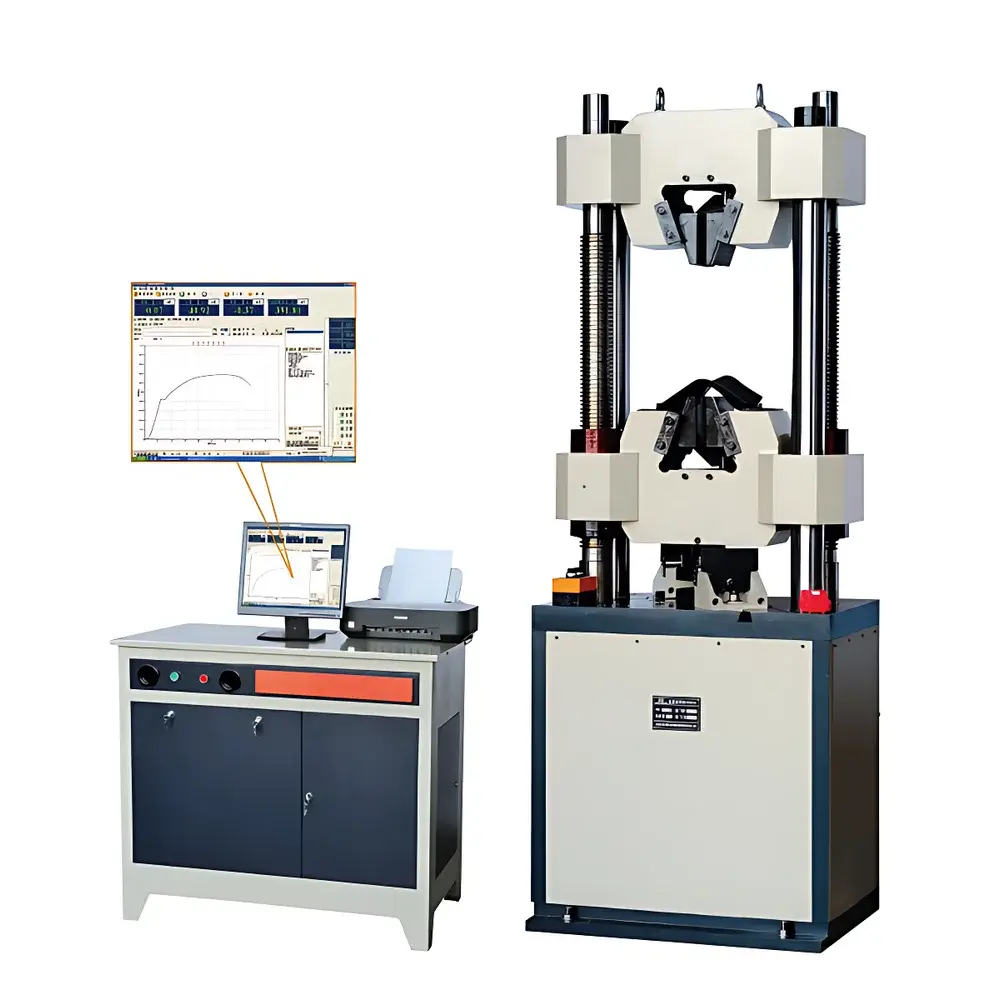
JB/WEW-1000B Hydraulic Universal Testing Machine by Jiubin Instruments
| Brand | Jiubin Instruments |
|---|---|
| Origin | Shanghai, China |
| Model | JB/WEW-1000B |
| Type | Hydraulic Universal Testing Machine |
| Max. Test Force | 1000 kN |
| Force Range | 50–1000 kN |
| Force Accuracy | ≤ ±1% of reading |
| Force Resolution | 0.01 kN |
| Displacement Resolution | 0.01 mm |
| Deformation Measurement Accuracy | 0.01 mm |
| Tensile Space | 700 mm |
| Compression Space | 380 mm |
| Piston Stroke | 150 mm |
| Round Specimen Clamping Diameter | Φ13–Φ40 mm |
| Flat Specimen Thickness Capacity | 0–15 mm |
| Flat Specimen Jaw Width | 75 mm |
| Compression Plate Diameter | φ160 mm |
| Bend Span (Two-Point) | 450 mm |
| Bend Support Roller Width | 140 mm |
| Bend Support Roller Diameter | Φ40 mm |
| Piston Speed | 50 mm/min |
| Clamping Method | Automatic Hydraulic Clamping |
| Main Frame Dimensions (W×D×H) | 720×580×2100 mm |
| Load Frame Control Cabinet Dimensions (W×D×H) | 1000×700×1400 mm |
Overview
The JB/WEW-1000B Hydraulic Universal Testing Machine is a high-capacity, microprocessor-controlled mechanical testing system engineered for precision static mechanical characterization of metallic and non-metallic materials under tension, compression, bending, and shear loading conditions. Based on classical hydraulic servo-actuation architecture, the machine employs a dual-cylinder, fixed-beam load frame with automatic hydraulic clamping—ensuring consistent preload application and minimized alignment error across repeated test cycles. Its 1000 kN nominal capacity satisfies structural component validation, raw material qualification, and quality control requirements in heavy manufacturing, civil infrastructure, aerospace subcontracting, and national metrology laboratories. The system complies with fundamental mechanical testing principles defined in ISO 6892-1 (tensile testing of metallic materials), ISO 15630-1 (reinforcing steels), ASTM E4 (load verification), and ASTM E8/E9 (tension/compression testing methods), forming a traceable foundation for GLP-compliant reporting.
Key Features
- Robust four-column, fixed-crosshead hydraulic frame with integrated oil reservoir and pressure-regulated actuation circuit for stable force delivery and minimal thermal drift.
- Automatic hydraulic clamping system with adjustable pressure threshold—enabling reproducible grip integrity across round (Φ13–Φ40 mm) and flat (0–15 mm thick × 75 mm wide) specimens without manual torque intervention.
- Dual-channel digital measurement architecture: high-resolution load cell (0.01 kN resolution, ≤ ±1% accuracy per ISO 7500-1 Class 1) synchronized with linear variable differential transformer (LVDT)-based displacement transduction (0.01 mm resolution) and optional extensometer input for strain-controlled protocols.
- Real-time data acquisition at ≥1 kHz sampling rate, supporting full-cycle capture of force–displacement, stress–strain, and time-based response curves—including up to six simultaneous plot configurations exportable in vector format.
- Modular software architecture with role-based access control (Administrator / Tester), audit-trail logging, and password-protected method editing—aligned with FDA 21 CFR Part 11 readiness for regulated environments.
- Open Excel-based report engine allowing user-defined templates, multi-specimen batch printing, customizable field selection, and sort-by-parameter output sequencing.
Sample Compatibility & Compliance
The JB/WEW-1000B accommodates standard and custom geometries per ISO 6892-1, ASTM E8, ASTM C39 (concrete cylinders), and ISO 14125 (fiber-reinforced composites). Standard fixtures include wedge-action tensile jaws, flat-faced compression platens (φ160 mm), three-point bend assemblies (450 mm span, Φ40 mm rollers), and optional shear adapters per ASTM D5379. All mechanical components conform to GB/T 228.1–2021 (Chinese national equivalent of ISO 6892-1) and are CE-marked for machinery safety (2006/42/EC). Calibration certificates follow ISO/IEC 17025 requirements when performed by accredited third-party providers.
Software & Data Management
The embedded Windows-based control software supports real-time closed-loop control (force, displacement, or strain rate modes), programmable multi-step test sequences, and post-test analytical functions including yield point detection (0.2% offset, tangent, or graphical), modulus calculation (secant, chord, or initial linear fit), and fracture energy integration. Data files are stored in encrypted binary format with embedded metadata (operator ID, timestamp, environmental notes, calibration expiry). Export options include CSV, XML, and PDF; all reports retain digital signatures and revision history. Audit trails record every parameter change, test execution, and user login—supporting GMP/GLP documentation workflows and internal QA audits.
Applications
This system serves as a primary mechanical validation tool in steel mills (rebar, billet, plate), foundry QC labs (cast iron, aluminum alloys), composite material R&D centers (carbon fiber laminates, polymer matrix systems), and construction materials certification bodies (concrete, mortar, masonry units). It enables compliance testing for ISO 1099 (fatigue pre-conditioning), ASTM A615/A706 (reinforcing bars), EN 10002-1 (metallic tensile), and GB/T 7314 (compression of metallic materials). Educational institutions utilize its modular design for hands-on curriculum in solid mechanics, materials science, and mechanical engineering laboratories.
FAQ
What standards does the JB/WEW-1000B comply with for force calibration?
It meets ISO 7500-1 Class 1 requirements for static force verification, with traceability to national metrology institutes via certified load cells and annual recalibration protocols.
Can the system perform closed-loop strain-controlled tests?
Yes—when equipped with an ASTM E83-compliant extensometer (e.g., 25 mm or 50 mm gauge length), the controller executes displacement- or strain-rate regulation with ≤0.5% setpoint deviation over full range.
Is remote monitoring or network integration supported?
The control cabinet includes Ethernet and RS-232 interfaces; OPC UA and Modbus TCP drivers are available as optional add-ons for MES/SCADA integration.
What maintenance intervals are recommended for hydraulic components?
Hydraulic oil replacement every 2,000 operating hours or biannually (whichever occurs first); filter elements replaced quarterly; cylinder seal inspection recommended annually under continuous operation.
Does the software support multi-language UI and report generation?
The base interface is English-only; however, report templates and exported Excel outputs fully support Unicode, enabling localized labels, units, and annotations without software modification.



