
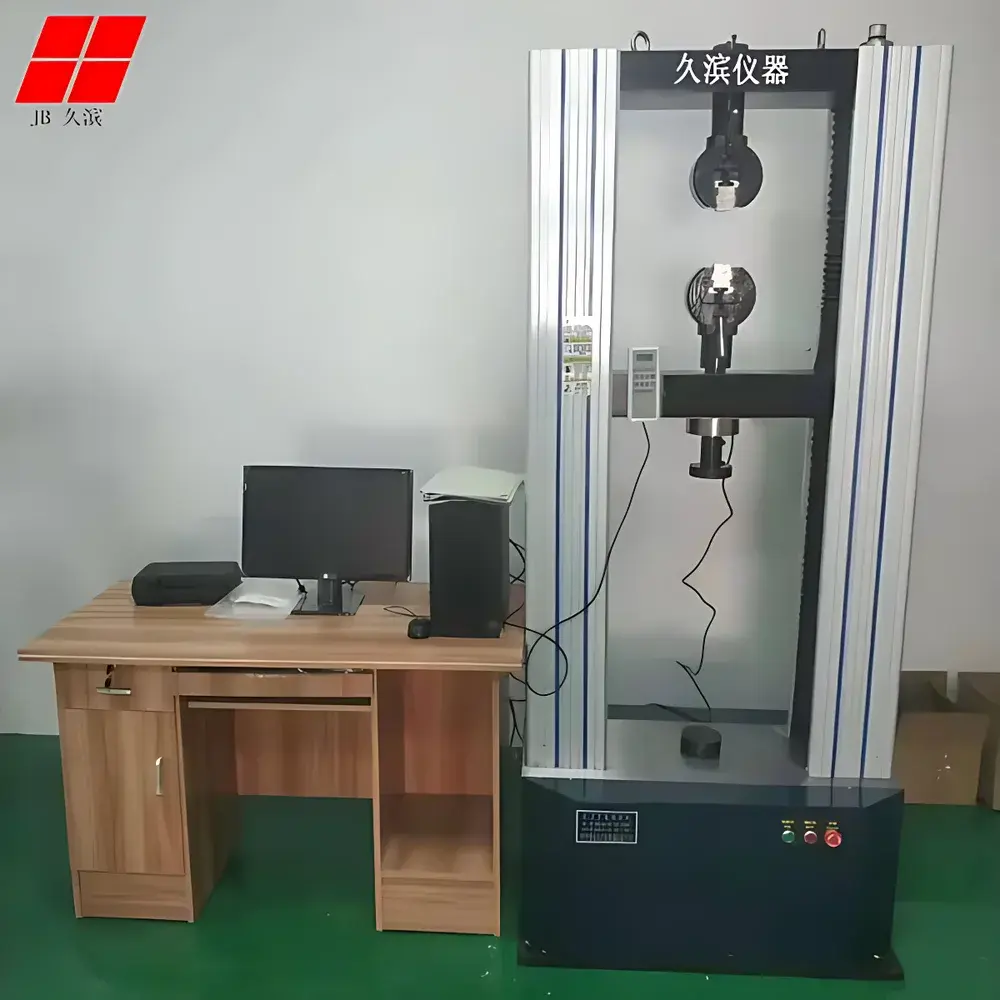
Jiubin JB-118 Electronic Universal Tensile Testing Machine
| Brand | Jiubin |
|---|---|
| Origin | Shanghai, China |
| Model | JB-118 |
| Instrument Type | Electronic Universal Testing Machine |
| Max Test Force | Customizable (Standard Options: 10 kN, 20 kN, 50 kN, 100 kN) |
| Force Accuracy | ±0.5% or ±1% FS |
| Force Resolution | 1/200,000 |
| Displacement Accuracy | ±0.5% of reading |
| Displacement Resolution | 0.05 µm |
| Strain Measurement Compliance | ASTM E8, ISO 6892-1, GB/T 228.1-2010 |
| Speed Range | 0.001–500 mm/min |
| Crosshead Travel (excl. fixtures) | 700 mm |
| Power Supply | AC 220 V ±10%, 50 Hz |
| Dimensions (W×D×H) | 600 × 360 × 1850 mm |
| Weight | ~600 kg |
Overview
The Jiubin JB-118 Electronic Universal Tensile Testing Machine is a precision-engineered electromechanical system designed for static mechanical property characterization of metallic materials under uniaxial loading conditions. Based on the principles of load-controlled and displacement-controlled servo-actuation, the system applies calibrated axial force to standardized specimens while synchronously measuring force, displacement, and optional strain via extensometry. Its rigid portal frame architecture, coupled with high-resolution force transducers and closed-loop motion control, ensures high reproducibility in tensile, compression, bending, and shear testing per international standards including ASTM E8/E21, ISO 6892-1, and GB/T 228.1–2010. The machine is configured for laboratory-based quality control, R&D validation, and incoming material verification in metallurgical, aerospace, automotive, and heavy industrial manufacturing environments.
Key Features
- Two-stage safety protection: programmable software limits and mechanical end-stop switches prevent over-travel and crosshead collision
- Auto-range switching: dynamic selection of optimal load cell range during test execution to maintain resolution across wide force spans
- Predefined test profiles: users store standardized test parameters—including target strain rate, hold duration, and stop criteria—as reusable modules for batch processing
- Real-time adaptive speed control: crosshead velocity automatically adjusts per user-defined ramp-hold-step sequences or manual override
- Integrated auto-calibration routine: traceable force and displacement verification using internal reference signals and external standard weights
- High-fidelity data acquisition: synchronized sampling at up to 1 kHz for force, displacement, and extensometer channels
- Dual-mode operation: supports both load-controlled (constant rate of force application) and displacement-controlled (constant crosshead speed) test modes
- Comprehensive overload protection: hardware-triggered shutdown when load exceeds 103–105% of selected full-scale range
Sample Compatibility & Compliance
The JB-118 accommodates standardized tensile specimens per ISO 6892-1 (Type A, B, C), ASTM E8 (flat and round bars), and GB/T 228.1 (P1, P2, P3 geometries), with custom fixture sets available for compression platens, three/four-point bend assemblies, and shear adapters. All test methods comply with GLP-aligned documentation requirements: audit trails log operator ID, timestamp, calibration status, environmental conditions (optional temperature/humidity input), and raw channel data. System validation documentation supports IQ/OQ protocols per ISO/IEC 17025 and aligns with FDA 21 CFR Part 11 expectations for electronic records integrity—provided optional digital signature and user access control modules are deployed.
Software & Data Management
The Windows-based control interface provides bilingual (English/Chinese) menu navigation with intuitive mouse-driven workflow configuration. Real-time plotting displays live stress–strain, force–displacement, and force–time curves with dynamic scaling and cursor-based point interrogation. Post-test analysis includes yield strength (0.2% offset, upper/lower yield), ultimate tensile strength, elongation at break, reduction in area, Young’s modulus, and proof strength determination. Export formats include CSV, XML, and PDF report templates compliant with ISO 5893 and ASTM E4. Raw binary data files retain full 32-bit resolution for third-party statistical process control (SPC) or finite element model correlation.
Applications
- Verification of mechanical properties for hot-rolled/cold-drawn steel, aluminum alloys, titanium grades, and nickel-based superalloys
- Lot acceptance testing per ASME BPVC Section II, MIL-STD-883, or EN 10002-1 specifications
- Fracture toughness pre-cracking support through controlled slow-strain-rate testing
- Creep and stress-relaxation preliminary screening using extended hold segments
- Evaluation of weld joint integrity, heat-affected zone (HAZ) ductility, and coating adhesion substrates
- Calibration reference for field-deployable hardness testers and portable ultrasonic thickness gauges
FAQ
Is the JB-118 compliant with ISO/IEC 17025 accreditation requirements for testing laboratories?
Yes—the system supports documented calibration intervals, traceable force verification, environmental monitoring integration, and full audit trail generation required for scope accreditation.
Can the machine perform cyclic loading or fatigue tests?
No—the JB-118 is designed exclusively for quasi-static monotonic testing; fatigue applications require dedicated servo-hydraulic or electromagnetic systems.
What extensometer options are supported?
Both clip-on and non-contact video extensometers compliant with ISO 9513 Class 1 or better may be integrated via analog/digital I/O ports.
Does the software support automated report generation for regulatory submissions?
Yes—customizable templates meet FDA eCTD, EU Annex 11, and ICH M7 reporting structures when paired with optional electronic signature and role-based access modules.
Is remote diagnostics and firmware update capability available?
Remote maintenance is enabled via secure TLS-encrypted Ethernet connection; firmware updates require local administrator authentication and checksum validation.



