
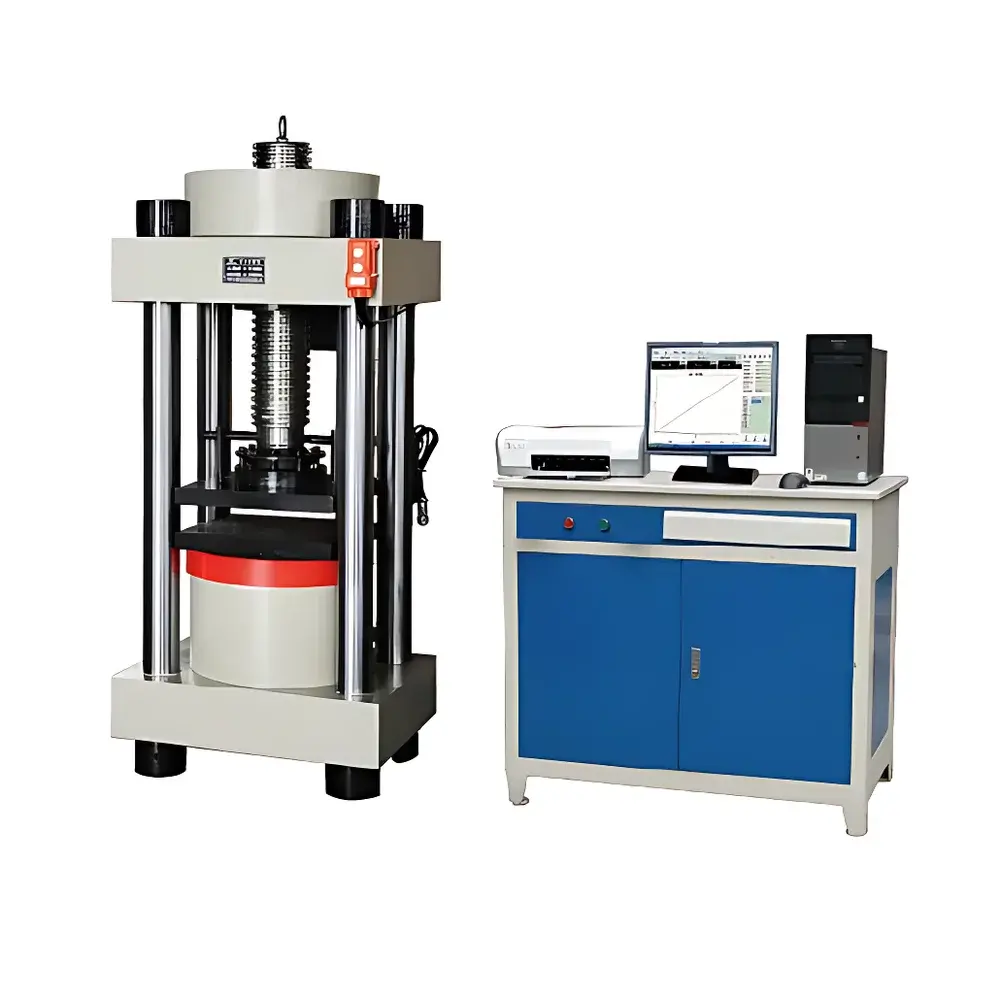
Jiubin Instruments JB/YAW-3000 Fully Automated Compression Testing Machine
| Brand | Jiubin Instruments |
|---|---|
| Origin | Shanghai, China |
| Model | JB/YAW-3000 |
| Maximum Test Load | 3000 kN |
| Load Measurement Range | 5–100% FS |
| Load Indication Accuracy | ≤ ±1% of reading |
| Load Resolution | 0.01 kN |
| Hydraulic Pump Rated Pressure | 40 MPa |
| Platen Dimensions | 500 × 500 mm |
| Max Platen Spacing | 500 mm |
| Piston Diameter | φ310 mm |
| Piston Stroke | 100 mm |
| Motor Power | 3-phase 1.1 kW |
| Machine Weight | 2500 kg |
Overview
The Jiubin Instruments JB/YAW-3000 Fully Automated Compression Testing Machine is a high-capacity, microprocessor-controlled hydraulic testing system engineered for precise and repeatable uniaxial compressive strength evaluation of construction materials. It operates on the principle of servo-controlled hydraulic actuation with closed-loop force feedback, enabling accurate application of load under programmable rate control—either constant load rate (kN/min) or constant stress rate (MPa/min). Designed in accordance with core mechanical testing standards—including ASTM C39/C109/C140, ISO 7500-1 (Class 1 accuracy), and GB/T 3159 (Chinese national standard for universal testing machines)—the JB/YAW-3000 delivers traceable, audit-ready results for quality control laboratories, precast concrete plants, and civil engineering research facilities.
Key Features
- Fully automated hydraulic loading system with real-time force闭环 control, ensuring stable load application and minimal overshoot during ramping phases.
- Programmable loading profiles: users may select either constant-rate load control or constant-rate stress control, with adjustable ramp rates and hold durations.
- Digital load measurement via precision load cell with 0.01 kN resolution and ≤ ±1% indication error across 5–100% of full scale (3000 kN).
- Integrated industrial-grade control cabinet with embedded motion controller, pressure transducer feedback, and safety interlock circuitry compliant with EN 60204-1.
- Rugged dual-platen design featuring hardened 500 × 500 mm steel platens with parallelism tolerance < 0.02 mm/m, optimized for uniform stress distribution across large-format specimens (e.g., 150 mm concrete cubes, 200 mm cylinders, or full-scale masonry units).
- Self-contained hydraulic power unit rated at 40 MPa maximum working pressure, equipped with temperature-stabilized oil reservoir and fine-filtered circulation to minimize drift and extend component service life.
Sample Compatibility & Compliance
The JB/YAW-3000 accommodates standard and non-standard compression specimens per international material specifications: cement mortars (ISO 679), concrete cubes/cylinders (ASTM C39, EN 12390-3), fired clay bricks (ASTM C67), autoclaved aerated concrete (EN 772-1), and structural grouts (ASTM C1019). Its 500 mm vertical clearance and 500 × 500 mm platen surface support oversized specimens up to 450 mm in height and 400 mm in planar dimension. All test sequences adhere to GLP principles: operator ID logging, timestamped test records, digital signature support, and immutable data archiving. The system supports audit trails compliant with ISO/IEC 17025 requirements for accredited testing laboratories.
Software & Data Management
The JB/YAW-3000 is supplied with proprietary Windows-based testing software (v3.2+) installed on a dedicated Lenovo desktop PC. The software provides intuitive test setup wizards, real-time load–displacement curve visualization, automatic peak detection, and modulus calculation (secant or tangent, per user-defined strain range). Test reports are generated in PDF and XLSX formats; report templates are fully customizable using built-in field editors—users may define header layouts, parameter tables, pass/fail criteria, and institutional logos. All raw data—including time-stamped load, displacement, and system status flags—is stored in encrypted binary files with SHA-256 checksums. Exported Excel files retain full numerical precision (16-digit floating point) and include metadata headers for traceability. Software complies with FDA 21 CFR Part 11 requirements for electronic records and signatures when configured with user authentication and audit log activation.
Applications
- Compressive strength validation of Portland cement, blended cements, and supplementary cementitious materials (SCMs) per ASTM C150 and EN 197-1.
- Quality assurance testing of ready-mix and precast concrete elements prior to site delivery or structural certification.
- Research-level investigation of creep behavior, stress–strain linearity, and fracture energy in high-performance concretes and fiber-reinforced composites.
- Standardized testing of masonry units (clay, concrete, calcium silicate) for compliance with ASTM C62, C140, and ISO 6707-1.
- Calibration verification of field rebound hammers and ultrasonic pulse velocity devices using reference specimens with known strength grades.
FAQ
What is the maximum specimen height supported by the JB/YAW-3000?
The maximum distance between platens is 500 mm, allowing testing of specimens up to 450 mm in height while maintaining adequate alignment clearance and hydraulic stability.
Does the system meet ISO 7500-1 Class 1 calibration requirements?
Yes—the load cell and signal conditioning chain are factory-calibrated to ISO 7500-1 Class 1 (≤ ±1% error), with optional third-party certification available upon request.
Can test data be exported directly to LIMS platforms?
Raw data files (binary .jbt format) and CSV/XLSX exports are compatible with common LIMS interfaces; API documentation and sample import scripts are provided for integration with LabWare, STARLIMS, or Thermo Fisher SampleManager.
Is remote diagnostics or firmware update capability included?
The control system supports secure remote access via TLS-encrypted VNC for technical support; firmware updates are delivered as signed executable packages with version rollback safeguards.
What maintenance intervals are recommended for hydraulic oil and filters?
Hydraulic oil should be replaced every 2,000 operating hours or biannually, whichever occurs first; inlet and return-line filters require replacement every 500 hours or quarterly, with pressure-drop monitoring enabled in software.



