
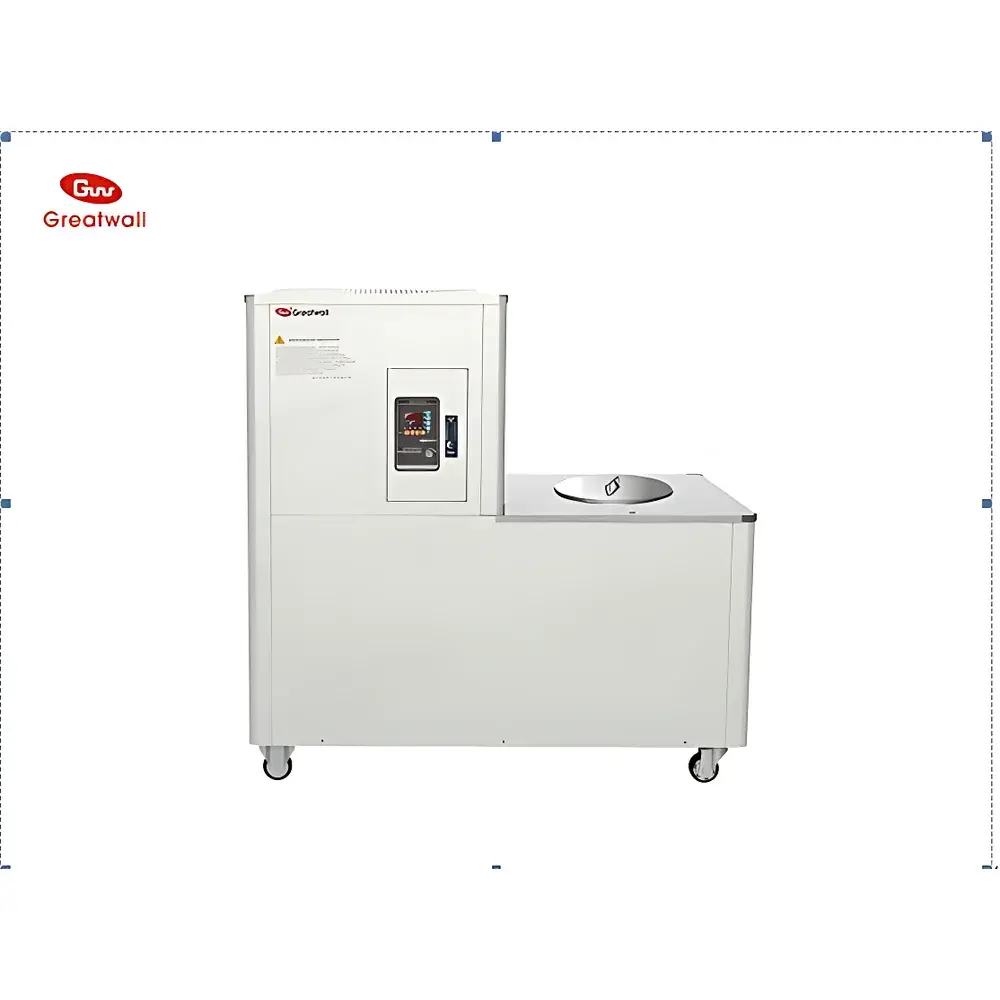
Great Wall DHJF-1050 Ultra-Low Temperature Circulating Bath
| Brand | The Great Wall |
|---|---|
| Origin | Henan, China |
| Manufacturer Type | Direct Manufacturer |
| Model | DHJF-1050 |
| Cooling Capacity | 700 W at −60 °C |
| Temperature Range | −100 °C to −60 °C |
| Temperature Stability | ±2 °C |
| Bath Volume | 50 L |
| Pump Flow Rate | 20 L/min |
| Maximum Pressure | 0.4 bar |
| Circulation Pump Power | 100 W |
| Total Power Consumption | 4876 W |
| Display Resolution | 0.1 °C |
| Refrigerant | Mixed Cryogenic Refrigerant |
| Evaporator Type | Coil-in-Tank (Stainless Steel 304) |
| Compressor | Panasonic Hermetic Scroll Compressor |
| Condenser | Air-Cooled Finned-Tube with Oxygen-Free Copper |
| Heat Exchanger Architecture | Single-Stage Compression with Series-Connected Subcooling Stages |
| Safety Protections | Phase Sequence, Overcurrent, Overheat, Delayed Start |
| Ambient Operating Conditions | 5–35 °C, ≤70% RH |
| Power Supply | 3-phase, 380 V, 50 Hz |
| External Port Size | 1/2″ BSP |
| Bath Opening Diameter | 400 mm |
| Bath Dimensions (Ø × H) | 450 × 320 mm |
| Max Flask Capacity | 20 L |
| Unit Dimensions (W × D × H) | 1340 × 820 × 1310 mm |
| Net Weight | 265 kg |
Overview
The Great Wall DHJF-1050 Ultra-Low Temperature Circulating Bath is an engineered solution for sustained, stable cryogenic thermal management in laboratory-scale chemical synthesis, low-temperature reaction kinetics studies, and material property characterization. Designed around a single-stage compression refrigeration architecture enhanced by series-connected subcooling heat exchangers, the system achieves operational temperatures from −100 °C to −60 °C without requiring cascade or multi-compressor configurations. Its core thermodynamic design leverages patented serial condensation technology—where refrigerant undergoes sequential pressure and phase transitions across multiple integrated heat exchange stages—enabling deep-cold performance while maintaining mechanical simplicity and long-term reliability. The bath integrates a hermetically sealed Panasonic scroll compressor with built-in thermal overload protection, an air-cooled finned-tube condenser constructed from oxygen-free copper tubing with proprietary expansion-bonding technology, and a submerged coil-type evaporator fabricated from ASTM A240 304 stainless steel. This configuration ensures high thermal transfer efficiency, resistance to cryogenic embrittlement, and immunity to mechanical failure during prolonged operation below −90 °C—even when the heat transfer fluid approaches solidification.
Key Features
- Single-stage compression ultra-low temperature capability down to −100 °C, enabled by series-connected subcooling heat exchangers and optimized refrigerant charge dynamics.
- Submerged stainless steel 304 coil evaporator fully immersed in the bath reservoir—designed to withstand repeated freeze-thaw cycles of ethylene glycol/water or ethanol-based cryogens without structural compromise.
- High-flow, low-noise shielded circulation pump (20 L/min @ 0.4 bar) with corrosion-resistant wetted parts compatible with common low-temperature heat transfer fluids.
- Digital microprocessor controller with 0.1 °C temperature resolution, real-time display, and intuitive keypad interface—supporting both internal bath temperature regulation and external jacketed reactor control via optional analog output.
- Comprehensive safety architecture including phase-sequence monitoring, overcurrent cutoff, compressor overheat detection, and delayed startup logic to prevent liquid refrigerant slugging.
- Structural integration of all major refrigeration components via full-penetration welding—minimizing leak paths and maximizing service life under continuous cryogenic duty.
Sample Compatibility & Compliance
The DHJF-1050 is intended for use with standard laboratory glassware up to 20 L capacity (e.g., jacketed reactors, three-neck flasks, and cryo-condensers), mounted directly onto its 400 mm-diameter open bath aperture. Its 304 stainless steel reservoir and circulation loop are chemically inert toward aqueous glycol mixtures, ethanol, methanol, and other widely accepted low-temperature heat transfer media. While not certified to IEC 61000-6-3 or UL 61010-1 out-of-the-box, the unit meets fundamental electrical safety requirements for Class I laboratory equipment per GB 4793.1–2007 (equivalent to IEC 61010-1:2010 Ed.3). It supports GLP-aligned documentation practices through configurable logging intervals and on-screen event timestamps. Note: Circulation mode must be disabled when bath setpoint falls below −90 °C to prevent pump cavitation and fluid phase separation.
Software & Data Management
The DHJF-1050 operates autonomously via its embedded digital controller; no external PC connection or proprietary software is required for basic operation. However, the controller provides a 0–5 V analog output (configurable as temperature or error signal) compatible with third-party data acquisition systems (e.g., LabVIEW, MATLAB, or DeltaV DCS interfaces) for integration into automated reaction platforms. Event logs—including power-on time, alarm triggers (overtemp, phase loss), and setpoint changes—are stored onboard with timestamp resolution of ±1 second and retained for ≥10,000 entries. Audit trail functionality complies with ALCOA+ principles when paired with validated external recording systems, supporting traceability in regulated environments where adherence to FDA 21 CFR Part 11 or EU Annex 11 is required.
Applications
- Controlled low-temperature Grignard, organolithium, and lithium–halogen exchange reactions demanding precise thermal profiles between −80 °C and −100 °C.
- Crystallization process development for pharmaceutical intermediates, where nucleation kinetics are highly sensitive to sub-zero thermal gradients.
- Cryogenic calibration of infrared detectors, bolometers, and superconducting sensors requiring stable, uniform cold-stage environments.
- Material testing of elastomers, composites, and battery electrolytes under extended exposure to extreme cold.
- Condensation trapping in vacuum distillations and solvent recovery systems operating below −80 °C.
FAQ
Can the DHJF-1050 operate continuously at −100 °C?
Yes—provided the circulation pump is disabled and only static cooling mode is used. Continuous pumping below −90 °C is prohibited per safety protocol.
What heat transfer fluids are recommended for operation below −80 °C?
Ethanol (≥99.8%), methanol, or custom-blended ethylene glycol/isopropanol mixtures with freezing points ≤−105 °C. Aqueous solutions are not recommended below −60 °C.
Is remote monitoring or Ethernet connectivity supported?
No native Ethernet or Wi-Fi interface is included; however, the analog voltage output enables integration with industrial SCADA or lab automation networks using standard signal conditioners.
Does the unit comply with ISO/IEC 17025 calibration requirements?
The controller’s 0.1 °C display resolution supports routine verification using NIST-traceable PRTs, though formal calibration certificates require third-party metrology services.
What maintenance intervals are recommended for the refrigeration system?
Compressor oil analysis every 3,000 operating hours; condenser coil cleaning every 6 months in non-laboratory ambient conditions; annual inspection of refrigerant charge integrity via manifold gauge set.



