
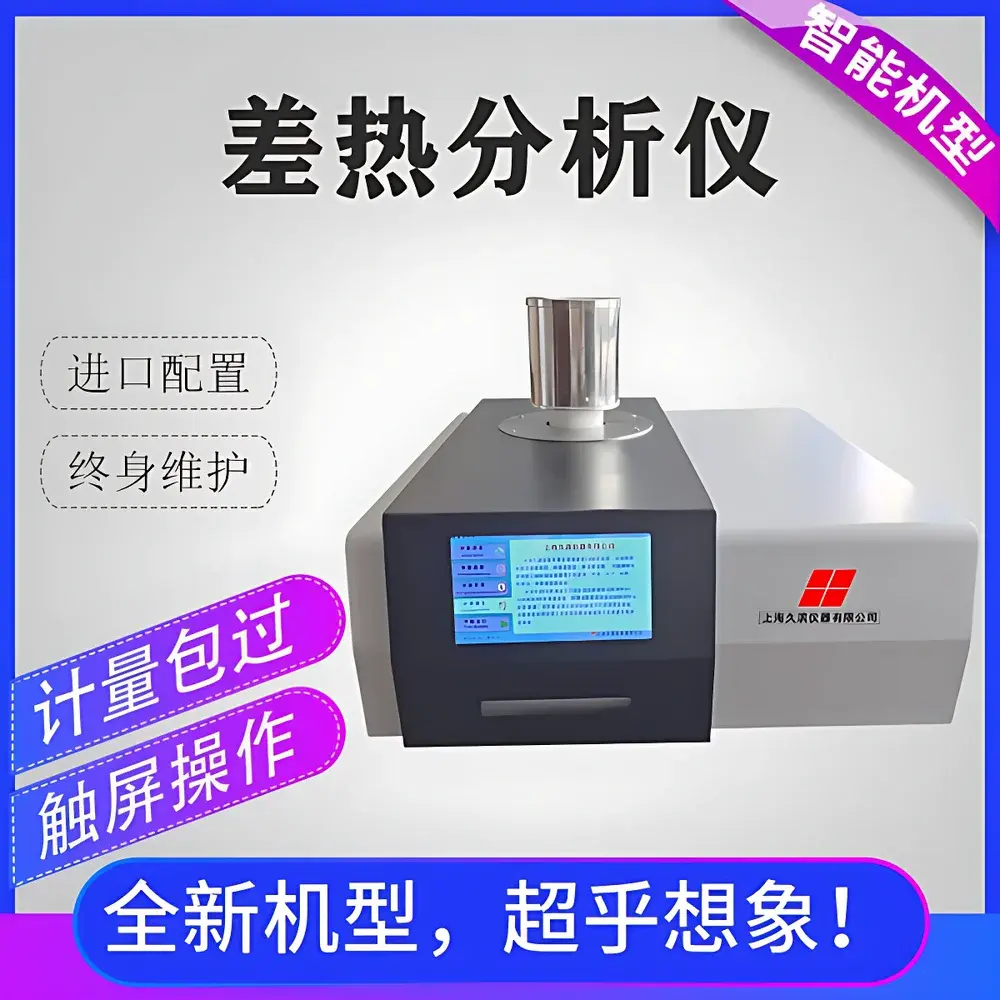
English Product Name
| Brand | Jiubin |
|---|---|
| Model | JB-DTA-1350 |
| Origin | Shanghai, China |
| Temperature Range | Ambient to 1350 °C |
| Temperature Accuracy | ±0.1 °C |
| Heating/Cooling Rate | 1–80 °C/min |
| DTA Signal Range | ±2000 μV |
| DTA Sensitivity | 0.01 μV |
| Temperature Resolution | 0.1 °C |
| Temperature Repeatability | ±0.1 °C |
| Furnace Type | Top-opening dual-wound Fe-Cr-Al heating element (1 kW) |
| Atmosphere Control | Automated internal gas switching |
| Interface | Standard USB 2.0 |
| Display | 7-inch 24-bit color TFT LCD touchscreen |
| Calibration | Built-in reference materials with one-click temperature calibration |
| Baseline Adjustment | Adjustable slope and intercept |
| Power Supply | AC 220 V, 50 Hz |
Overview
The Jiubin JB-DTA-1350 High-Temperature Differential Thermal Analyzer is a precision laboratory instrument engineered for quantitative thermal characterization of solid and powdered materials under controlled atmospheric conditions. It operates on the fundamental principle of differential thermal analysis (DTA), wherein the temperature difference (ΔT) between a sample and an inert reference material is continuously measured as both are subjected to identical, programmable thermal profiles. This ΔT signal reflects endothermic or exothermic events arising from phase transitions (e.g., melting, crystallization, allotropic transformations), decomposition, oxidation/reduction reactions, dehydration, polymorphic transitions, and structural relaxation processes. Designed specifically for high-temperature applications up to 1350 °C, the JB-DTA-1350 integrates a robust, top-opening furnace architecture with magnetically neutral Fe-Cr-Al heating elements—eliminating electromagnetic interference that could distort microvolt-level DTA signals. Its closed-loop temperature control system, driven by a Cortex-M3 ARM microcontroller, ensures stable ramping, precise isothermal holds, and reproducible cooling via forced-air regulation.
Key Features
- High-temperature capability: Continuous operation from ambient to 1350 °C with ±0.1 °C accuracy and 0.1 °C resolution over the full range.
- Magnetically compensated furnace: Dual-wound 1 kW Fe-Cr-Al heating element minimizes stray magnetic fields, critical for maintaining signal integrity in low-voltage DTA measurements (±2000 μV full scale, 0.01 μV sensitivity).
- Flexible thermal programming: Linear heating/cooling rates adjustable from 1 to 80 °C/min; user-defined multi-step temperature ramps and extended isothermal segments with arbitrary hold durations.
- Intuitive human-machine interface: 7-inch 24-bit color LCD touchscreen with responsive graphical navigation, real-time curve overlay, and on-screen parameter configuration.
- Integrated atmosphere management: Internal solenoid-valve manifold enables automated switching between inert (N₂, Ar), oxidizing (air, O₂), or reducing (H₂/N₂) gas environments without manual intervention.
- Traceable calibration system: Supplied with certified reference materials (e.g., high-purity Al, Zn, Sn) and one-click calibration workflow compliant with ISO 11357-1 and ASTM E794 standards.
- Baseline optimization: Software-enabled linear baseline correction via independent adjustment of slope and intercept—essential for quantitative peak integration in complex thermal event sequences.
Sample Compatibility & Compliance
The JB-DTA-1350 accommodates standard ceramic or platinum crucibles (typically 60–100 μL volume) and supports samples ranging from 1 mg to 100 mg in mass, including metals, ceramics, refractories, geological specimens, battery cathode materials, and high-performance polymers. Crucible selection and purge gas composition are configurable to prevent unwanted reactions (e.g., alumina crucibles for alkaline melts; graphite for reducing atmospheres). The instrument meets essential requirements for GLP-compliant thermal analysis workflows: audit-trail-capable software logging, user-access-level controls, electronic signature support (via optional FDA 21 CFR Part 11 add-on), and alignment with ISO/IEC 17025 documentation practices. All thermal calibrations adhere to traceability chains linked to NIST-traceable reference standards.
Software & Data Management
The JB-DTA-1350 is supplied with proprietary Windows-based acquisition and analysis software supporting real-time data streaming, synchronized multi-channel recording (DTA, furnace temperature, gas flow status), and post-run processing. Key functions include automatic peak detection, onset/midpoint/peak temperature annotation, enthalpy estimation using area-under-curve integration (with user-defined baselines), comparative overlay of multiple runs, and export to CSV, TXT, or PDF formats. Raw data files retain full metadata (operator ID, date/time stamp, method name, calibration history), enabling retrospective review and regulatory submission readiness. USB 2.0 connectivity ensures plug-and-play compatibility with modern lab PCs and facilitates firmware updates and method library synchronization.
Applications
This analyzer serves core R&D and quality control functions across advanced materials science and industrial manufacturing sectors. Typical use cases include: determining eutectic and peritectic temperatures in metallurgical alloys; quantifying decomposition onset and activation energy of ceramic precursors; evaluating thermal stability and phase evolution in Li-ion battery cathode materials (e.g., NMC, LFP); characterizing sintering behavior and densification kinetics in powder metallurgy; identifying glass transition and crystallization peaks in specialty glasses; verifying purity and polymorphic form in pharmaceutical intermediates; and assessing oxidative degradation thresholds of high-temperature composites. Its high upper-temperature limit and stable baseline performance make it particularly suited for refractory material development and nuclear fuel research.
FAQ
What types of reference materials are included with the JB-DTA-1350?
Certified pure metals (Al, Zn, Sn) and oxide standards (α-Al₂O₃) are provided for temperature and enthalpy calibration per ISO 11357-1.
Can the instrument operate under vacuum conditions?
No—vacuum operation is not supported; however, it accepts continuous gas purge at pressures up to 0.2 MPa gauge, with optional pressure-regulated mass flow controllers available.
Is the DTA signal output compatible with third-party data acquisition systems?
Yes—the USB interface provides direct access to raw DTA voltage, furnace thermocouple output, and status flags via documented ASCII protocol; analog voltage output (±5 V) is also available upon request.
How is temperature uniformity maintained across the furnace zone?
The dual-wound Fe-Cr-Al coil design creates an extended isothermal zone (>30 mm axial length) verified by multi-point thermocouple mapping per ASTM E1545.
Does the software support automated reporting for ISO/IEC 17025 accreditation?
Yes—report templates include instrument ID, calibration dates, operator credentials, uncertainty statements, and raw data attachment options, fully configurable for accredited lab documentation workflows.



