
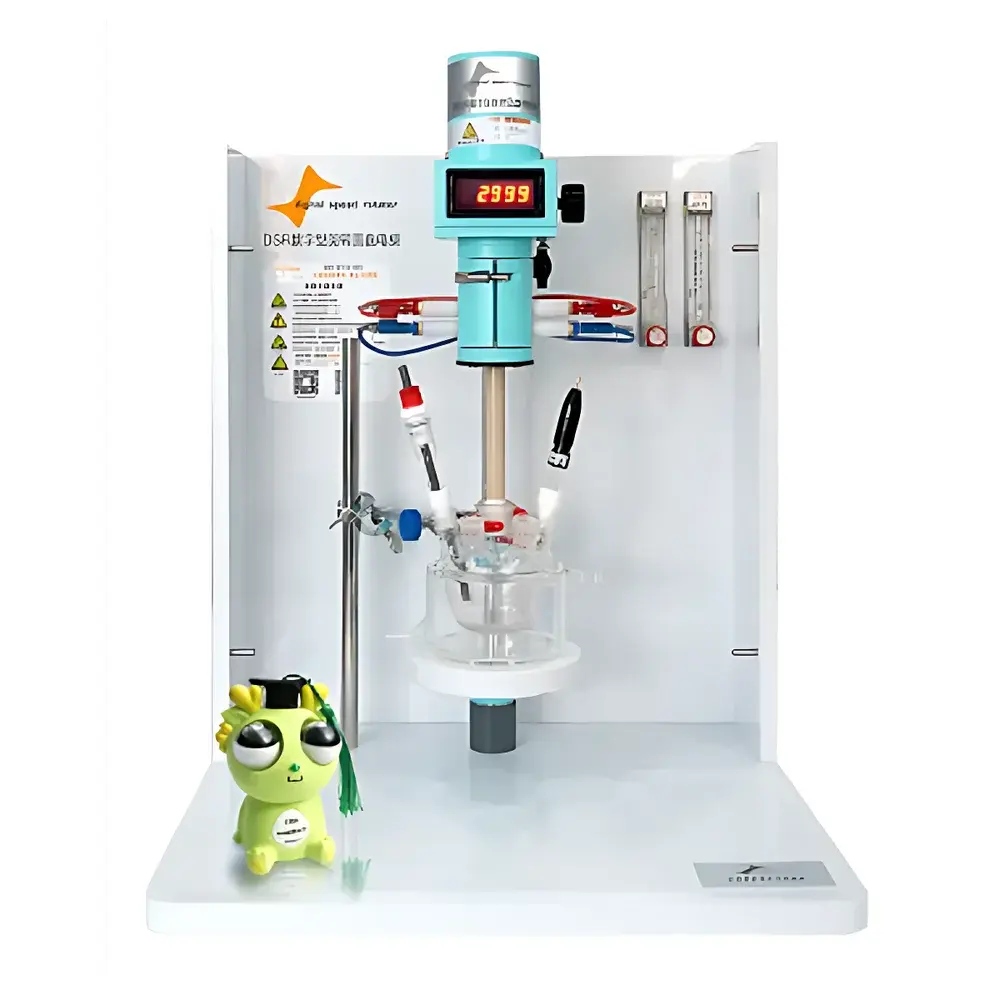
dc-energies DSR-M Rotating Ring-Disk Electrode (RRDE) System
| Brand | dc-energies |
|---|---|
| Origin | Hubei, China |
| Manufacturer Type | Authorized Distributor |
| Model | DSR-M (RRDE) |
| Rotation Speed Range | 0–10,000 rpm |
| Motor Power | 20 W |
| Disk Electrode Material | Glassy Carbon |
| Ring Electrode Material | Platinum |
| Disk Diameter | 5.61 mm |
| Ring Inner Diameter | 6.25 mm |
| Ring Outer Diameter | 7.92 mm |
| Disk-Ring Gap | ≤320 µm |
| Collection Efficiency | 37% |
| Disk-Ring Dimensional Tolerance | ±0.01 mm |
| Electrode Body Material | PTFE-coated |
| Rotating Shaft Length | 170 mm |
| Shaft Outer Diameter | 15 mm |
| Control Interface | Analog voltage input/output (0–10 V), TTL-compatible |
| Operating Temperature | Ambient |
| Compliance | Designed for inert-atmosphere glovebox integration |
Overview
The dc-energies DSR-M Rotating Ring-Disk Electrode (RRDE) System is an engineered electrochemical hydrodynamic measurement platform designed for quantitative kinetic and mechanistic analysis of multi-step redox processes. Based on the principles of controlled convection and dual-electrode amperometry, the DSR-M enables simultaneous detection of primary reaction products at the disk electrode and secondary species generated or consumed at the concentric ring electrode. Its precise geometric configuration—defined by a 5.61 mm glassy carbon disk and a 6.25–7.92 mm platinum ring with a gap ≤320 µm—ensures a calibrated collection efficiency of 37%, traceable to classical Levich-Koutecký theory. The system operates under laminar flow conditions governed by the Levich equation, allowing accurate determination of diffusion-controlled current densities, electron transfer numbers (n), and intermediate lifetimes in catalytic oxygen reduction (ORR), oxygen evolution (OER), hydrogen evolution (HER), and CO₂ reduction (CO₂RR) reactions. Designed for integration with potentiostats supporting analog control protocols, the DSR-M delivers reproducible rotation rates from 0 to 10,000 rpm with <1% speed deviation at 1 rpm (1 mV input equivalence), making it suitable for both steady-state polarization and transient hydrodynamic modulation studies.
Key Features
- High-precision RRDE geometry: Disk (glassy carbon, 5.61 mm Ø) and ring (platinum, 6.25–7.92 mm Ø) fabricated to ±0.01 mm dimensional tolerance; verified collection efficiency of 37%.
- Stable rotational actuation: 20 W brush motor with silver-plated carbon brushes ensuring low contact resistance (<5 mΩ), minimal signal interference, and extended service life under continuous operation.
- Glovebox-compatible modular architecture: Detachable rotating shaft (170 mm length, 15 mm OD, internal thread) and polypropylene base enable safe handling in inert-atmosphere environments for non-aqueous battery research.
- Analog I/O interface: 0–10 V input for external speed control (sine, square, or arbitrary waveforms); real-time 0–10 V tachometer output for synchronization with oscilloscopes or data acquisition systems.
- Chemically resistant construction: PTFE-insulated electrode body and corrosion-resistant housing ensure compatibility with aggressive electrolytes including LiPF₆-based carbonate solvents, KOH, and acidic PEMFC media.
- U-CUP replaceable disk module: Enables rapid exchange of disk materials (e.g., Pt, Au, Ni, or custom catalyst inks) without recalibration, reducing consumable cost and expanding experimental flexibility.
Sample Compatibility & Compliance
The DSR-M supports standard three-electrode electrochemical cells with common geometries (e.g., 25–100 mL volume, side-arm or double-junction configurations). Its 15 mm OD rotating shaft interfaces with commercial electrolytic cells via O-ring seals or custom adapters. The system meets mechanical and electrical safety requirements for laboratory use under ISO/IEC 17025-aligned environments and is routinely deployed in GLP-compliant catalyst screening workflows. While not certified to ATEX or IECEx standards, its intrinsic low-energy design (24 V DC motor drive, no internal spark sources) and optional explosion-proof enclosure kits facilitate safe operation in Class I, Division 2 hazardous locations when integrated with certified gloveboxes. All components comply with RoHS Directive 2011/65/EU and REACH Regulation (EC) No. 1907/2006.
Software & Data Management
The DSR-M operates as a hardware-peripheral device, requiring no embedded firmware or proprietary software. It integrates natively with industry-standard electrochemical workstations (e.g., BioLogic SP-300, Pine Research WaveDriver, Metrohm Autolab PGSTAT series) via analog voltage control lines. Rotation speed is logged synchronously with current/potential data through the workstation’s auxiliary ADC channel. For advanced hydrodynamic waveform experiments—such as sinusoidal rotation modulation for frequency-resolved mass transport analysis—the system accepts externally generated analog signals conforming to IEEE 1139-2008 waveform standards. Audit trails for speed calibration and mechanical maintenance are maintained per laboratory SOPs; full traceability is supported when used within FDA 21 CFR Part 11–compliant data acquisition frameworks employing electronic signatures and version-controlled instrument logs.
Applications
- Quantitative ORR mechanism studies: Discrimination between 2e⁻ (H₂O₂) and 4e⁻ (H₂O) pathways via ring current integration and K-L plot analysis.
- Electrocatalyst stability assessment: In situ detection of metal dissolution (e.g., Pt²⁺ at ring) during accelerated stress tests in PEMFC-relevant potentials.
- OER intermediate trapping: Identification of surface-bound *O or *OOH species through ring oxidation currents under controlled rotation.
- CO₂RR selectivity mapping: Real-time monitoring of C₂+ product formation (e.g., ethylene, ethanol) versus HER competition across rotation-dependent mass transport regimes.
- Corrosion inhibitor evaluation: Measurement of protective film formation kinetics via suppressed ring oxidation currents during disk-anodization scans.
- Electrodeposition kinetics: Time-resolved analysis of nucleation overpotential shifts under varying convective flux.
FAQ
What is the calibrated collection efficiency of the DSR-M RRDE?
The system is geometrically validated to deliver a collection efficiency of 37% for the specified disk-ring dimensions and gap tolerance, consistent with theoretical predictions for laminar flow over rotating electrodes.
Can the DSR-M be operated inside an argon-filled glovebox?
Yes—the modular, tool-free disassembly design, polypropylene base, and absence of internal batteries or wireless modules allow full integration into standard nitrogen- or argon-purged gloveboxes (O₂ < 0.1 ppm).
Is the rotation speed digitally controllable via USB or Ethernet?
No—the DSR-M uses analog voltage control only. Digital speed command requires an external DAC module interfaced with the workstation’s digital I/O port.
What torque specifications apply to the rotating shaft mounting threads?
The internal M4×0.7 thread on the shaft accepts standard electrode holders; maximum recommended tightening torque is 0.3 N·m to prevent PTFE deformation.
Does dc-energies provide NIST-traceable calibration certificates?
Calibration is performed using reference-grade optical tachometers and verified against ASTM D1298-12 Annex A1 procedures; formal NIST-traceable certification is available upon request with additional lead time.




