
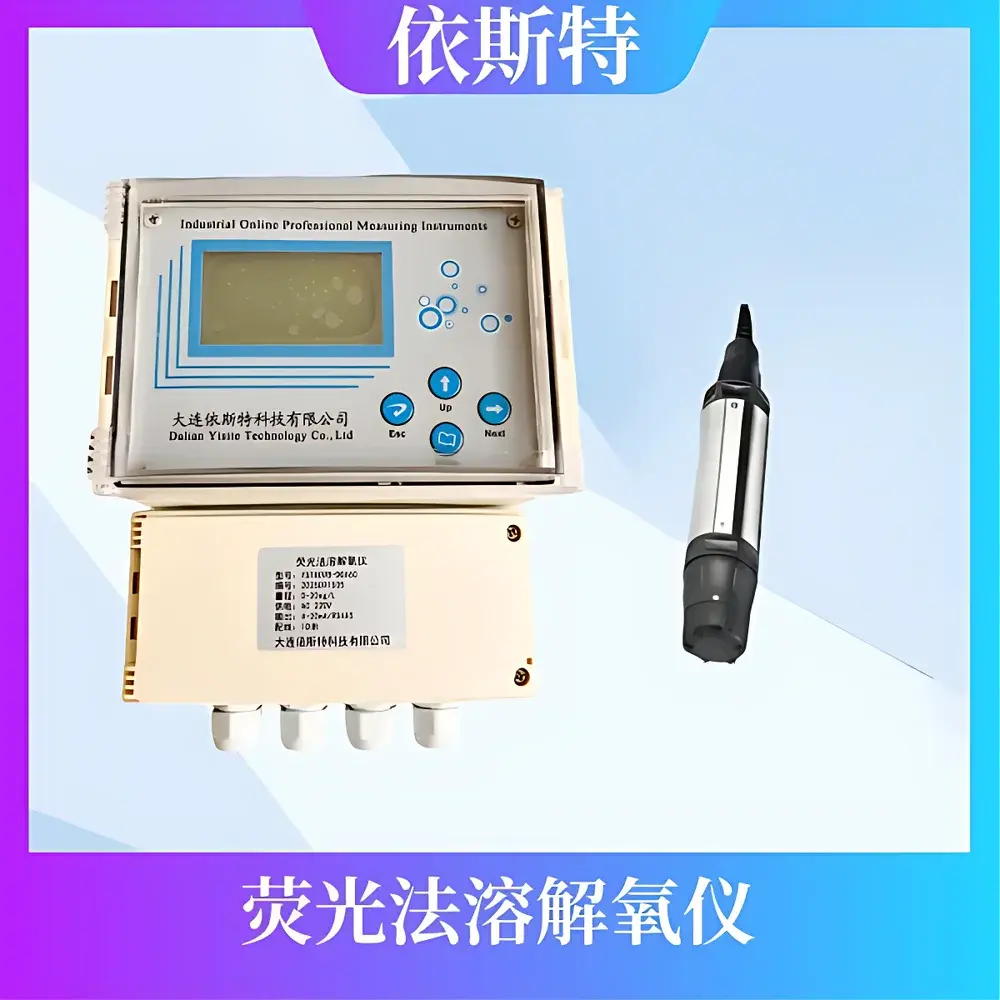
YST809B-DO660 Fluorescence-Based Dissolved Oxygen Analyzer for Municipal Wastewater Treatment Plants
| Brand | YST (Dalian Yist Instrument Co., Ltd.) |
|---|---|
| Origin | Liaoning, China |
| Model | YST809B-DO660 |
| Measurement Range | 0–20 mg/L DO / 0–200% saturation |
| Accuracy | ±0.1 mg/L (0–10 mg/L), ±0.2 mg/L (10–20 mg/L) |
| Temperature Compensation | 0–60 °C (automatic) |
| Response Time (t₉₀) | ≤60 s |
| Output Signals | 4–20 mA analog + RS485 digital (Modbus RTU) |
| Power Supply | AC 220 V ±10% or DC 24 V |
| Operating Environment | 0–50 °C, ≤90% RH (non-condensing) |
| Installation Options | Submersible, Flow-through, Pipe-mount |
| IP Rating | IP68 (sensor), IP65 (transmitter) |
Overview
The YST809B-DO660 is a fluorescence-based dissolved oxygen (DO) analyzer engineered specifically for continuous, high-reliability monitoring in municipal wastewater treatment plants. It operates on the principle of fluorescence quenching (also known as luminescence lifetime detection), where a 470 nm blue LED excites an oxygen-sensitive fluorophore embedded in a replaceable optical sensing cap. The phase shift or decay time of the resulting red emission (centered at ~620 nm) is quantitatively correlated to molecular oxygen concentration via Stern–Volmer kinetics. Unlike Clark-type electrochemical sensors, this method requires no oxygen-consuming reaction, membrane replacement, or electrolyte refilling—eliminating drift due to membrane fouling, electrolyte depletion, or cathode polarization. Integrated temperature, pressure, and salinity compensation algorithms ensure accurate DO reporting across variable process conditions typical in aeration basins, secondary clarifiers, and effluent channels.
Key Features
- Optical sensing architecture with no consumable membranes or liquid electrolytes—reducing long-term calibration drift and maintenance labor.
- Replaceable fluorescent sensing cap with typical service life of 12–36 months under continuous wastewater exposure; field replacement completed in under 60 seconds without tools.
- Simultaneous dual-output interface: isolated 4–20 mA analog signal compliant with industrial process control standards, plus RS485 serial communication supporting Modbus RTU protocol for seamless integration into PLC, DCS, or SCADA systems.
- Robust mechanical design: sensor body rated IP68 for permanent submersion in aggressive wastewater environments; transmitter enclosure rated IP65 for wall- or panel-mount deployment in humid, dust-laden control rooms.
- Wide operational temperature range (0–60 °C) with automatic temperature compensation—validated for stable performance during seasonal thermal shifts common in northern Chinese municipal plants.
- No flow dependency: delivers accurate measurements in static or low-flow zones such as sedimentation tanks and effluent weirs, where traditional polarographic sensors fail due to diffusion-limited response.
Sample Compatibility & Compliance
The YST809B-DO660 is validated for use in raw influent, activated sludge mixed liquor, secondary effluent, and disinfection contact basins. Its optical sensing surface exhibits minimal interference from common wastewater constituents—including sulfide (H₂S), chloride (Cl⁻), hydrogen peroxide (H₂O₂), and residual chlorine—enabling stable operation without chemical conditioning or frequent recalibration. While not certified to ISO 5814 or ASTM D888 for laboratory-grade compliance, the instrument meets functional requirements aligned with EPA Method 360.1 (luminescent dissolved oxygen measurement) and supports data integrity practices consistent with GLP-aligned operational protocols. Its analog and digital outputs are compatible with IEC 61131-3 programmable logic controllers and support audit-ready logging when paired with compliant data acquisition systems.
Software & Data Management
The analyzer does not include onboard graphical software but is fully interoperable with industry-standard supervisory platforms via Modbus RTU. Configuration parameters—including measurement units (mg/L or % saturation), temperature compensation coefficients, and output scaling—are programmable using standard Modbus function codes (e.g., FC03/FC06). When integrated into a central SCADA system, timestamped DO values can be archived with metadata (e.g., sensor ID, calibration status flag, temperature reading) to support trend analysis, alarm generation (e.g., DO < 1.5 mg/L in aerobic zones), and energy optimization models for blower control. Optional third-party middleware enables automated report generation aligned with local environmental regulatory reporting cycles (e.g., China’s HJ 212–2017 data transmission standard).
Applications
- Real-time DO feedback control in plug-flow and complete-mix aeration basins to optimize air delivery and reduce energy consumption by up to 15–25%.
- Monitoring dissolved oxygen gradients across multi-zone biological reactors (e.g., anoxic/oxic/anoxic configurations) for denitrification efficiency assessment.
- Effluent quality assurance in final clarifiers and disinfection channels to verify compliance with discharge limits (e.g., ≤2 mg/L DO for receiving water protection).
- Performance validation of membrane bioreactors (MBRs) and moving bed biofilm reactors (MBBRs), where conventional electrochemical probes suffer rapid fouling.
- Commissioning and troubleshooting of new or retrofitted blower systems—providing high-temporal-resolution data to correlate airflow changes with DO dynamics.
FAQ
Does the YST809B-DO660 require zero-point or span calibration during routine operation?
No—routine calibration is not required due to inherent stability of the optical sensing principle. A single factory calibration is traceable to NIST-traceable DO standards. Field verification using air-saturated water or Winkler titration may be performed quarterly for QA/QC; full recalibration is only necessary after sensor cap replacement or exposure to extreme chemical shock.
Can the sensor be installed directly in a pipe without a flow cell?
Yes—the probe supports direct insertion into pressurized pipelines (up to 6 bar) using standard NPT or DIN 11851 fittings. A minimum flow velocity of 0.1 m/s is recommended to prevent biofilm accumulation, though static measurement remains valid.
Is the device compatible with existing Siemens S7 or Rockwell ControlLogix PLCs?
Yes—Modbus RTU over RS485 is natively supported. Preconfigured function block libraries are available for both platforms upon request.
What is the expected lifespan of the fluorescent sensing cap in raw sewage?
Under typical municipal wastewater conditions (COD < 500 mg/L, TSS < 200 mg/L), the cap maintains metrological integrity for ≥18 months. In high-fouling applications (e.g., grease-laden influent), semi-annual visual inspection and cleaning with mild citric acid solution are advised.
Does the transmitter support HART protocol or Profibus DP?
No—only 4–20 mA analog and RS485/Modbus RTU are implemented. HART or Profibus variants are available upon OEM request but require hardware revision and extended lead time.







