
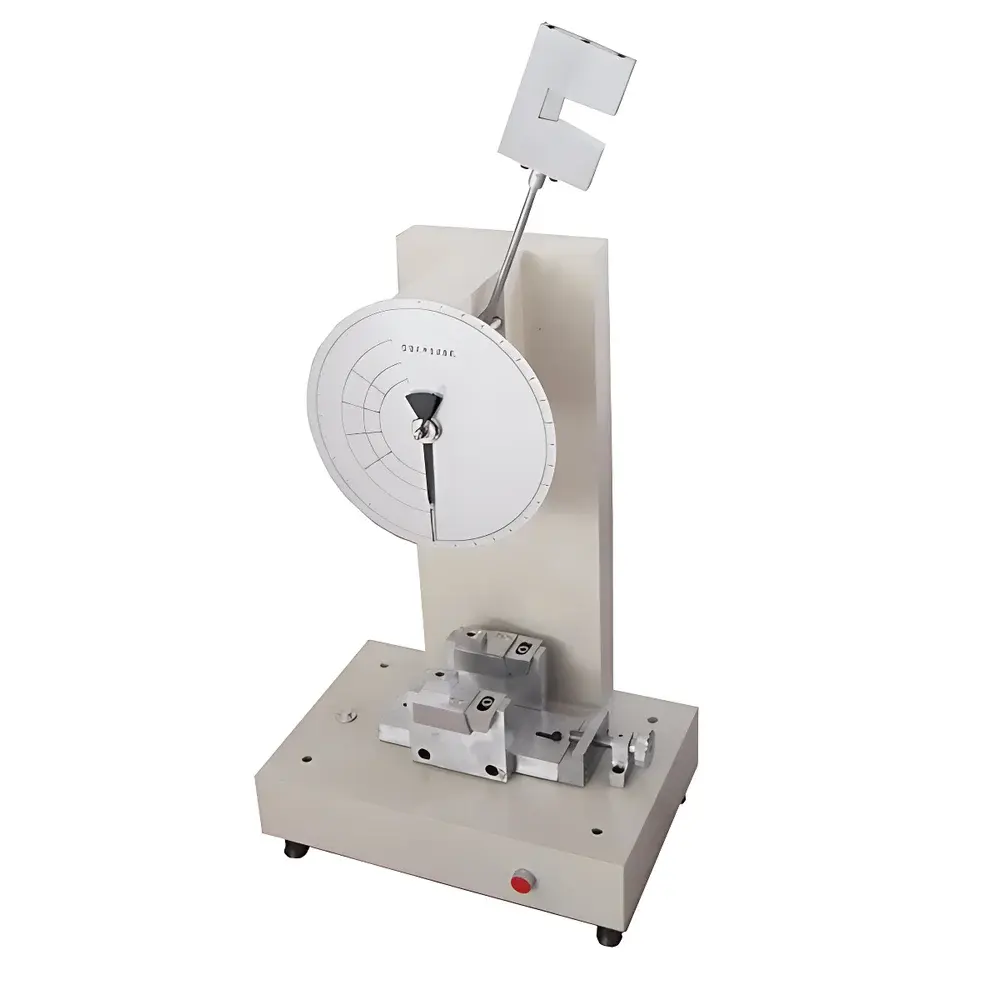
Jiubin Instruments JB-XJJ-50 Charpy/IZOD Impact Tester (Simply Supported Beam Configuration)
| Brand | Jiubin Instruments |
|---|---|
| Origin | Shanghai, China |
| Model | JB-XJJ-50 |
| Impact Energy | 50 J |
| Impact Velocity | 3.8 m/s |
| Pendulum Radius (Impact Constant) | R = 2 ± 0.5 mm |
| Pendulum Lifting Height | 95 mm |
| Support Span Options | 40, 60, 62, 70, 95 mm |
| Notch Knife Radius | R = 2 ± 0.5 mm |
| Anvil Radius | R = 1 ± 0.1 mm |
| Knife Angle | 30° ± 1° |
| Energy Loss (Empty Swing) | ≤2% (for 0.5–1 J), ≤1% (for 2 J), ≤0.5% (for 4–5 J) |
| Compliance | ISO 179-1, GB/T 1043.1, GB/T 2612, JB/T 8762, GB 4742 |
Overview
The Jiubin Instruments JB-XJJ-50 is a precision-engineered simply supported beam impact tester designed for standardized Charpy and IZOD-type impact resistance evaluation of rigid thermoplastics, fiber-reinforced composites (e.g., glass-reinforced nylon), laminates, and rigid elastomers. Based on the classical pendulum impact principle—where gravitational potential energy is converted into kinetic energy upon release—the instrument measures the energy absorbed by a notched or unnotched specimen during fracture under three-point bending loading. The pendulum arm rotates about a fixed axis, striking the specimen centered between two supports; the angular displacement post-impact is converted into absorbed energy via calibrated torque and geometry relationships. This mechanical analog method delivers high reproducibility in controlled laboratory environments and aligns with long-standing international test protocols requiring minimal electronic dependency.
Key Features
- Modular pendulum system supporting multiple nominal impact energies (7.5 J, 15 J, 25 J, and 50 J) via interchangeable hammers—enabling full-range characterization without recalibration.
- Precision-machined anvil and clamping jaws with traceable radii: knife edge radius R = 2.0 ± 0.5 mm; anvil radius R = 1.0 ± 0.1 mm; knife angle 30° ± 1°—all conforming to dimensional tolerances specified in ISO 179-1 Annex A and GB/T 1043.1.
- Adjustable support span configuration (40 mm, 60 mm, 62 mm, 70 mm, and 95 mm) accommodates diverse specimen geometries per standard requirements, including non-standard spans for research-grade investigations.
- Low-energy loss pendulum design: verified empty-swing energy loss ≤2% at 0.5–1 J, ≤1% at 2 J, and ≤0.5% at 4–5 J—ensuring measurement fidelity across the entire energy scale.
- Rigid cast-iron frame with vibration-damped base minimizes external interference during impact event, contributing to inter-laboratory repeatability.
- Manual release mechanism with mechanical locking ensures consistent release angle (160°) and eliminates operator-induced variability in initiation timing.
Sample Compatibility & Compliance
The JB-XJJ-50 accepts rectangular bar specimens (typically 80 × 10 × 4 mm per ISO 179 or GB/T 1043), with optional notch configurations (A, B, C per ISO 179-2). It is validated for use with unreinforced and filled thermoplastics (e.g., ABS, PC, POM), thermoset composites (e.g., epoxy-glass laminates), and rigid biopolymers. All mechanical dimensions, energy calibration procedures, and verification protocols comply with ISO 179-1:2019 (Plastics — Determination of Charpy impact properties — Part 1: Non-instrumented impact testing), GB/T 1043.1–2018 (Chinese national equivalent), and supplementary standards including JB/T 8762–2008 (Mechanical testing machines — Pendulum impact testers — Technical requirements) and GB 4742–1984 (Testing methods for impact strength of plastics). The system supports GLP-aligned documentation when used with external data recording workflows.
Software & Data Management
This analog impact tester operates without embedded microprocessors or digital readout systems; energy values are determined mechanically via pointer-and-scale indication. For traceable digital archiving, users may integrate optional external digital calipers or high-speed photogate sensors (not included) to capture pendulum angle displacement, enabling automated calculation of absorbed energy using the formula E = m·g·H·(1 − cosθ), where m is effective pendulum mass, g is local gravitational acceleration, H is pivot-to-center-of-mass distance, and θ is residual swing angle. When paired with compliant laboratory information management systems (LIMS), raw angular data can be imported for audit trails satisfying FDA 21 CFR Part 11 requirements if accompanied by electronic signature controls and change history logging.
Applications
- Quality control of injection-molded plastic components in automotive and consumer electronics supply chains.
- Comparative assessment of polymer toughness before and after thermal aging, UV exposure, or chemical immersion per ASTM D790 or ISO 179 series.
- Validation of fiber-matrix interfacial adhesion in glass- or carbon-fiber-reinforced composites.
- Research into brittle-to-ductile transition behavior in engineering thermoplastics below and above glass transition temperature.
- Third-party certification testing for CE-marked products requiring documented conformity to EN ISO 179-1.
FAQ
Is the JB-XJJ-50 suitable for both Charpy and IZOD configurations?
Yes—the machine supports both simply supported beam (Charpy-style) and cantilever beam (IZOD-style) setups via repositioning of the specimen clamp and anvil alignment; no hardware modification is required.
Does it meet ISO 179-1:2019 verification requirements for pendulum calibration?
Yes—its geometric tolerances, energy loss performance, and support span adjustability satisfy Clause 6 (Verification of instruments) and Annex B (Calibration procedures) of ISO 179-1:2019.
Can it be used for testing specimens thicker than 4 mm?
Standard configurations accommodate 4 mm thickness; for specimens up to 10 mm, custom anvil spacing and pendulum energy selection (e.g., 50 J hammer) must be validated per GB/T 1043.1 Clause 7.2 for dimensional correction factors.
What maintenance is required to ensure long-term accuracy?
Biannual verification of knife edge radius, anvil radius, and support span using certified gauge blocks and optical profilometry is recommended; pendulum bearing lubrication should follow manufacturer guidelines every 12 months or after 5,000 impacts.
Is third-party calibration certification available?
Yes—Jiubin Instruments provides optional NIST-traceable calibration reports issued by CNAS-accredited laboratories in Shanghai, including uncertainty budgets per ISO/IEC 17025:2017.
Related Products



