
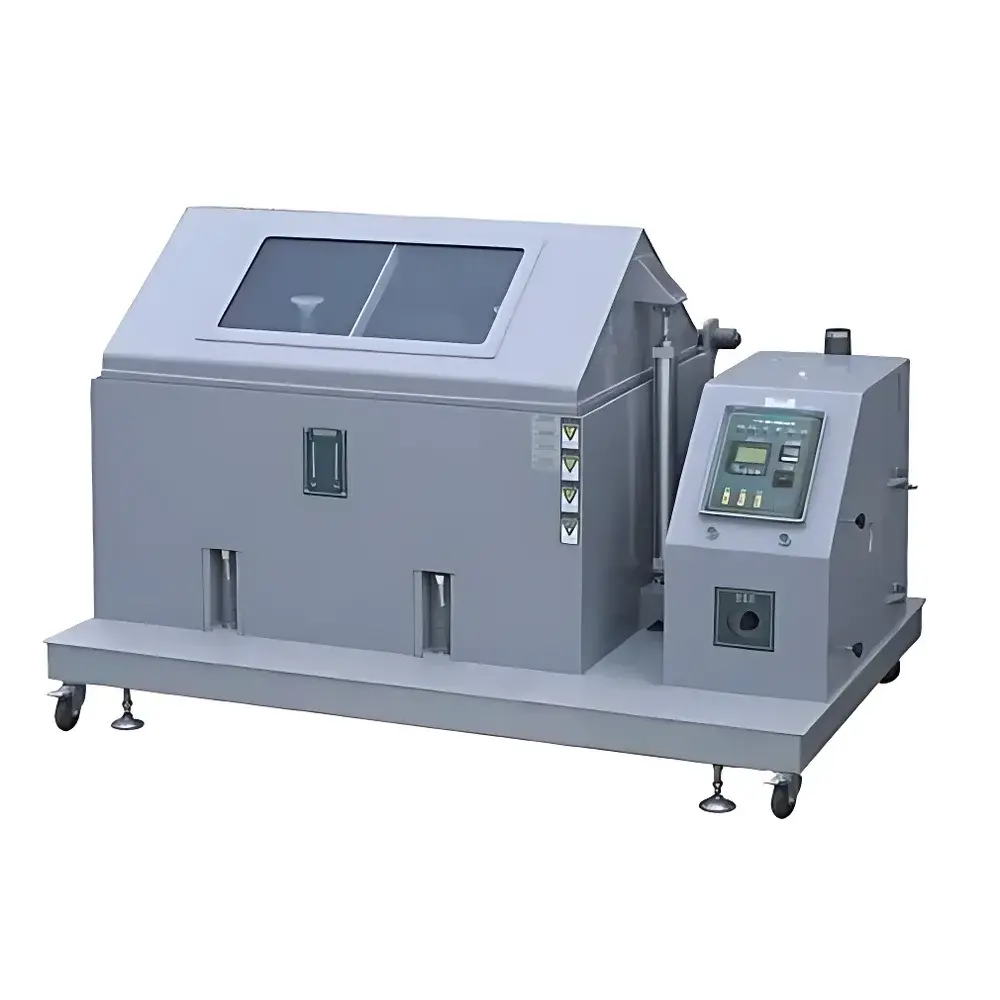
Jiubin JB-128 Salt Spray Test Chamber
| Brand | Jiubin Instruments |
|---|---|
| Origin | Shanghai, China |
| Model | JB-128 |
| Spray Mode | Continuous or Intermittent |
| Spray Rate | 1–2 mL / 80 cm²·h |
| Nozzle Pressure | 0.7–1.0 kg/cm² |
| Fog Removal Method | Air-pressure-assisted exhaust |
| Salt Deposit Rate | 1–2 mL / 80 cm²·h |
| Temperature Range | NSS/ACSS: 35°C ±1°C |
| CASS | 50°C ±1°C |
| Chamber Construction | FRP or PVC (optional) |
| Sealing | Water-sealed lid to prevent fog leakage |
| Compliance | GB/T 2423.17, GB/T 18912–2002, ASTM B117, ISO 9227, IEC 60068-2-11, DIN 50021, MIL-STD-810 |
Overview
The Jiubin JB-128 Salt Spray Test Chamber is an engineered environmental test system designed for accelerated corrosion evaluation of metallic substrates, coated components, and electroplated finishes under controlled saline aerosol conditions. It operates on the principle of generating a continuous or intermittent mist of sodium chloride (NaCl) solution—typically 5% w/w—atomized via precision nozzles into a thermally stabilized chamber. The chamber maintains strict temperature uniformity (±1°C) across its working volume, enabling reproducible simulation of aggressive marine or industrial coastal environments. Unlike natural exposure testing—which may require months or years—the JB-128 accelerates degradation mechanisms such as pitting, crevice corrosion, and galvanic breakdown by elevating salt concentration, temperature, and exposure continuity, thereby supporting rapid comparative assessment of protective systems including paints, conversion coatings, zinc plating, and stainless alloys.
Key Features
- Robust chamber construction using corrosion-resistant fiberglass-reinforced polymer (FRP) or optional PVC panels—ensuring long-term structural integrity and chemical inertness against acidic chloride mists.
- Adjustable tower-type spray nozzle assembly with uniform spatial distribution and fine-tuned deposition control, allowing precise regulation of salt fog density across the test specimen surface.
- Water-sealed lid design eliminates external fog leakage, maintaining operator safety and lab environmental compliance while enabling unobstructed visual monitoring through transparent FRP or anti-corrosive PVC viewing windows.
- Dual LED digital display interface showing both setpoint and real-time chamber temperature with 0.01°C resolution; microprocessor-based calibration offset correction ensures traceable thermal accuracy.
- Programmable auto-shutdown function with timer range from 0 to 9999 hours, supporting unattended operation for extended cyclic or static salt spray protocols.
- Integrated air-pressure-assisted fog evacuation system prevents condensate accumulation and ensures consistent chamber atmosphere composition during prolonged tests.
Sample Compatibility & Compliance
The JB-128 accommodates standard-sized test specimens up to 128 L internal volume (as indicated by model designation), suitable for flat panels, fasteners, PCB assemblies, automotive trim parts, and small mechanical subassemblies. Its operational parameters meet internationally recognized salt fog test standards including ASTM B117 (Neutral Salt Spray), ISO 9227 (NSS, AASS, CASS variants), IEC 60068-2-11, DIN 50021, and MIL-STD-810 Method 509. It further satisfies national metrological verification requirements per GB/T 18912–2002 for photovoltaic module testing equipment and conforms to GB/T 2423.17 for general electronic and electrical product environmental qualification. When operated under GLP or GMP-regulated quality systems, the unit supports audit-ready documentation when paired with external data loggers compliant with FDA 21 CFR Part 11 requirements.
Software & Data Management
The JB-128 utilizes embedded firmware—not PC-dependent software—for core control logic, ensuring deterministic response and minimal failure modes in industrial settings. While the base configuration does not include proprietary PC software, analog voltage outputs (0–5 V or 4–20 mA) are available upon request for integration with third-party SCADA or LIMS platforms. Temperature logging can be achieved via external calibrated thermocouple arrays connected to validated data acquisition systems, facilitating full traceability required for ISO/IEC 17025-accredited laboratories. All calibration records—including temperature sensor drift verification and nozzle flow rate validation—must be retained per internal QA procedures aligned with ISO 9001 clause 7.1.5.
Applications
- Evaluation of corrosion resistance in zinc-nickel, chromium, and epoxy-coated steel used in automotive chassis components.
- Qualification testing of printed circuit board conformal coatings per IPC-CC-830B and MIL-I-46058C specifications.
- Accelerated aging of aluminum alloy anodized layers for aerospace hardware per AMS 2469.
- Comparative analysis of anti-corrosion pretreatments for cold-rolled steel prior to coil coating.
- Validation of passivation efficacy on stainless steel surgical instruments per ASTM A967.
- Reliability screening of marine-grade connectors and housings exposed to simulated offshore environments.
FAQ
What standards does the JB-128 support out-of-the-box?
The chamber is factory-configured to comply with ASTM B117, ISO 9227 (NSS mode), and GB/T 2423.17. Optional calibration kits enable verification for CASS (50°C) and AASS protocols.
Can the JB-128 perform cyclic corrosion testing (CCT)?
No—the JB-128 is a single-function neutral/acidic salt spray chamber without integrated humidity or drying cycles. For CCT, consider multi-climate chambers with programmable phase sequencing.
Is the spray rate independently verifiable?
Yes—users must conduct daily collection tests using standardized funnels (per ASTM B117 Section 7.2) to confirm 1–2 mL/80 cm²·h deposition within the working zone.
What maintenance intervals are recommended?
Nozzle inspection every 100 operational hours; pH and conductivity verification of salt solution before each test run; full chamber cleaning and gasket inspection quarterly or after 500 h of cumulative use.
Does the unit include temperature uniformity mapping certification?
No—uniformity validation requires user-performed mapping per ISO 17025 Annex A.3 using NIST-traceable sensors at nine defined chamber locations.



