
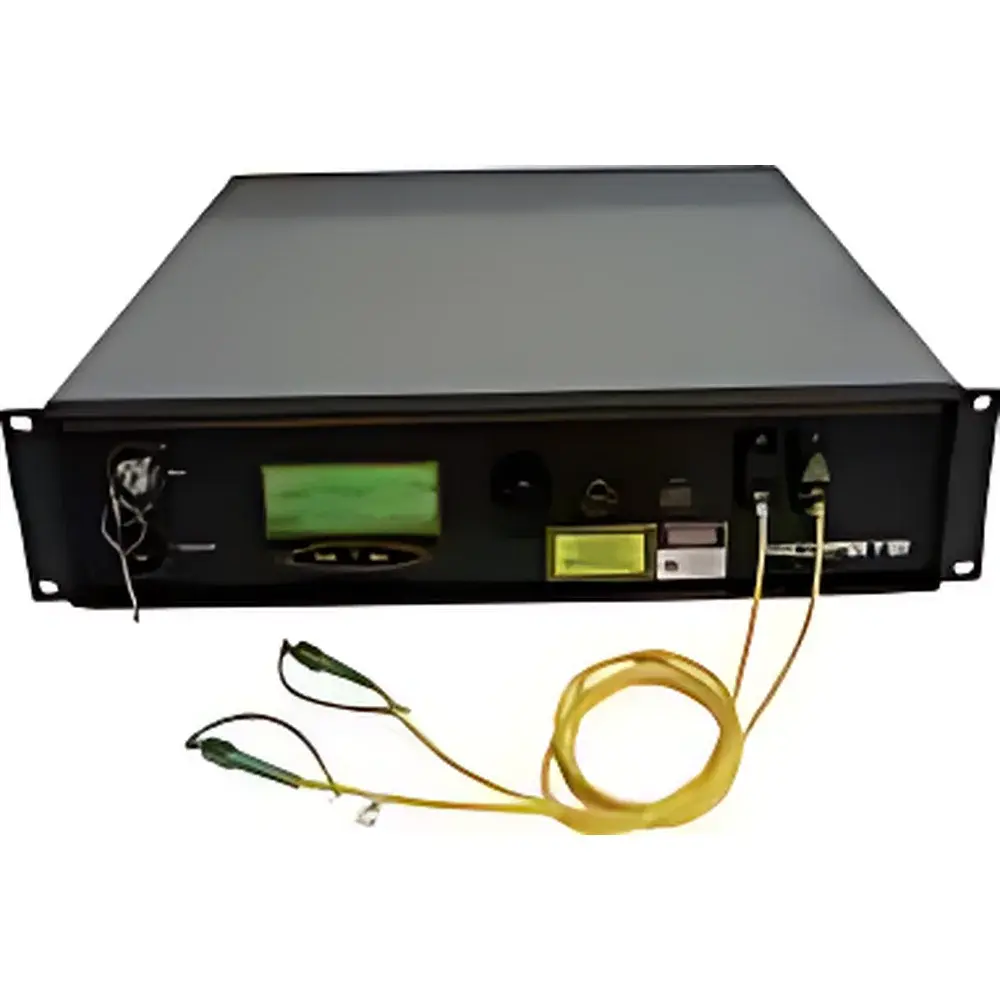
Keopsys CEFA-C-BO-HP High-Power Continuous-Wave Erbium-Doped Fiber Amplifier
| Brand | Keopsys |
|---|---|
| Origin | France |
| Model | CEFA-C-BO-HP |
| Operating Wavelength | 1540–1565 nm |
| Output Power Range | 25–42 dBm (316 µW – 15.8 mW) |
| Polarization | Linear (PM fiber, PER > 20 dB) |
| Input Power Range | 5–25 dBm |
| Noise Figure | <7–9.5 dB (depending on configuration) |
| Control Modes | ACC & APC (APC range: 10–100%) |
| Power Stability (1 h) | <1–2% |
| Fiber Types | SMF-28 or Panda PM fiber |
| Input/Output Connectors | FC/APC, SC/APC, E2PS, C1 |
| Power Consumption | 15–200 W |
| Monitoring | Input and Output (output optional) |
| Platform Compatibility | B202, M101, M301, M403, B301 |
Overview
The Keopsys CEFA-C-BO-HP is a high-performance, continuous-wave (CW), polarization-maintaining erbium-doped fiber amplifier (EDFA) engineered for demanding applications in optical test & measurement, free-space optical communication, remote sensing (including LIDAR and coherent radar systems), microwave photonics, and nonlinear optics. Operating within the C-band (1540–1565 nm), it delivers stable, low-noise amplification with precisely controlled linear polarization output—ensuring high extinction ratio (>20 dB) via integrated polarization-maintaining (PM) fiber architecture. Unlike broadband or pulsed amplifiers, the CEFA-C-BO-HP employs a dual-stage, thermally stabilized EDFA design with optimized pump diode management and gain-flattening filtering to achieve exceptional small-signal gain linearity, minimal ASE buildup, and long-term power stability (<1% over 1 hour). Its modular platform integration (B202, M101, M301, etc.) supports rack-mount deployment in laboratory, field-deployable, and OEM instrumentation environments compliant with IEC 61300 and Telcordia GR-1312-CORE standards.
Key Features
- High-output CW amplification from +25 dBm to +42 dBm (316 µW to 15.8 mW), scalable across seven standardized power grades (CPO25 to CPO42)
- Polarization-maintaining operation with PER >20 dB (Panda-type PM fiber standard; PER >17 dB optional)
- Low noise figure: <7 dB (SMF input, −6 dBm @1550 nm), <9.5 dB (PM input), meeting ITU-T G.663 and IEC 61290-3-1 requirements
- Dual-control architecture supporting both Automatic Current Control (ACC) and Automatic Power Control (APC), with APC adjustable from 10% to 100% of full-scale output
- Integrated real-time monitoring of input and output optical power (output monitoring optional per configuration)
- Thermally compensated design ensuring <±0.02 dB/°C gain drift across 15–35 °C ambient operating range
- Compliant with EN 61326-1 (EMC) and EN 60825-1 (laser safety Class 1M)
Sample Compatibility & Compliance
The CEFA-C-BO-HP is compatible with standard single-mode fiber (SMF-28) and Panda-type polarization-maintaining fiber. Input and output interfaces support FC/APC, SC/APC, E2PS, and C1 connectors—enabling seamless integration into existing optical benches, interferometric setups, and telecom-grade test platforms. All variants meet RoHS 2015/863/EU and REACH SVHC compliance. For regulated environments—including GLP/GMP laboratories and FDA-regulated photonic test systems—the amplifier supports optional firmware logging and audit-trail-ready control interfaces aligned with 21 CFR Part 11 principles when deployed with Keopsys’ M-Series controller platforms.
Software & Data Management
Control and configuration are managed via RS-232, USB, or optional Ethernet (TCP/IP) interface using Keopsys’ proprietary LabVIEW-compatible SDK and CLI commands. The embedded firmware provides programmable ramp-up/down profiles, alarm thresholds (e.g., pump failure, temperature excursion), and timestamped power logs (1 Hz sampling, 30-day buffer). When integrated with the M301 or M403 platform controllers, users gain access to GUI-based calibration wizards, multi-channel synchronization, and exportable CSV reports traceable to NIST-traceable reference sources. All firmware updates follow secure signed-package protocols and maintain backward compatibility across CEFA-C series generations.
Applications
- Optical component characterization: insertion loss, polarization-dependent loss (PDL), and return loss testing of isolators, circulators, and modulators
- Free-space optical links: pre-amplification of weak received signals in terrestrial and satellite-based interconnects
- FTTH and CATV network simulation: high-linearity analog RF-over-fiber transmission at 1550 nm
- LIDAR and coherent Doppler radar: seed-source amplification for narrow-linewidth, high-coherence master oscillators
- Microwave photonics: low-phase-noise optical carriers for photonic-assisted frequency synthesis and signal generation
- Nonlinear frequency conversion: pumping of PPLN, KTP, or MgO:PPLN crystals requiring stable, polarized CW sources
FAQ
What is the maximum allowable input power for safe operation?
The maximum input power depends on model variant: CPO25/CPO27 accept up to +15 dBm; CPO30/CPO33 up to +20 dBm; CPO37–CPO42 up to +25 dBm. Exceeding these limits may induce nonlinear effects or saturate the first gain stage.
Is APC mode mandatory for stable output under varying input conditions?
No—ACC mode maintains constant pump current and is suitable for fixed-input-power scenarios. APC is recommended when input power fluctuates (e.g., in dynamic test setups or cascaded systems) to preserve consistent output level.
Can the CEFA-C-BO-HP be used in vacuum or high-vibration environments?
Standard units are rated for laboratory use (IEC 60068-2-6 vibration, 5–500 Hz, 0.15 mm peak-to-peak). For space-qualified or airborne deployment, contact Keopsys for MIL-STD-810G-compliant ruggedized variants with hermetic sealing and extended thermal cycling validation.
Does the amplifier support wavelength tuning?
No—the CEFA-C-BO-HP is a fixed-wavelength C-band amplifier. Tunable operation requires integration with external tunable lasers or wavelength-selective filters upstream.
How is gain flatness characterized across the operating band?
Gain flatness is specified as ±0.5 dB over 1540–1565 nm for all models, measured at nominal output power with a calibrated optical spectrum analyzer per IEC 61290-10-1. Custom flattening filters are available upon request for ultra-narrowband applications.





