
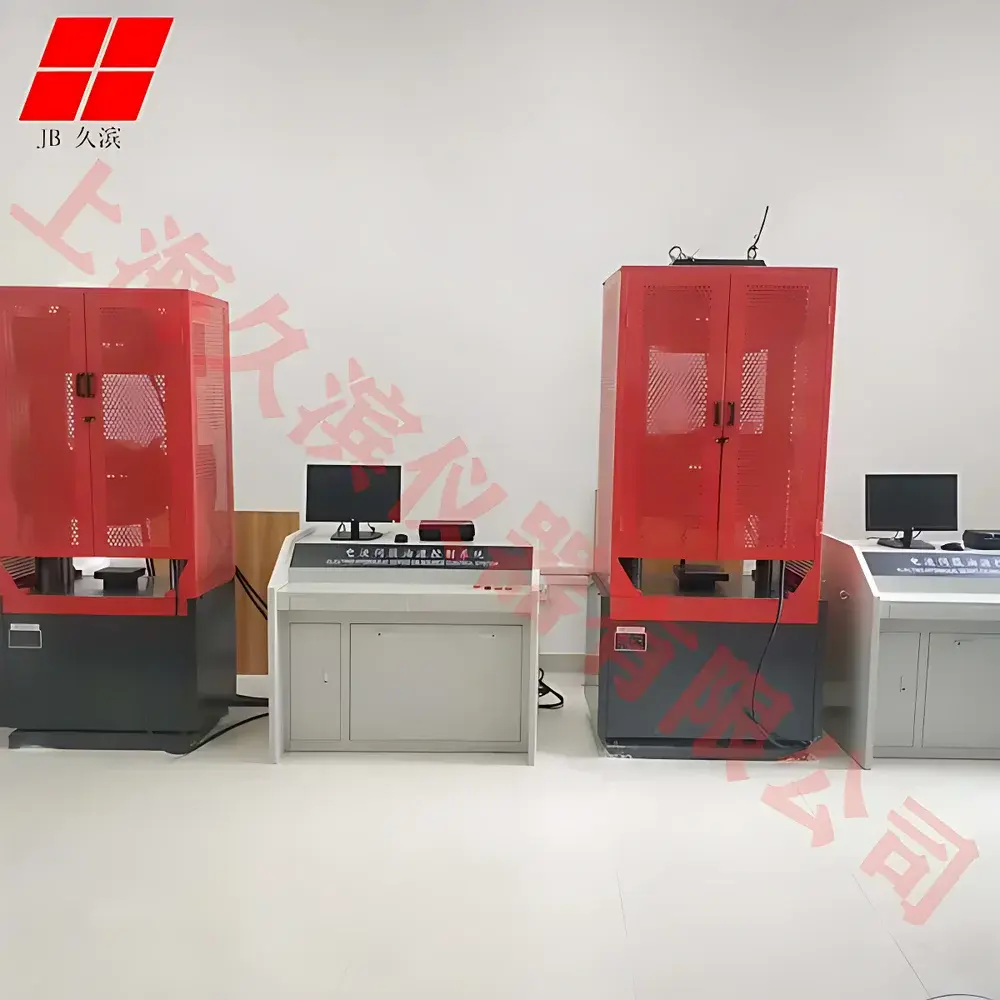
Jiubin JB/WAW-600 KN Electro-Hydraulic Servo Universal Testing Machine for Prestressed Steel Strands
| Brand | Jiubin |
|---|---|
| Model | JB/WAW-600 KN |
| Maximum Load Capacity | 600 kN |
| Control System | Microcomputer-Controlled Electro-Hydraulic Servo |
| Application | Tensile Strength, Non-Proportional Extension Strength (Rp0.2), Elastic Modulus, Elongation at Break of Prestressed Steel Strands |
| Compliance | ASTM A416, ISO 15630-2, GB/T 5224, EN 10138 |
| Test Space | Extended Vertical Clearance for Strand Specimens |
| Grips | Dedicated Long-Jaw Hydraulic Wedge Grips for Center-Fracture Reliability |
| Extensometer | High-Accuracy Clip-On or Non-Contact Extensometer (Optional) |
| Data Acquisition | 100 kHz Sampling Rate |
| Software | Windows-Based Universal Testing Software with Audit Trail, Calibration Traceability, and 21 CFR Part 11 Compliance Mode |
| Reporting | Six Standard Curve Types (Force–Displacement, Force–Strain, Stress–Displacement, Stress–Strain, Force–Time, Displacement–Time) + Numerical Output per ISO 5893 |
Overview
The Jiubin JB/WAW-600 KN Electro-Hydraulic Servo Universal Testing Machine is a precision-engineered system designed specifically for the mechanical characterization of prestressed steel strands used in post-tensioned concrete structures, bridge cables, and high-rise anchorage systems. Operating on the principle of closed-loop electro-hydraulic servo control, the machine delivers highly stable load application and displacement tracking across its full 600 kN capacity range. Its structural architecture features a rigid four-column frame with preloaded crosshead guidance, minimizing deflection and ensuring axial alignment during high-force tensile testing—critical for eliminating bending moments that compromise accuracy in strand elongation and modulus determination. The system complies with international test standards including ASTM A416 (Standard Specification for Steel Strands for Prestressed Concrete), ISO 15630-2 (Reinforcing steels and prestressing steels — Test methods — Part 2: Prestressing steels), GB/T 5224 (Chinese national standard for prestressed concrete steel strands), and EN 10138 (European standard for prestressing steels). It is validated for measurement traceability to national metrological institutes and supports calibration documentation compliant with ISO/IEC 17025 requirements.
Key Features
- Electro-hydraulic servo actuation with real-time PID feedback control, enabling precise load ramping, hold, and cyclic profiles per ASTM E4 and ISO 7500-1 Class 1 accuracy specifications.
- Dedicated long-jaw hydraulic wedge grips with hardened serrated clamping surfaces, engineered to distribute stress uniformly along extended grip lengths—reducing slippage and promoting fracture within the gauge length (center-break requirement per ASTM A416).
- Integrated high-resolution optical encoder and optional clip-on or video extensometer (0.1% strain resolution) for accurate measurement of non-proportional extension strength (Rp0.2), elastic modulus (E), and total elongation at break.
- Robust microcomputer-based control unit with dual-channel analog-to-digital conversion, 100 kHz data sampling rate, and synchronized acquisition of force, displacement, and strain signals.
- Modular software platform supporting multi-curve overlay, automatic yield point detection (0.2% offset method), modulus calculation via linear regression over specified strain ranges, and real-time pass/fail evaluation against user-defined acceptance criteria.
Sample Compatibility & Compliance
The JB/WAW-600 KN accommodates standard 7-wire prestressed steel strands (e.g., Φ12.6 mm, Φ15.2 mm, Φ15.7 mm) with nominal tensile strengths up to 1860 MPa. Specimen lengths are configurable from 1.5 m to 3.0 m to meet minimum gauge length requirements (≥500 mm per ISO 15630-2). All test procedures align with GLP (Good Laboratory Practice) and GMP (Good Manufacturing Practice) frameworks where applicable. The system’s firmware and software support audit trail logging, electronic signature capability, and 21 CFR Part 11-compliant user access controls—including role-based permissions, session lockout, and immutable record retention—making it suitable for quality assurance laboratories operating under regulated environments.
Software & Data Management
The universal testing software provides an intuitive Windows-based interface with multilingual support (English default), customizable report templates (PDF, Excel, XML), and direct integration with LIMS via ODBC. Each test generates a timestamped digital record containing raw sensor data, processed results (Rp0.2, Rm, Agt, E), curve metadata, operator ID, calibration status, and environmental conditions (if external sensors are connected). All data files are digitally signed and checksum-verified to ensure integrity. Calibration parameters are stored in encrypted configuration files with version history; recalibration events trigger automatic log entries with technician ID and reference standard IDs. Software validation documentation (IQ/OQ/PQ protocols) is available upon request for regulatory submissions.
Applications
- Determination of ultimate tensile strength (Rm) and proof strength at 0.2% non-proportional extension (Rp0.2) for incoming material inspection per ASTM A416 Grade 270.
- Evaluation of elastic modulus (E) using initial linear region slope analysis, critical for structural modeling of tendon behavior in finite element simulations.
- Measurement of total elongation at maximum force (Agt) and residual elongation after fracture, supporting compliance with EN 10138 ductility classifications.
- Relaxation testing preparation (when paired with environmental chambers and long-term load hold modules) for assessing time-dependent stress loss in pretensioned systems.
- Research-grade mechanical property mapping across heat lots, drawing reductions, and surface treatment variations in high-strength strand development programs.
FAQ
What standards does this machine validate against for steel strand testing?
ASTM A416, ISO 15630-2, GB/T 5224, and EN 10138 are fully supported through preconfigured test methods, reporting formats, and pass/fail logic.
Can the system perform relaxation tests?
The JB/WAW-600 KN serves as the core load frame for relaxation testing; full relaxation capability requires optional environmental enclosures, load-hold stabilization modules, and dedicated relaxation software add-ons.
Is third-party certification available for ISO/IEC 17025 compliance?
Yes—factory calibration certificates include uncertainty budgets traceable to NIM (China) or NIST (USA); on-site verification and accreditation support services are offered globally.
How is grip slippage mitigated during high-strength strand testing?
Through proprietary long-jaw hydraulic wedge grips with graded serration geometry and programmable clamping pressure profiles synchronized with load ramping.
Does the software support automated report generation for QA/QC workflows?
Yes—templates conform to internal QA checklists and external client specifications; batch reporting, barcode-driven specimen ID linking, and electronic approval routing are natively supported.



