
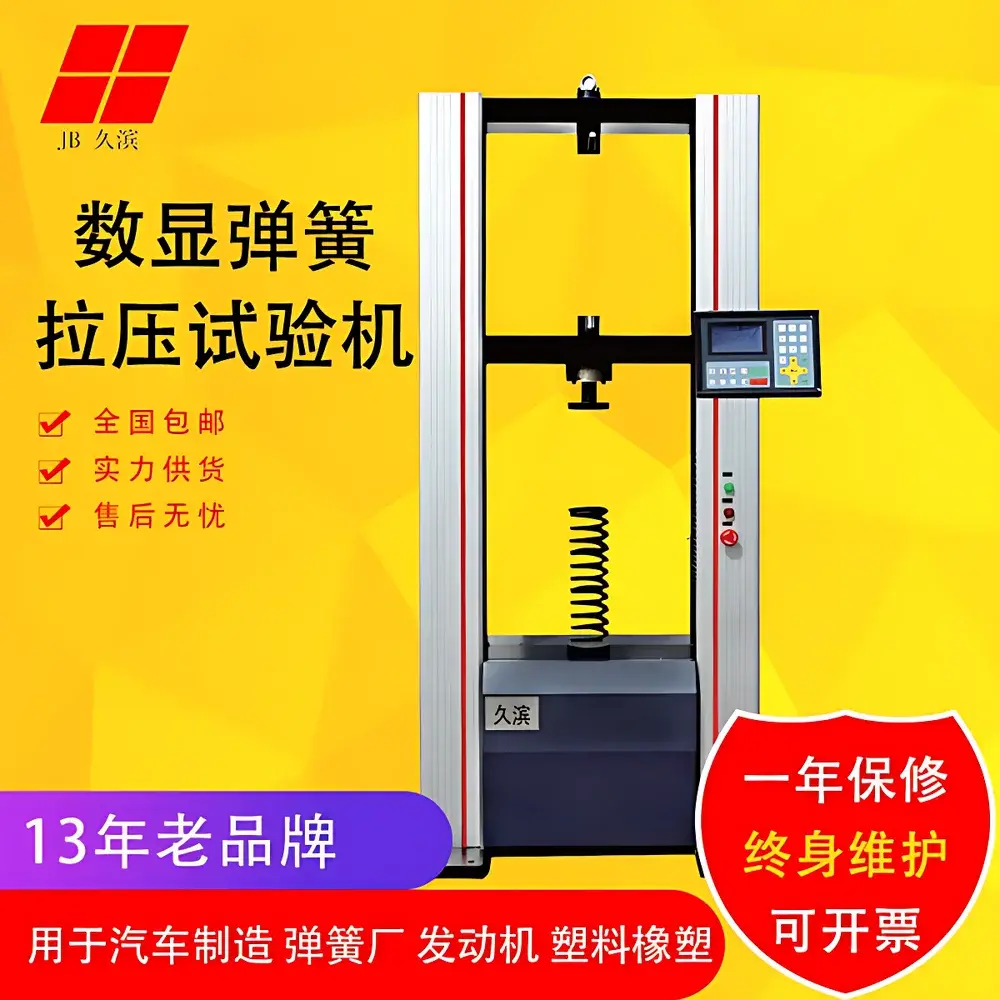
JB-TS Universal Spring Tension & Compression Testing Machine
| Brand | Jiubin Instruments |
|---|---|
| Origin | Shanghai, China |
| Model | JB-TS |
| Max Test Force | Configurable per fixture and load cell selection (standard options: 500 N, 1 kN, 2.5 kN, 5 kN) |
| Compliance | Designed to support ISO 10243, ASTM E4, ASTM F1678, GB/T 25797, GB/T 2611 |
Overview
The JB-TS Universal Spring Tension & Compression Testing Machine is an electromechanical static testing system engineered for high-reproducibility mechanical characterization of helical coil springs, disc springs (Belleville washers), conical springs, and wave springs. It operates on a servo-controlled dual-column frame architecture with precision ball-screw actuation and integrated load-cell feedback, enabling bidirectional force application—tension and compression—in a single test setup. Unlike dedicated spring testers limited to one loading mode, the JB-TS implements a true universal configuration: its crosshead travel range (up to 600 mm), adjustable top/bottom fixtures, and reversible load train allow seamless transition between tensile extension tests (e.g., hook-to-hook elongation of extension springs) and compressive deflection tests (e.g., stack behavior of multi-disc Belleville assemblies). The system complies with fundamental metrological requirements outlined in ISO 10243 (springs — testing methods) and aligns with mechanical testing infrastructure standards referenced in ASTM E4 (practices for force verification of testing machines) and GB/T 2611 (general requirements for testing machines).
Key Features
- Servo-motor-driven dual-column frame with 0.01 mm position resolution and ±0.5% full-scale load accuracy (per calibrated load cell)
- Modular fixture system: interchangeable upper/lower grips including hook-type clamps, flat platens, spherical seats, and custom disc-spring nesting inserts
- Real-time force-displacement data acquisition at up to 100 Hz sampling rate, synchronized with displacement encoder feedback
- Predefined test templates for common spring standards: load-deflection curves, set loss evaluation (permanent deformation after 100% compression), relaxation testing (time-dependent force decay under constant deflection), and fatigue pre-conditioning cycles
- Integrated safety interlocks: emergency stop circuit, overload cutoff (>110% FS), and mechanical limit switches on both travel ends
- Compliance-ready architecture: supports audit trails, user access levels (admin/operator), and electronic signature capability for GLP/GMP environments
Sample Compatibility & Compliance
The JB-TS accommodates springs ranging from miniature precision components (wire diameter ≥ 0.3 mm, free height ≥ 2 mm) to industrial-grade units (free height ≤ 300 mm, outer diameter ≤ 180 mm). Disc spring stacks up to 12 layers can be evaluated under controlled preload and progressive compression. The system meets mechanical interface requirements defined in ISO 10243 Annex A for disc spring testing geometry and conforms to GB/T 25797 (helical compression spring technical specifications) for test methodology validation. Calibration certificates traceable to CNAS-accredited laboratories are provided with each delivery. Optional documentation packages include IQ/OQ protocols aligned with FDA 21 CFR Part 11 expectations for regulated pharmaceutical and medical device suppliers.
Software & Data Management
Control and analysis are executed via the proprietary SpringTest Pro v3.2 software suite, a Windows-based application supporting multilingual UI (English, Chinese, German). The software enables real-time curve overlay (multiple runs), automatic yield point detection using second-derivative algorithms, and export of raw ASCII/CSV datasets with timestamps and metadata (operator ID, sample ID, environmental temperature/humidity if connected to optional sensors). All test files are stored in encrypted SQLite databases with built-in version control; modification history—including parameter changes and manual data edits—is logged with timestamp and user attribution. For enterprise integration, the system offers OPC UA server functionality and RESTful API endpoints for LIMS or MES synchronization.
Applications
- Quality assurance of automotive valve springs, clutch diaphragm springs, and suspension coil units (e.g., BYD, Geely, Chery, SAIC)
- R&D validation of high-temperature alloy disc springs used in aerospace actuators and nuclear control rod mechanisms
- Biomedical device component testing: stainless steel and nitinol orthodontic springs, implantable micro-spring assemblies
- Pharmaceutical packaging spring mechanisms (e.g., auto-injector trigger springs, vial cap retention systems per USP )
- Material science studies on viscoelastic recovery behavior of polymer-composite springs under cyclic loading
- Third-party certification testing per ISO/IEC 17025 accredited laboratories (e.g., CTI, Huace, NAST)
FAQ
What load cell capacities are available for the JB-TS?
Standard configurations include 500 N, 1 kN, 2.5 kN, and 5 kN load cells, all calibrated to ISO 376 Class 1 accuracy. Custom high-capacity options up to 20 kN are available upon request.
Can the JB-TS perform relaxation or creep testing?
Yes—the system supports time-controlled hold phases at specified deflection or load targets, with duration programmable up to 100 hours and data logging intervals configurable from 1 second to 10 minutes.
Is ASTM F1678 compliance verified out-of-the-box?
The mechanical design and control firmware meet all functional requirements of ASTM F1678 (standard specification for disc spring materials and testing). Full compliance documentation, including fixture geometry verification reports, is supplied with the instrument.
Does the software support 21 CFR Part 11 compliance?
SpringTest Pro v3.2 includes role-based authentication, electronic signatures, and immutable audit trails. Validation documentation (IQ/OQ) and configuration management records are available as optional add-ons.
How is thermal drift compensated during extended tests?
Load cells incorporate temperature-compensated strain gauge bridges; software applies real-time thermal correction algorithms based on internal sensor readings, maintaining force stability within ±0.1% FS over 8-hour continuous operation at ambient 23±2°C.



